


- Mecca Defence Alliance aims to guarantee regional security and collective deterrence among member states.
- Spokesperson Sajjad Haider Khan confirms that alliance expansion is currently not under consideration.
- The three founding nations are concentrating on institutional consolidation before opening membership to other states.
- A permanent secretariat is being established in Saudi Arabia with a Pakistani official leading as Secretary General for the first three years.
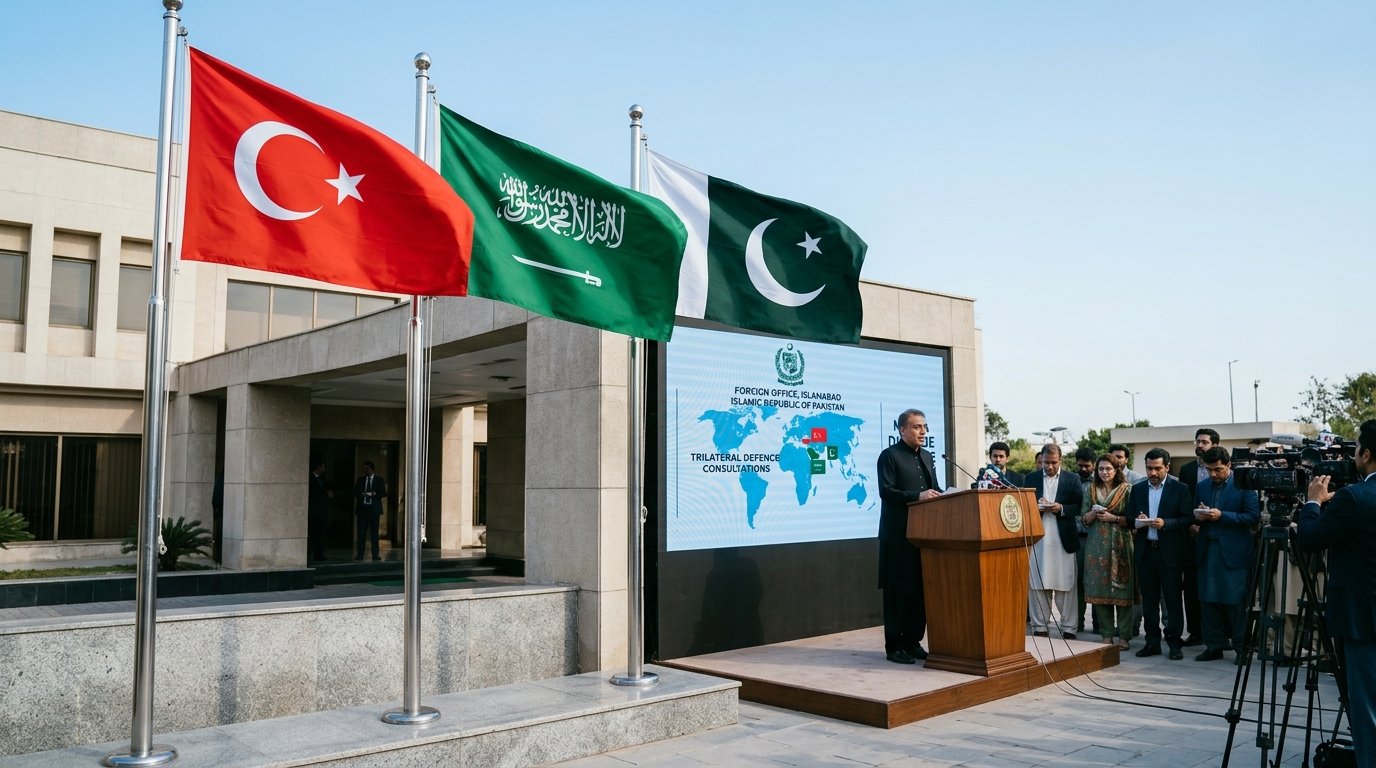
ISLAMABAD — The Foreign Office (FO) on Thursday clarified that the newly formed Mecca Defence Alliance between Pakistan, Saudi Arabia, and Turkey is strictly defensive in nature, emphasizing that any prospective expansion of the pact to include other regional nations is currently “not on the cards.”
Addressing media representatives during a weekly news briefing in the capital, FO Spokesperson Sajjad Haider Khan provided key insights into the operational framework, strategic goals, and long-term roadmap of the trilateral arrangement. He underscored that the primary mandate of the agreement centers on establishing a durable security umbrella designed to stabilize the broader region while mitigating potential external threats.
Strategic Deterrence and Defense Orientation
Dispelling speculation regarding an immediate broadening or assertive military posture by the coalition, Khan stated that the agreement is fundamentally a “defensive alliance to ensure regional security primarily through deterrence.”
He reiterated that the founding member states remain laser-focused on laying down the necessary institutional groundwork rather than inducting new partners into the fold. According to the spokesperson, the founding triad—Islamabad, Riyadh, and Ankara—must first establish a seamless operational framework and align their coordination mechanisms.
READ NEXT: Mecca Summit Istanbul: Can the Regional Four Build a New Middle Eastern Security Order?
“Pakistan, Saudi Arabia and Turkey must first further consolidate their organisation and cooperation,” Khan remarked, adding that only after achieving comprehensive organizational maturity would the alliance consider welcoming other partners into the fold.
He noted that following this initial phase of consolidation, the agreement will eventually be “open to all countries that share similar stances and perspectives.” However, he made it explicitly clear that formal deliberations regarding second-tier expansion remain tabled for a later period. “At this stage, there are no discussions regarding the expansion of the Mecca agreement,” he affirmed, reiterating that any collective decisions on widening the bloc’s scope will occur down the line.
Consultation Mechanics and Structural Framework
The spokesperson highlighted that the three participating capitals are actively engaged in structured dialogue across multiple administrative, technical, and diplomatic levels to iron out the finer details of the agreement.
READ MORE: FO says Makkah defence pact ‘defensive’ in nature, expansion currently ‘not on the cards’
Characterizing the alliance as being in its nascent phase, Khan emphasized that detailed joint consultations regarding its overarching structure, procedural workflows, and legal protocols are actively underway. “Significant work lies ahead to finalise the organisation’s structure, mechanisms, and procedures,” he explained, assuring the press that further procedural milestones and clarity regarding future developments will emerge in due course.
When questioned about upcoming high-level ministerial or summit-level sessions under the umbrella of the alliance, Khan noted that relevant information will be shared with the public and media “on an ongoing basis,” though exact dates for the next round of official talks have yet to be finalized.
Mecca Defence Alliance: Mutual Defense and Institutional Foundations
The tripartite defense agreement, officially signed on August 7, represents a landmark shift in defense cooperation among the three prominent sovereign states. Central to the agreement is a robust collective security mechanism engineered to bolster mutual deterrence and empower signatory states to treat an armed attack against any single member as an aggression directed against them all.
The pact’s inaugural session took place on August 31 in Istanbul, setting in motion key organizational structures needed to execute its operational mandate. During the Istanbul summit, member nations unanimously resolved to establish a permanent secretariat headquartered in Saudi Arabia to oversee administrative and strategic coordination.
In a move reflecting Pakistan’s strategic role within the grouping, member states agreed that the secretariat’s initial leadership will be headed by a Secretary General hailing from Pakistan, who will serve a three-year tenure to steer the alliance through its foundational setup.
As South Asian and Middle Eastern security dynamics continue to evolve, Islamabad’s official stance underscores a measured approach: prioritizing internal synergy and formal institutional building over rapid enlargement, while maintaining a clear posture of defensive deterrence.