



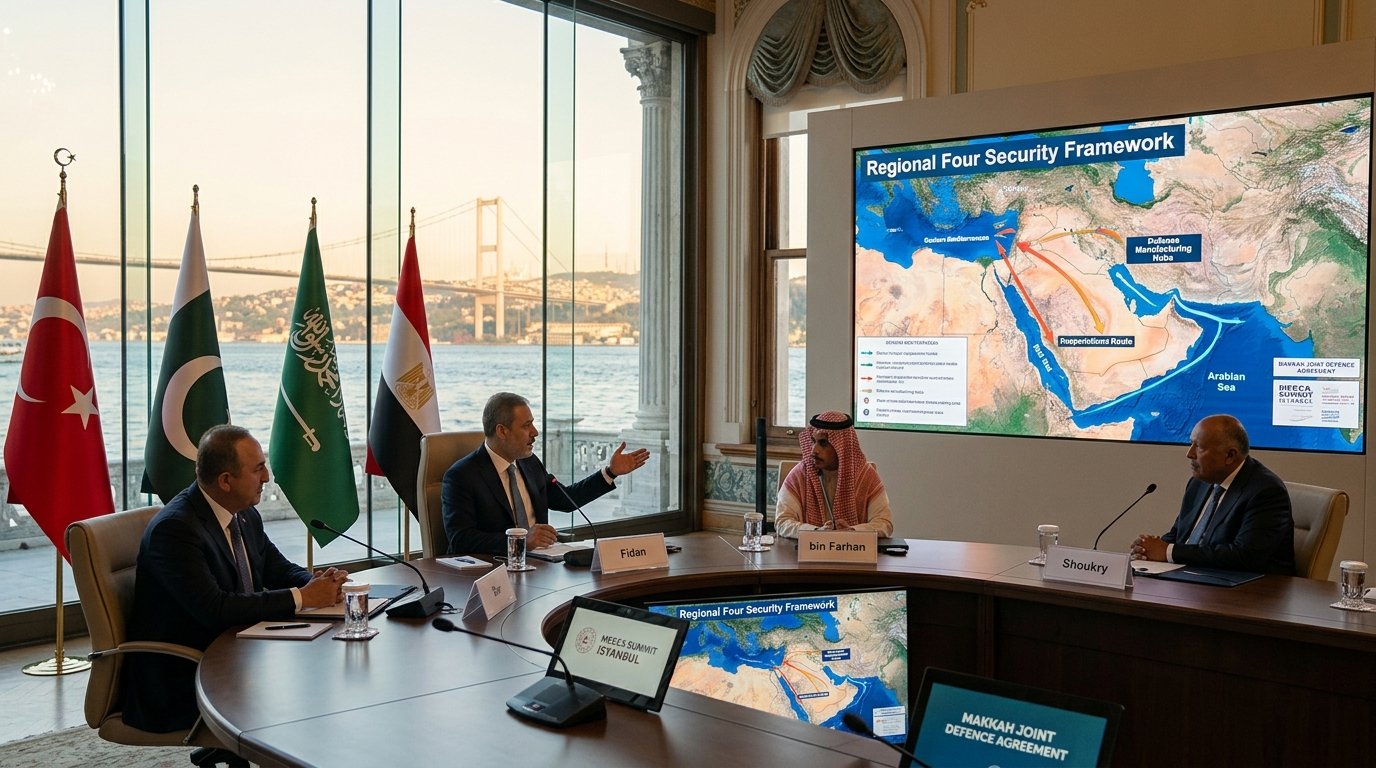
- Mecca Summit Istanbul could determine whether the Regional Four becomes a functioning security mechanism.
- The meeting will test the future of the Makkah Joint Defence Agreement and its collective-defence principle.
- The Summit in Istanbul also carries implications for Iran, regional deterrence and global energy security.
Mecca Summit Istanbul is emerging as a significant diplomatic milestone in the rapidly changing security landscape of the Middle East and South Asia. Türkiye’s invitation to Pakistan’s Deputy Prime Minister and Foreign Minister Ishaq Dar for consultations in Istanbul comes as Saudi Arabia, Türkiye and Pakistan move to translate their new defence partnership into a broader regional framework involving Egypt.
The meeting follows the signing of the Makkah Joint Defence Agreement by Saudi Arabia, Türkiye and Pakistan on August 7. The agreement declares that an armed attack against one of the three countries will be regarded as an attack against all. It represents a significant attempt to build a regional deterrence mechanism at a time when governments across the Middle East are reassessing their security arrangements.
The strategic importance of Mecca Summit Istanbul lies in its potential to move the agreement from political symbolism toward institutional cooperation.
The four prospective partners bring complementary capabilities. Türkiye has a large conventional military and a rapidly expanding defence industry. Pakistan offers extensive military experience, a nuclear deterrent and an established aerospace and defence manufacturing sector. Saudi Arabia provides financial strength, energy resources and strategic geography. Egypt adds considerable military weight and control of the Suez Canal and Red Sea approaches.
Together, these capabilities could create a security network extending from the eastern Mediterranean to the Arabian Sea.
As discussed in The Islamabad Telegraph’s “Makkah Defence Pact Shapes Me”, the agreement could represent a wider restructuring of regional security. Its implications may also extend into Syria and the Levant, as explored in “Syria: Makkah Defence Pact”.
The broader regional context makes Mecca Summit Istanbul even more consequential. Foreign Policy’s analysis has highlighted the emergence of closer cooperation among Saudi Arabia, Türkiye, Pakistan and Egypt as regional governments respond to growing instability and the changing balance of power.
Yet the emerging grouping should not be described as a Middle Eastern NATO—at least not yet.
The Makkah agreement establishes a collective-defence principle but does not appear to create a permanent multinational military command or an automatic mechanism requiring members to launch offensive operations after an attack. That distinction is critical.
According to The Washington Post’s reporting on the defence pact, Turkish Foreign Minister Hakan Fidan has emphasised that the agreement is defensive and that assistance could take different forms depending on circumstances.
This flexibility could become one of its greatest strengths.
If Iran were to launch another major attack against Saudi Arabia, enforcement of the pact would probably begin politically and defensively rather than with immediate strikes against Iranian territory. Riyadh could request intelligence, air-defence, logistical and military assistance. Türkiye could provide drones, electronic warfare and intelligence capabilities, while Pakistan could contribute personnel, military expertise and defensive support.
Egypt could reinforce maritime security around the Red Sea and Suez Canal.
The key question would be whether Tehran believes that attacking Saudi Arabia would trigger a coordinated response from the other signatories.
That is the real deterrent value of Mecca Summit Istanbul.
A direct military retaliation against Iran would be far more complicated. Türkiye and Pakistan would have to weigh the credibility of the collective-defence commitment against the risk of triggering a much wider war. The pact could therefore be enforced without necessarily requiring an immediate offensive campaign.
Its objective would be to make aggression more expensive while preserving diplomatic space.
The economic consequences could be enormous.
The Strait of Hormuz carries a substantial share of global oil and LNG shipments. A major Saudi-Iranian confrontation threatening the waterway could send crude prices sharply higher, increase tanker insurance costs and disrupt global supply chains. A simultaneous crisis around the Red Sea would add further pressure to international shipping.
This gives Mecca Summit Istanbul an importance that extends beyond military affairs.
The security of Saudi oil infrastructure, Hormuz and Red Sea shipping routes is also a matter of global economic stability. Any credible regional deterrence mechanism could therefore reduce the risk premium attached to Middle Eastern energy supplies.
Defence production could become another pillar of the emerging arrangement.
Türkiye, Pakistan and Saudi Arabia have strong incentives to move beyond conventional arms purchases toward joint manufacturing, technology transfer, maintenance facilities and research cooperation. Turkish unmanned systems and electronic-warfare technologies could complement Pakistani aerospace expertise and Saudi investment.
The outcome of Mecca Summit Istanbul could determine whether those ambitions develop into concrete industrial agreements.
Egypt’s participation would further strengthen the maritime dimension. With the Suez Canal linking the Mediterranean to the Red Sea, Cairo could provide the R4 with an important strategic role in protecting international shipping.
But political differences remain.
Türkiye has major interests in Syria and the eastern Mediterranean. Egypt’s priorities include Gaza, Libya, Sudan and Red Sea security. Pakistan must balance its strategic partnership with Saudi Arabia against its geographical relationship with Iran. Riyadh, meanwhile, must manage its regional security concerns alongside its relationship with Washington.
Those differences make a rigid military alliance difficult.
They also make a flexible security network potentially more realistic.
The significance of Mecca Summit Istanbul will therefore be measured not by declarations alone but by whether the four countries establish permanent diplomatic consultations, intelligence-sharing arrangements, military exercises and defence-industrial mechanisms.
For Iran, the concern is not necessarily that an anti-Iran alliance already exists. Rather, it is that four strategically important states could gradually develop enough coordination to make pressure against any one of them more difficult.
For Saudi Arabia, the objective is strategic autonomy. For Türkiye, it is greater influence over the regional order. For Pakistan, it offers a larger diplomatic and security role. For Egypt, it could strengthen its position in Red Sea and Arab security affairs.
The outcome of Mecca Summit Istanbul could therefore shape a new balance of power.
If the meeting produces practical mechanisms for collective defence, joint production and crisis management, the Makkah agreement could become the foundation of a new regional security architecture. If it remains largely declaratory, its deterrent effect will remain limited.
The central question surrounding Mecca Summit Istanbul is consequently not whether the four countries can defeat Iran. It is whether they can build enough collective strength to make a major regional war less likely.
Makkah created the principle. Mecca Summit Istanbul could determine whether that principle becomes an institution.