



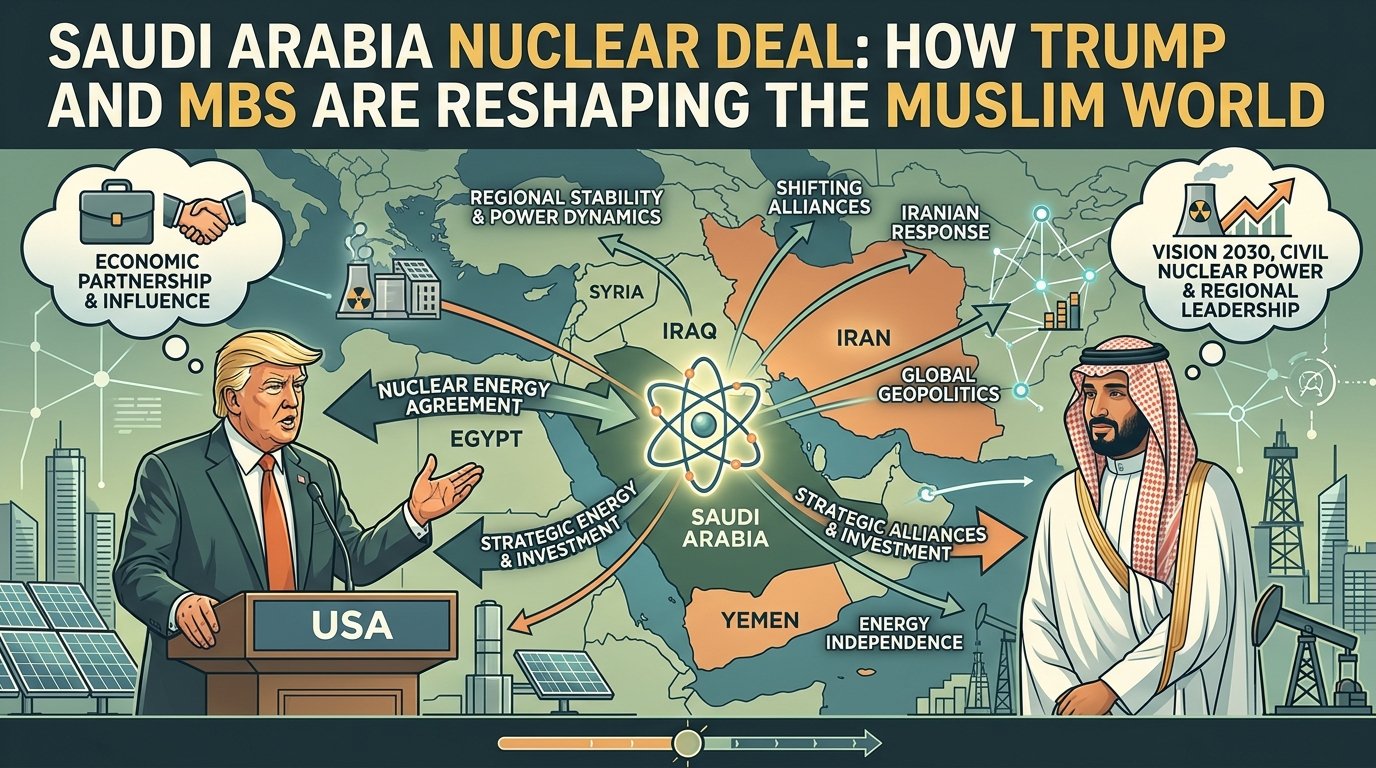
- Saudi Arabia Nuclear Deal enters a crucial phase as Trump submits the landmark accord to Congress while insisting Riyadh normalize relations with Israel.
- Deal could strengthen MBS’s position as a leading statesman of the Muslim world, backed by growing strategic ties with Pakistan and Türkiye.
- Landmark Deal may accelerate a new regional power balance, raising concerns in Iran while positioning Riyadh as an emerging strategic powerhouse in the Middle East.
WASHINGTON/RIYADH — The Middle East is changing faster than the old maps of power can accommodate.
For decades, the region’s strategic architecture revolved around a handful of familiar pillars: American military power, Israeli technological superiority, Iranian revolutionary influence and Saudi Arabia’s oil wealth. But that architecture is now being rearranged.
At the center of the emerging order is Saudi Crown Prince Mohammed bin Salman.
The latest evidence came this week when President Donald Trump submitted the landmark U.S.-Saudi civilian nuclear cooperation agreement to Congress for review. The 30-year agreement, signed by U.S. and Saudi officials in July, would give American companies a central role in developing the kingdom’s nuclear infrastructure. The move has been described by the Wall Street Journal’s latest report on the U.S.-Saudi nuclear accord as a major step toward implementing the agreement.
But Trump has attached a condition that could prove more consequential than the nuclear agreement itself: Saudi Arabia must normalize relations with Israel and join the Abraham Accords.
READ VEXT: Saudi Nuclear Deal Hits Limbo as Trump Mandates Israel Normalization
That condition has placed the Saudi nuclear project in diplomatic limbo. The Islamabad Telegraph’s earlier analysis of Trump’s decision to tie the nuclear agreement to Israeli normalization examined how the president’s last-minute demand transformed what had appeared to be a straightforward nuclear-energy agreement into a much broader diplomatic bargain.
Yet it would be a mistake to view the dispute simply as another disagreement between Washington and Riyadh. Something much larger is taking shape.
The Saudi nuclear dream moves closer
For Saudi Arabia, nuclear power is about far more than electricity.
The kingdom wants to reduce the amount of oil consumed domestically, preserve more crude for export and build a diversified energy economy under Vision 2030. Washington says the agreement will expand American nuclear exports and establish a long-term U.S. role in Saudi Arabia’s civilian nuclear sector.
The sensitive issue is uranium enrichment.
The Guardian’s detailed examination of the U.S.-Saudi nuclear agreement noted that the agreement could eventually open the way for domestic enrichment, raising concerns among non-proliferation experts about the precedent it could establish in the Middle East.
That is precisely where the strategic implications become enormous.
READ MORE: Trump Sends Nuclear Agreement With Saudi Arabia to Congress
A Saudi Arabia with a sophisticated civilian nuclear industry would possess technological capabilities that could, under certain circumstances, provide a pathway toward a much more advanced nuclear infrastructure.
That does not mean Saudi Arabia is automatically becoming a nuclear-weapons state.
But it does mean that the kingdom’s strategic weight would increase dramatically.
And that is what worries Iran and other regional rivals.
Saudi Arabia Nuclear Deal: Trump is building a different Middle East
Trump’s approach is not traditional alliance management.
He is attempting to construct a Middle East in which economic power, military deterrence, energy and diplomacy reinforce each other.
The Saudi nuclear agreement fits directly into that strategy.
So does Trump’s insistence on the Abraham Accords.
Washington wants Riyadh to normalize with Israel. Riyadh wants American technology, investment, security cooperation and strategic recognition of its growing regional role.
The bargain is therefore much larger than a reactor.
It is potentially a new strategic architecture.
The Washington Post’s reporting and analysis of the changing U.S.-Saudi regional relationship has underscored how Saudi Arabia’s growing importance is becoming central to Trump’s plans for reshaping the Gulf and wider Middle East.
The problem is that Saudi Arabia has not abandoned its Palestinian condition.
Trump’s Middle East Strategy
Riyadh has repeatedly maintained that normalization with Israel requires a credible pathway toward Palestinian statehood. That position hardened after the October 2023 Hamas attack and Israel’s subsequent war in Gaza.
This is the fundamental contradiction.
Trump wants Saudi Arabia inside the Abraham Accords.
MBS wants Saudi Arabia to emerge as an independent regional power rather than appear to be following Washington’s instructions.
The nuclear agreement has therefore become the bargaining table on which the future Middle East is being negotiated.
The MBS factor
The extraordinary part of the current transformation is the convergence around Mohammed bin Salman.
Trump has embraced MBS as an indispensable strategic partner.
Türkiye’s President Recep Tayyip Erdogan has deepened strategic cooperation with Riyadh.
And Pakistan’s military leadership under Field Marshal Asim Munir has moved closer to Saudi Arabia at precisely the moment when the kingdom is seeking a stronger regional security architecture.
The result is the beginning of an extraordinary strategic triangle linking Saudi Arabia, Pakistan and Türkiye, with Washington increasingly positioned behind the emerging configuration.
This is one of the most important developments in the Muslim world’s strategic landscape in years.
It is also why the Saudi nuclear question cannot be examined in isolation.
There is now a broader Saudi-centered network emerging.
Saudi Arabia brings money, energy, the Islamic world’s two holiest cities and immense diplomatic influence.
Türkiye brings a powerful military, NATO experience and an expanding defense industry.
Pakistan brings one of the Muslim world’s most experienced militaries and the only established nuclear-weapons capability among the three.
And Washington brings something none of them can replicate: global financial, technological and diplomatic power.
At the heart of this emerging configuration sits MBS.
Pakistan’s increasingly important role
Pakistan’s role deserves particular attention.
Islamabad’s relationship with Saudi Arabia is much deeper than a conventional diplomatic partnership. The two countries have maintained decades of defense cooperation, and Pakistan has historically provided military training and expertise to the kingdom.
The Islamabad Telegraph’s previous report on the emerging Trump-MBS-Pakistan strategic alignment explored how the relationship between Washington, Riyadh and Islamabad has been acquiring a wider geopolitical dimension as tensions with Iran intensify.
Pakistan’s technical and strategic experience inevitably makes Islamabad an important partner as Saudi Arabia develops its civilian nuclear capabilities.
That distinction matters.
It would be premature to claim that Pakistan is transferring nuclear weapons technology to Saudi Arabia. There is no public evidence establishing such a transfer.
But Pakistan’s nuclear experience, military expertise and longstanding defense relationship with Riyadh make its role strategically significant.
The future Saudi nuclear program will be judged not merely by what Riyadh says it wants today, but by the technological infrastructure it develops over the next decade.
Iran watches the transformation
For Tehran, this is an uncomfortable strategic picture.
Iran has long viewed Saudi Arabia as its principal Arab competitor for influence in the Gulf and wider Muslim world.
A Saudi Arabia backed by Washington, increasingly integrated with Türkiye and Pakistan, and developing a sophisticated nuclear-energy infrastructure represents a fundamentally different strategic challenge.
The Iranian concern is not necessarily that Riyadh will immediately build a bomb.
The deeper concern is that Saudi Arabia could acquire the technological and strategic foundations that would allow it to respond rapidly if the regional nuclear balance deteriorates.
That would fundamentally change deterrence calculations across the Gulf.
The Arab News analysis of the future of the U.S.-Saudi nuclear agreement similarly identifies two major obstacles: proliferation concerns and Trump’s requirement that Riyadh normalize relations with Israel.
Israel, meanwhile, faces a different dilemma.
Jerusalem wants normalization with Riyadh because Saudi recognition would be the biggest diplomatic prize still available to the Abraham Accords.
But Israeli opposition to Palestinian statehood makes the Saudi condition extremely difficult to satisfy.
Thus Trump has created an extraordinary paradox: the same nuclear agreement designed to deepen the U.S.-Saudi partnership is now being held hostage to the unresolved Israeli-Palestinian conflict.
A new Muslim power center
Here is that passage condensed into three paragraphs of equal length (55 words each):
The most consequential development may nonproliferation-wise not be the reactor itself, but the emergence of Saudi Arabia as the political center of a new Muslim strategic bloc. This is not yet a formal alliance, nor should the Saudi-Pakistani-Turkish security relationship automatically be interpreted as an anti-Iran or anti-Israel military coalition across the region.
However, geopolitics is often shaped by capabilities long before it is shaped by formal declarations. Saudi Arabia now possesses unprecedented financial resources, highly ambitious technological plans, increasingly sophisticated armed forces, and significantly stronger strategic relationships with Pakistan and Türkiye. Crown Prince Mohammed bin Salman has strategically positioned himself directly at the intersection of all these relationships.
Trump’s Washington sees him as an indispensable central partner, while Ankara views Riyadh as a critical strategic and economic ally. Islamabad sees Saudi Arabia as a historic ally whose overall importance is rapidly growing. Ultimately, the wider Muslim world increasingly views Riyadh—through its immense economic and strategic weight—as a major emerging center of gravity.
The nuclear question will define the next phase
That is why the congressional review of the U.S.-Saudi agreement matters so much. Congress is not merely reviewing a commercial nuclear agreement; it is effectively examining whether Washington is prepared to help create a new strategic power center in the Middle East. The United States says the agreement contains nonproliferation safeguards and is designed for peaceful purposes. However, critics argue that permitting enrichment-related capabilities in Saudi Arabia could severely weaken decades of established American nonproliferation policy across the region.
Saudi Arabia, meanwhile, has a much larger calculation. For decades, Riyadh was primarily viewed as an oil power. Under MBS, it is trying to become a technological, financial, military, and diplomatic power simultaneously, with a nuclear-energy program adding another crucial layer to that transformation. The Abraham Accords condition could delay the process, while congressional scrutiny could complicate it. Iran could attempt to counter it, Israel could seek to shape it, and China and Russia could offer competing nuclear alternatives.
Washington has already made one thing clear: it wants the United States, not Beijing or Moscow, at the center of Saudi Arabia’s nuclear future. That is why the nuclear agreement matters far beyond nuclear energy—it is ultimately about who will shape the next Middle East. With Trump’s backing, Türkiye’s partnership, and Pakistan’s strategic support, Saudi Arabia is moving toward becoming the principal power center of the Muslim world as a new Saudi-centered regional order begins to emerge.