



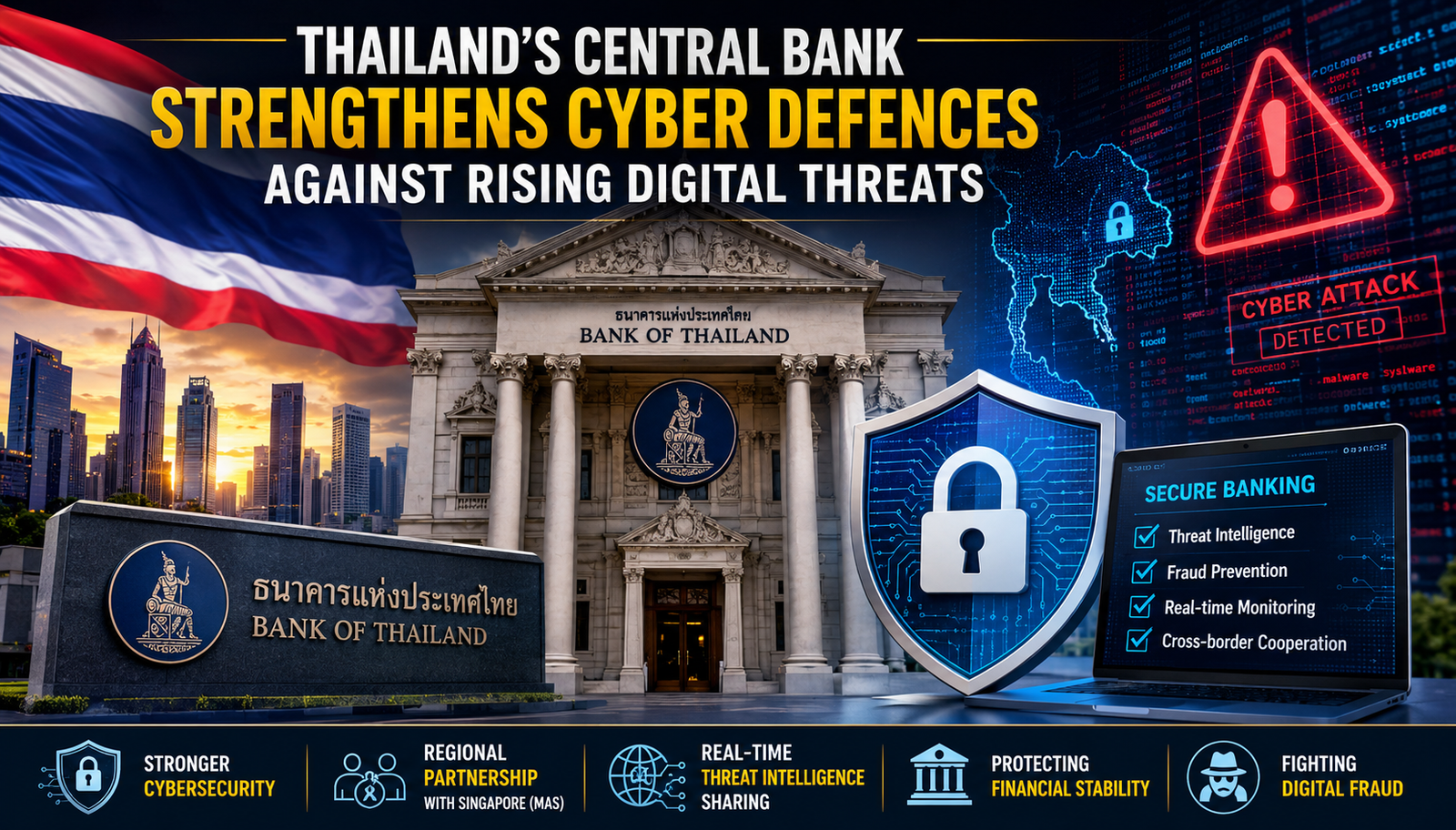
- Thailand cyber threats banking sector faces rising phishing, ransomware, and digital fraud risks
- Central bank strengthens cybersecurity through Singapore partnership and real-time intelligence sharing
- New regulations, stress testing, and cross-border drills aim to protect financial stability
Thailand’s Central Bank Deepens Cyber Defences as Cross-Border Threats Surge
Bangkok — Thailand’s central bank has stepped up its campaign against cyber threats after signing a new memorandum of understanding with the Monetary Authority of Singapore, marking a significant escalation in regional efforts to combat digital fraud and financial-sector cyber risks.
The agreement, signed by MAS managing director Chia Der Jiun and Bank of Thailand (BOT) governor Vitai Ratanakorn, establishes a framework for joint cross-border cybersecurity and crisis-management exercises, alongside real-time sharing of threat intelligence and regulatory updates. The move comes as cyber attacks targeting banks and payment systems across Southeast Asia intensify in both frequency and sophistication.
“Cyber risks and digital fraud are key transnational threats confronting our region,” Mr Chia said, underscoring the need for deeper collaboration. Mr Ratanakorn added that the partnership would “achieve seamless cross-border intelligence exchange to counter emerging threats,” reflecting Bangkok’s growing concern over vulnerabilities in its financial infrastructure.
Thailand Cyber Threats Banking: Rising Threat Landscape
Thailand has emerged as one of the region’s more exposed markets to cyber risks, driven by rapid digitalisation, high mobile banking penetration, and a surge in real-time payment adoption. According to regional cybersecurity assessments, financial institutions in Southeast Asia faced a double-digit increase in phishing attacks and ransomware incidents over the past two years, with Thailand ranking among the top targets.
READ NEXT: Thailand Cracks Down on Oil Mafia as PM Warns Against War-Driven Profiteering Amid Global Energy Crisis
Industry data suggests that digital fraud losses in Thailand’s banking and payments ecosystem have climbed steadily, with social engineering scams, account takeovers and malware-driven intrusions posing the greatest risks. Central bank officials have warned that smaller financial institutions and non-bank lenders are particularly vulnerable due to weaker cybersecurity frameworks.
The BOT has responded by tightening supervisory oversight and mandating stricter cybersecurity standards for banks, including enhanced authentication protocols, real-time transaction monitoring and mandatory incident reporting. In recent years, it has also pushed financial institutions to adopt zero-trust security models and improve resilience against distributed denial-of-service (DDoS) attacks.
From Domestic Safeguards to Regional Coordination
The MoU with Singapore marks a shift from domestic containment to regional coordination. Under the agreement, the two central banks will conduct joint simulation exercises designed to test responses to cross-border cyber crises, such as coordinated attacks on payment systems or disruptions to foreign exchange settlement networks.
READ MORE: Thai Central Bank Stays on Hold as It Gauges Risks
The collaboration also includes staff training, study visits and the sharing of policy research, signalling a broader push to harmonise cybersecurity frameworks across ASEAN financial systems. This builds on earlier cooperation between MAS, BOT and the Bank of England, which explored synchronised cross-border foreign exchange settlement — a system increasingly exposed to cyber vulnerabilities.
Analysts say such partnerships are critical as cyber threats become more interconnected. “Financial systems are no longer confined within borders,” said a Bangkok-based risk consultant. “A breach in one jurisdiction can quickly cascade into others, especially with integrated payment networks.”
Economic Context and Financial Stability Risks
The cyber push comes at a delicate moment for Thailand’s economy. The BOT recently held its policy rate at 1.00%, citing uneven growth and lingering risks despite a modest improvement in outlook. The central bank has raised its 2026 growth forecast to 2.3%, up from 1.5% earlier this year, as the economic fallout from Middle East tensions proved less severe than feared.
However, policymakers remain cautious. Household debt levels are high, small businesses continue to struggle, and inflation—while expected to ease—has been pushed up by supply-side pressures such as energy costs. These vulnerabilities heighten the systemic risks posed by cyber incidents, which could disrupt financial flows or erode consumer confidence.
“Cybersecurity is no longer just an IT issue; it is a financial stability issue,” a senior BOT official noted in a recent briefing.
Building a More Resilient Financial System
Beyond regulatory tightening, the BOT has invested in strengthening national cyber resilience through public-private coordination. Banks are now required to conduct regular stress tests simulating cyber attacks, while the central bank has expanded its oversight of digital payment platforms and fintech firms.
Thailand has also increased collaboration with law enforcement agencies to track and dismantle fraud networks, many of which operate across borders. Efforts include real-time fraud monitoring systems and public awareness campaigns aimed at reducing susceptibility to scams.
The MAS-BOT partnership is expected to accelerate these initiatives by enabling faster intelligence sharing and coordinated responses to emerging threats. For a region increasingly reliant on digital finance, such cooperation may prove essential.
As Southeast Asia’s financial systems grow more interconnected, Thailand’s approach could serve as a template for others grappling with the same challenge: how to secure the digital backbone of modern banking without slowing innovation.
For Bangkok, the message is clear — in an era of borderless cyber threats, defending the financial system requires equally borderless cooperation.