



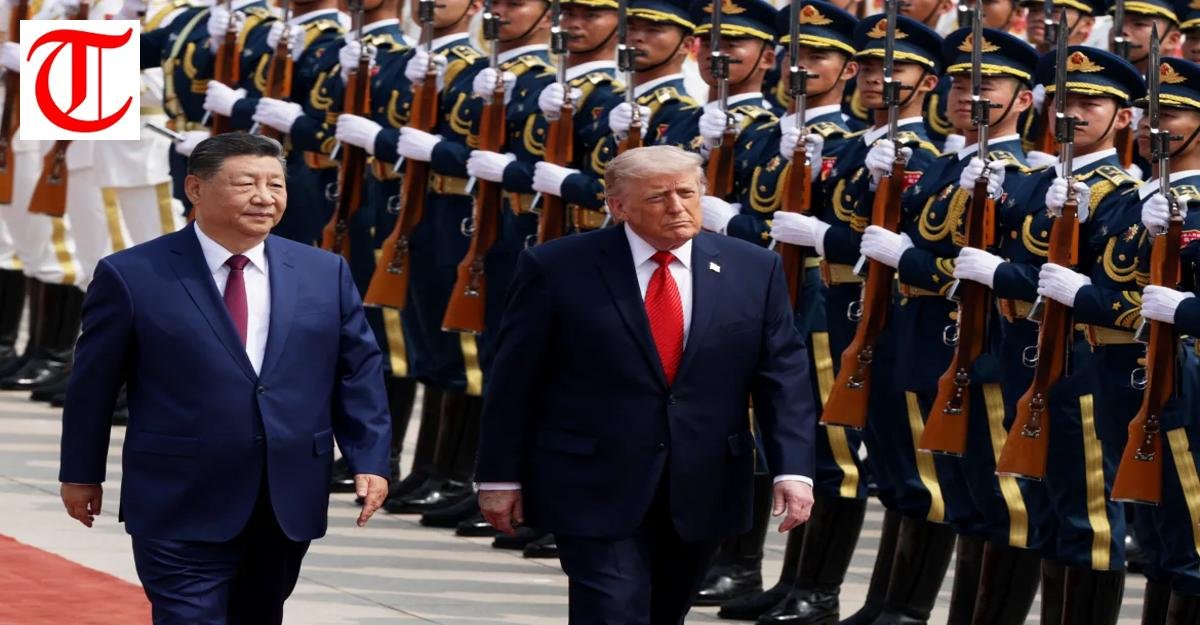
- Trump China Visit 2026 marks first US state visit to Beijing since 2017
- Trade war and tariffs exceeding 100% reshaped global economic dynamics
- Chips, AI, and rare earth metals dominate strategic negotiations
- Experts say visit could stabilize ties between world’s two largest economies
U.S. President Donald Trump’s ongoing state visit to China marks a pivotal moment in global diplomacy, representing the first such visit by an American president to Beijing since his own landmark trip in November 2017. At a time when geopolitical tensions, trade disputes, and technological rivalries have defined U.S.-China relations, this visit carries immense symbolic and strategic weight.
Unlike the atmosphere of Trump’s earlier visit—characterized by ceremonial grandeur and personal rapport with Chinese President Xi Jinping—the current engagement reflects a more complex and recalibrated dynamic. The balance of power has shifted, and both nations now approach negotiations with a mix of caution and necessity.
Ali Wyne, Senior Advisor for U.S.-China relations at the International Crisis Group, highlighted this evolution: “China was trying to persuade the United States of its growing status… This time around it is the United States, of its own volition, that is acknowledging that status.” Trump’s revival of the term “G2” further reinforces this emerging recognition of a shared—albeit competitive—global leadership framework.
Trump-Xi summit Singapore markets fail to rally investors despite positive diplomatic signals
Trade Wars and Economic Interdependence
Trade remains the cornerstone of U.S.-China relations, despite years of disruption caused by tariff escalations. Bilateral trade between the two economies continues to hover between $575 billion and $600 billion annually, underscoring the depth of their economic interdependence.
However, the tariff war initiated during Trump’s first term and intensified in his second imposed duties exceeding 100 percent on selected goods, triggering retaliatory measures from Beijing. These actions disrupted global supply chains, increased costs for businesses and consumers, and slowed economic growth on both sides.
Trump China Visit 2026: High-Stakes Summit Faces Taiwan, Trade, and Security Flashpoints
The broader global economy has also borne the consequences. Estimates from international financial institutions suggest that prolonged U.S.-China trade tensions have reduced global GDP growth by up to 1 percent, reflecting the systemic importance of this bilateral relationship.
Now, both Washington and Beijing appear willing to recalibrate. The United States is seeking expanded access for its corporations in Chinese markets, while China is pushing for the removal or reduction of tariffs and sanctions.
China’s Xi warns Trump about Taiwan at Beijing summit
Islamabad-based foreign policy expert Mustansar Klasra emphasized the significance of the visit, stating: “Trump’s visit to China will surely mend ties between two powerful nations. The economic interdependence between Washington and Beijing is too significant to ignore, and both leaderships appear ready to prioritize stability over prolonged confrontation.”
Technology Rivalry and Resource Leverage
While trade disputes dominate headlines, the deeper strategic competition lies in technology and critical resources. The United States has imposed stringent export controls on advanced semiconductors, aiming to limit China’s progress in artificial intelligence and high-performance computing.
American firms such as Nvidia previously held dominant market positions in China, controlling up to 95 percent of the advanced chip segment before restrictions were tightened. China’s AI market alone is projected to reach $50 billion, making it an indispensable arena for global technology companies.
In response, China has leveraged its dominance in rare earth metals, controlling approximately 60–70 percent of global supply and an even greater share of refining capacity. These materials are essential for manufacturing advanced technologies, including defense systems and consumer electronics.
Beijing’s decision to restrict exports of several rare earth elements last year highlighted its strategic leverage. Although some of these restrictions have been temporarily eased under a bilateral truce, they remain a powerful negotiating tool.
A Washington-based analyst observed: “This is no longer merely a trade dispute; it is a comprehensive economic competition. However, both nations recognize that complete decoupling is neither practical nor desirable. What is unfolding is an effort to establish structured coexistence.”
Geopolitical Fault Lines and Strategic Bargaining
Beyond economics, geopolitical tensions continue to shape the contours of U.S.-China relations. During the current summit, President Xi Jinping reiterated that Taiwan remains a non-negotiable red line, warning that any miscalculation could lead to serious conflict.
The United States maintains its long-standing policy of “strategic ambiguity,” balancing its recognition of Taiwan’s status with opposition to unilateral changes by force. This delicate positioning reflects the high stakes involved.
Simultaneously, Washington has sought Beijing’s cooperation on issues related to Iran, including ensuring that Tehran does not acquire nuclear weapons and maintaining the free flow of energy through the Strait of Hormuz.
This interplay underscores a transactional dimension to the relationship: the United States prioritizes Iran-related stability, while China remains firmly focused on Taiwan.
The presence of leading American corporate executives—including those from Tesla, Apple, Nvidia, and Boeing—further highlights the economic stakes. These companies depend heavily on China for manufacturing, supply chains, and market access, reinforcing the urgency of stabilizing bilateral ties.
Forecast: Managed Competition with Strategic Stabilization
Despite positive diplomatic signals, expectations for a comprehensive breakthrough remain tempered. The most probable outcome of Trump’s visit is a measured and pragmatic reset, rather than a full reconciliation.
In the short term, both sides are likely to extend tariff truces, ease selected export restrictions, and facilitate limited agreements on rare earth supplies and technology exchanges. Such steps would provide immediate relief to global markets and restore a degree of investor confidence.
Over the medium term, incremental progress may be seen in market access, investment flows, and regulatory cooperation. However, structural competition—particularly in advanced technologies and military capabilities—will persist.
In the long term, U.S.-China relations are expected to evolve into a model of managed strategic competition, where rivalry coexists with cooperation under clearly defined boundaries.
Trump’s visit reflects a broader realization: neither Washington nor Beijing can afford sustained confrontation without incurring significant global and domestic costs. As such, both powers appear increasingly inclined toward stability, even as they continue to compete for influence.
For the international community, the implications are profound. A stabilized relationship between the world’s two largest economies could ease geopolitical tensions, support global economic recovery, and restore confidence in international markets. Conversely, any failure to sustain this fragile détente would risk renewed volatility.
In Beijing, therefore, the objective is not to resolve all differences—but to prevent them from spiraling into crisis. That alone may define the success of this historic visit.