



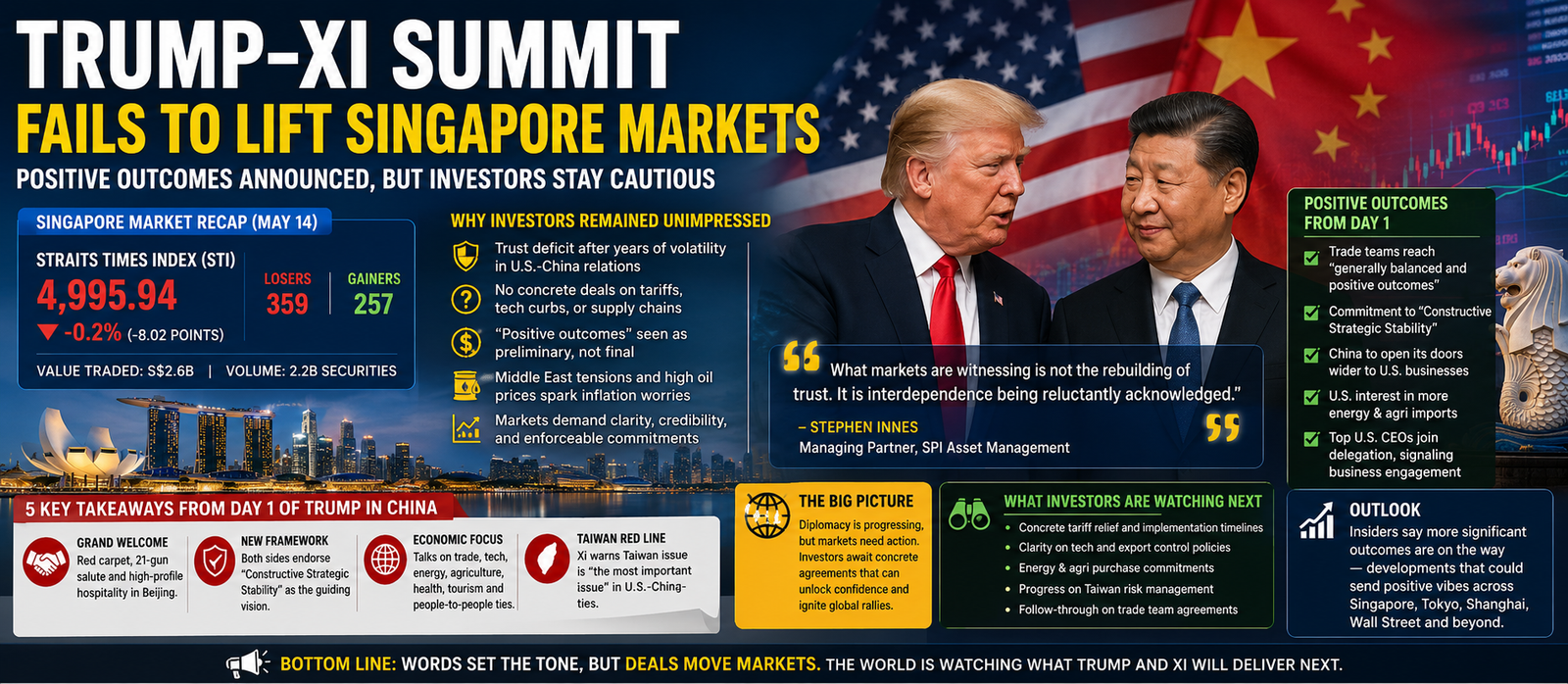
- Trump Xi summit Singapore markets remained under pressure as the Straits Times Index fell 0.2% despite diplomatic optimism
- Investors ignored positive trade signals, citing lack of concrete agreements on tariffs, tech restrictions, and supply chains
- Analysts say markets are stuck in a “wait-and-see” mode amid geopolitical uncertainty and inflation risks from oil volatility
- Insiders expect delayed but stronger policy outcomes that could eventually lift global equities including Singapore, Tokyo, and Wall Street
Singapore’s financial markets delivered a cautious verdict on one of the most anticipated geopolitical events of 2026. Despite a seemingly constructive opening to the Trump-Xi summit in Beijing, investors in Singapore—and across Asia—remained unmoved, reflecting deeper anxieties that go beyond diplomatic optics.
The benchmark Straits Times Index (STI) slipped 0.2 percent to close at 4,995.94 on May 14, with losers outpacing gainers. The muted reaction underscores a broader truth: while diplomacy may be progressing, markets are still searching for clarity, credibility, and concrete outcomes.
At first glance, the summit between U.S. President Donald Trump and Chinese President Xi Jinping produced encouraging signals. Both leaders spoke of “constructive strategic stability,” while trade teams reportedly achieved “generally balanced and positive outcomes.”
Trump Xi Summit 2026 Signals Global Reset as China Draws Taiwan Red Line
Yet, for investors, these phrases fell short of delivering the decisive momentum needed to trigger a rally.
Why Investors Remained Unimpressed
The lack of investor enthusiasm in Singapore stems largely from a trust deficit built over years of volatile U.S.-China relations. Markets are no longer swayed by rhetoric alone; they demand enforceable agreements, timelines, and measurable deliverables.
Stephen Innes of SPI Asset Management captured the mood succinctly, noting that what markets are witnessing is “not the rebuilding of trust, but reluctant interdependence.” This distinction is critical. Investors perceive the current phase not as a breakthrough, but as a temporary alignment of necessity between two competing superpowers.
Trump China Visit 2026: High-Stakes Summit Faces Taiwan, Trade, and Security Flashpoints
Moreover, structural concerns continue to weigh heavily. Key issues such as tariffs, technology restrictions, and supply chain decoupling remain unresolved. The absence of a clear roadmap on these fronts has prevented investors from pricing in long-term stability.
Compounding the uncertainty is the ongoing geopolitical turbulence in the Middle East. Elevated oil prices and fears of prolonged conflict have revived inflationary concerns, particularly in Asia, where economies remain heavily dependent on energy imports. For Singapore, a global trade hub, these risks translate directly into market caution.
Positive Outcomes That Failed to Translate
Ironically, the summit did produce several tangible positives. Trade negotiations yielded balanced outcomes, and both sides reaffirmed their commitment to economic cooperation. China reiterated its willingness to open its markets further, while the U.S. signaled interest in expanding exports, particularly in energy and agriculture.
Xi warns Trump that mishandling Taiwan could spark ‘conflicts’
High-profile business participation also added weight to the discussions. Executives from major corporations—including Apple, Tesla, Nvidia, and Citigroup—joined Trump’s delegation, signaling strong corporate interest in stabilizing U.S.-China ties.
Yet, these developments failed to energize markets. The reason lies in timing and credibility. Investors view these outcomes as preliminary steps rather than final agreements. Without formal announcements or signed deals, optimism remains speculative.
Key Takeaways from Trump’s First Day in China
The first day of Trump’s visit to Beijing offered several important insights into the evolving dynamics of U.S.-China relations.
The Iran War’s Aftershocks: Hormuz Chokepoint, Fragile Ceasefire, and the Road to America’s Midterms
First, the tone of the meeting was notably cordial and ceremonial. Trump received a grand welcome at the Great Hall of the People, complete with a red carpet and a 21-gun salute—signaling China’s intent to project stability and respect in bilateral ties.
Second, the concept of “constructive strategic stability” emerged as a central theme. Xi emphasized a framework combining cooperation with manageable competition, suggesting a shift away from outright confrontation toward structured coexistence.
Third, economic engagement remained a priority. Discussions focused on trade expansion, market access, and sectoral cooperation, particularly in technology, agriculture, and energy.
Fourth, Taiwan was firmly established as a red line. Xi’s warning that mishandling the issue could lead to “clashes and conflict” served as a stark reminder of the underlying tensions that continue to define the relationship.
Finally, the presence of top U.S. business leaders highlighted the economic stakes involved. Their participation signals that while governments negotiate, corporations are preparing for potential opportunities—albeit cautiously.
Markets Waiting for the “Real Deal”
Insiders suggest that the most significant outcomes of the Trump-Xi summit may still be in the pipeline. Behind closed doors, negotiators are reportedly working on agreements that could deliver clearer policy direction and tangible economic benefits.
If finalized, these developments could inject much-needed confidence into global markets. Stock exchanges in Singapore, Tokyo, Shanghai, and Wall Street are all poised to respond positively to any credible breakthroughs.
For now, however, markets remain in a holding pattern. The initial phase of the summit has set a constructive tone, but it has not yet crossed the threshold required to shift investor sentiment.
A Cautious Global Outlook
The broader takeaway is that global markets are evolving. In an era defined by geopolitical uncertainty, investors are becoming increasingly discerning. Symbolism and rhetoric, once powerful drivers of market movements, are no longer sufficient.
The Trump-Xi summit may yet prove to be a turning point. But for Singapore’s investors—and the world at large—the real test lies ahead. Until concrete agreements emerge, caution will continue to define market behavior.
As one analyst put it, the world’s two largest powers may be learning to coexist—but markets will only rally when that coexistence is backed by action, not just words.