



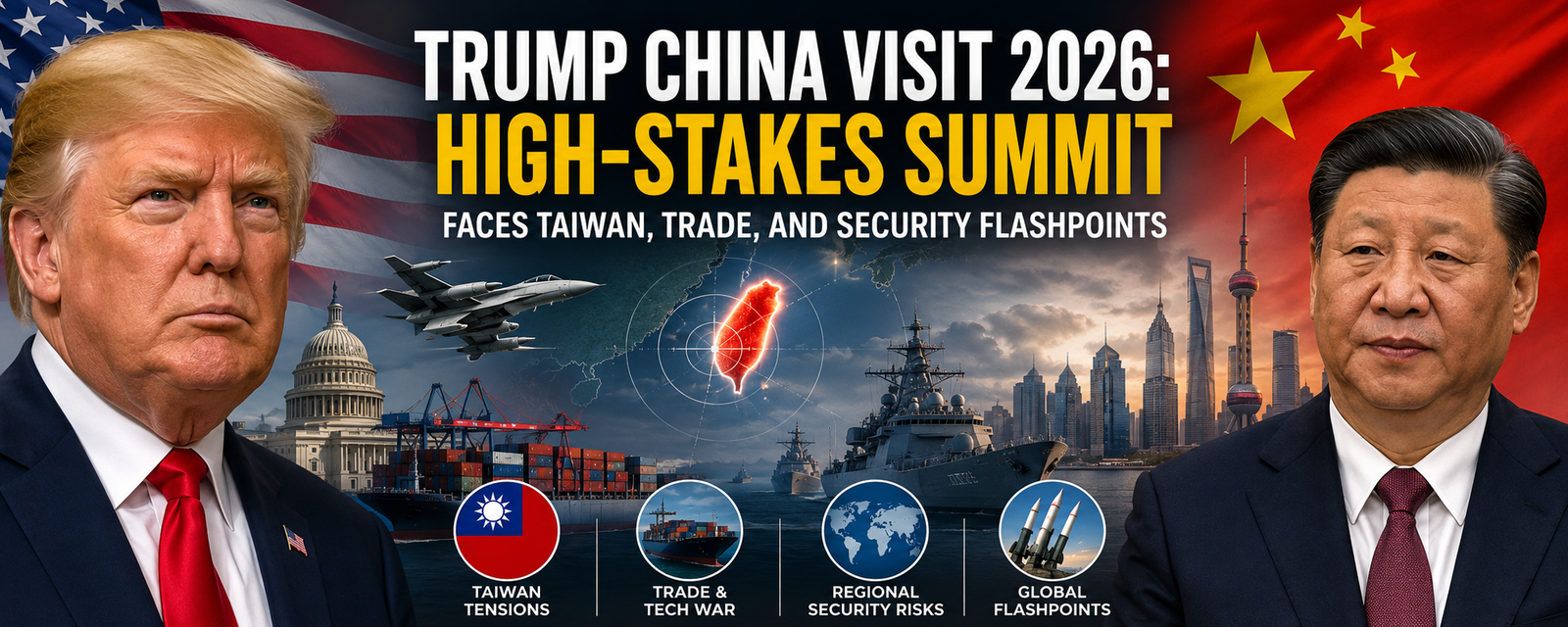
- Trump China Visit 2026 highlights rising geopolitical risks between Washington and Beijing
- Taiwan remains the most dangerous flashpoint with potential for direct military confrontation
- South China Sea tensions increase risk of accidental conflict between major powers
- Trade, technology, and global conflicts deepen mistrust and strategic rivalry
President Donald Trump’s upcoming visit to China on 14–15 May 2026 comes at a time of growing geopolitical tension and uncertainty. Relations between the United States and China remain strained over military competition, economic rivalry, and regional security disputes. While the summit aims to improve communication and stabilize ties, several sensitive flashpoints could rapidly escalate into a larger confrontation if not carefully managed.
Among the most dangerous issues are Taiwan, military activity in the South China Sea, trade and technology disputes, China’s possible involvement in the Iran conflict, and North Korean provocations. Each of these areas carries the potential for misunderstanding, military accidents, or political miscalculation that could push both powers toward direct conflict.
Despite intense rivalry, neither the United States nor China appears to seek direct war. However, the combination of nationalism, military competition, political pressure, and strategic mistrust creates an environment where small incidents could escalate unexpectedly. Trump’s visit therefore represents both a risk and an opportunity. If managed carefully, the summit could reopen dialogue, strengthen crisis management mechanisms, and reduce tensions in key regions.
China US Trade Tensions Persist Despite Recent Engagements: Analysis
If mishandled, however, it could intensify existing disputes and increase the possibility of confrontation. The coming weeks will test whether both powers can balance competition with diplomacy. In an increasingly unstable international environment, effective communication and restraint may be the only barriers preventing regional tensions from turning into a global crisis.
US China chip war escalates as export controls tighten semiconductor rivalry
Taiwan remains the most immediate and serious risk in U.S.–China relations. Beijing considers Taiwan a core national interest and strongly opposes any foreign support for Taiwanese independence. Any major U.S. arms sale, military cooperation, or political statement supporting Taiwan during Trump’s visit could be viewed by China as crossing a red line.
US China chip war escalates as export controls tighten semiconductor rivalry
Recent Chinese military drills around Taiwan demonstrate how quickly tensions can rise. A new American arms package or a symbolic diplomatic gesture could trigger a large-scale response from the People’s Liberation Army, including naval exercises, air incursions, or even blockade threats. Such actions could lead to dangerous encounters between Chinese and U.S. forces operating in the region.
Trump’s China Trip Offers a Golden Chance to Inspire Freedom
To reduce the risk, both sides should prioritize communication and restraint. Delaying sensitive arms announcements until after the summit, reopening military hotlines, and publicly reaffirming the “One China” policy could help prevent escalation.
High-Stakes Diplomacy: Iran and U.S. Delegations Converge in Islamabad for Critical Peace Talks
Another major source of tension is the South China Sea, where the United States and its allies continue military exercises and freedom-of-navigation operations. Joint drills involving the U.S., Japan, and the Philippines are viewed by China as provocative and aimed at containing Chinese influence.
Iran focus at Trump-Xi summit may delay progress on tariffs, rare earths
The risk in this region lies not only in deliberate confrontation but also in accidental incidents. A ship collision, dangerous aircraft intercept, or misunderstanding during military exercises could quickly spiral into a diplomatic or military crisis. During high-level political visits, such incidents become even more sensitive and harder to control.
Confidence-building measures are essential. Advance notification of exercises, stronger naval safety protocols, and renewed regional dialogue through ASEAN could help reduce tensions and prevent unintended escalation.
Economic competition between Washington and Beijing continues to deepen, particularly in technology and strategic industries. Tariffs, export controls, semiconductor restrictions, and disputes over critical minerals have become central tools in the rivalry.
A renewed trade confrontation during Trump’s visit could further damage relations and expand beyond economics into national security concerns. China’s restrictions on rare-earth exports and American tariffs on Chinese goods have already demonstrated how economic pressure can disrupt global supply chains and increase mistrust.
To avoid further escalation, both countries could establish a permanent trade coordination mechanism to manage disputes and stabilize economic relations. Cooperation on supply chains and transparent communication regarding export restrictions would also help reduce uncertainty in global markets.
The ongoing Middle East conflict presents another challenge in U.S.–China relations. Washington remains concerned that Chinese military assistance or technology transfers to Iran could indirectly threaten American or allied forces in the region. If Chinese-made weapons were linked to attacks against U.S. personnel or assets, the situation could escalate rapidly. At the same time, American sanctions targeting countries assisting Iran could increase tensions with Beijing and push China into a more confrontational position.
Diplomatic coordination is therefore critical. China and the United States should work together to support ceasefire efforts, maintain maritime security, and prevent the conflict from expanding into a broader international crisis.
North Korea also remains a potential destabilizing factor. Pyongyang frequently uses missile launches and military provocations during periods of international tension to gain attention or leverage. During the Trump–China summit, North Korea may attempt another missile or nuclear test to pressure both powers. Such actions could trigger military responses from the United States, South Korea, or Japan, increasing the risk of broader regional instability.
If China becomes involved diplomatically or militarily, tensions could intensify further. Close coordination between Washington and Beijing will be necessary to deter provocations and manage any crisis quickly. Crisis communication channels and measured military responses would help avoid misunderstandings and prevent escalation.