



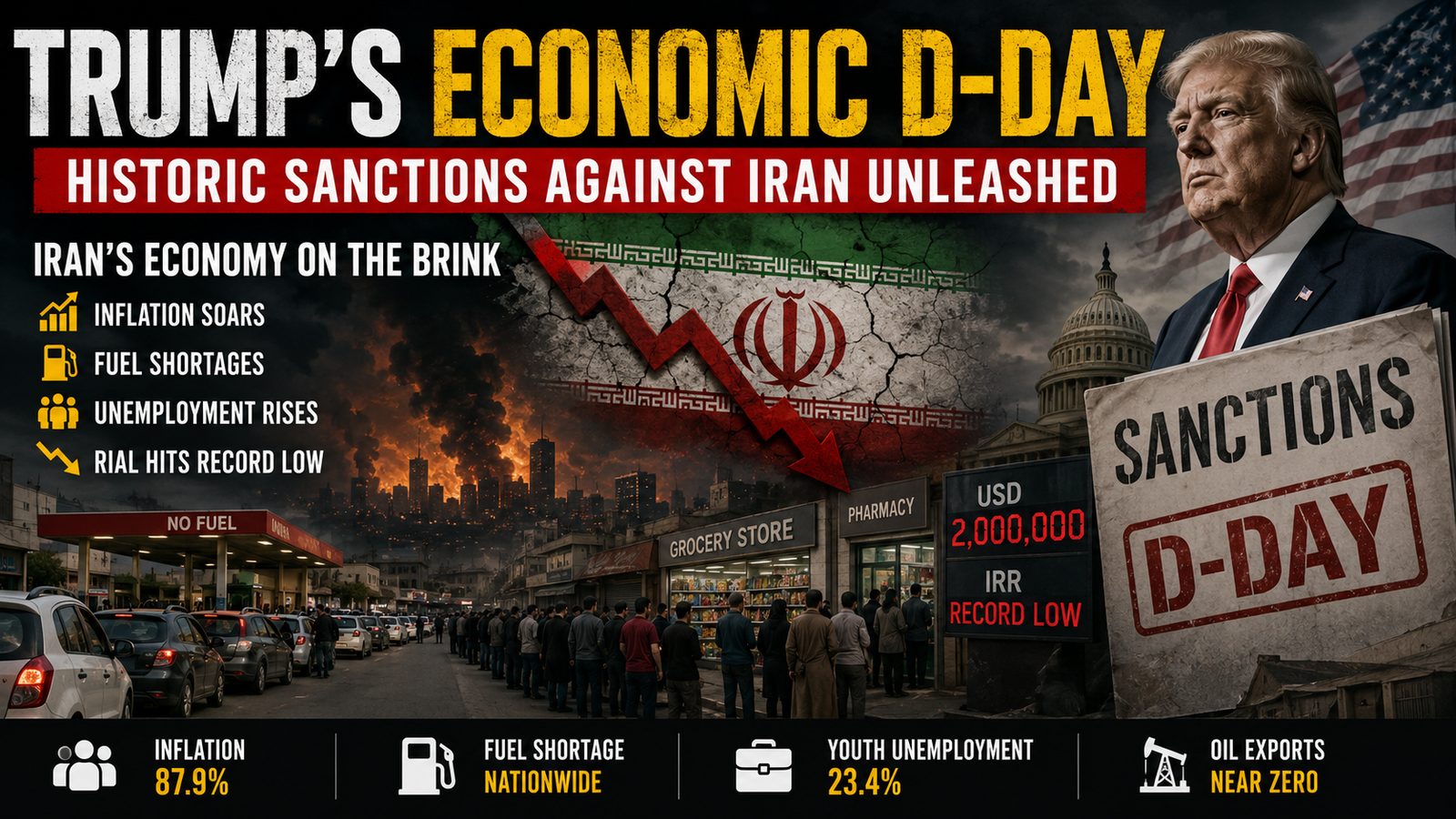
- Trump Economic D-Day Iran marks a major escalation, with Washington preparing unprecedented financial pressure on Tehran and entities that continue doing business with Iran.
- Iran enters the confrontation with soaring inflation, a collapsing rial, fuel shortages, unemployment and declining purchasing power.
- Tehran is threatening retaliation through the Strait of Hormuz, creating the possibility that an economic confrontation could rapidly become a wider regional crisis.
WASHINGTON/TEHRAN — The Trump administration is opening a new and potentially decisive front against Iran today, with Treasury Secretary Scott Bessent declaring that an “economic D-Day” has begun and promising the most sweeping financial offensive yet against Tehran.
Bessent has described the campaign as “the single greatest financial offensive ever marshalled against an adversary,” while President Donald Trump has warned that countries, banks, companies and other entities continuing to provide Iran with economic lifelines will face severe consequences. The Islamabad Telegraph’s analysis of Trump’s economic isolation strategy Wall Street Journal: Trump Threatens Iran With “Economic D-Day”
The precise measures being unveiled by Washington are not yet fully known. But the administration has signaled that this will not simply be another list of Iranian officials and companies. The campaign is expected to target the networks that keep Iranian oil, banking, shipping and trade connected to the outside world, including foreign entities that continue doing business with Tehran. Washington Post: Trump warns of “economic D-Day” against Iran
The objective is clear: make the cost of doing business with Iran so high that Tehran’s remaining economic lifelines become increasingly impossible to maintain.
Xi-Trump Summit: The High-Stakes Encounter Reshaping War, Trade, and the Global Order
And Iran is entering this new phase of economic warfare in an exceptionally vulnerable condition.
An Economy Under Extreme Pressure
For decades, Tehran has developed mechanisms for surviving sanctions. Iran has relied on alternative banking channels, informal currency markets, sanctions-evasion networks, barter arrangements and commercial relationships with China and neighboring states.
But the economic environment of 2026 is dramatically more difficult.
READ MORE: August 23, 2026 — Bessent promises ‘economic D-Day’ ahead of expected Iran sanctions
The Iranian rial has plunged to an extraordinary new low, with the dollar reaching around 2 million rials on the open market. Iranians interviewed by local media have described growing financial desperation as the currency collapse pushes the prices of food and essential goods beyond the reach of ordinary families.
Inflation has meanwhile reached devastating levels. Iranian official data cited in recent reporting put annual inflation at 66 percent in July, while point-to-point inflation reached 87.9 percent and food prices rose more than 128 percent year-on-year.
The consequences are visible in ordinary life.
Families are cutting shopping lists. Workers are watching their wages lose value. Businesses are struggling to obtain foreign currency. And the government is confronting a growing dilemma over fuel prices at precisely the moment when higher prices could trigger another wave of public anger.
READ NEXT: Empty Tanks, Rising Prices and Growing Anger: Iran’s Economic Crisis Tests the Government
The New York Times has reported on the growing impact of U.S. economic pressure on Iranians, while noting that Tehran is trying to develop alternative trading routes and reduce its dependence on vulnerable southern ports. New York Times reporting on Iran’s sanctions crisis
Trump Economic D-Day Iran: The Petrol Paradox
Perhaps nowhere is Iran’s economic crisis more striking than at petrol stations.
Iran is one of the world’s major energy producers, yet its domestic fuel system is under severe pressure. War damage, import difficulties and the widening gap between domestic gasoline production and consumption have forced Tehran to consider rationing and other emergency measures.
Long queues outside petrol stations are becoming an increasingly familiar sight.
The irony is difficult to miss: a country sitting atop enormous hydrocarbon reserves is struggling to ensure adequate fuel reaches its own citizens.
The government has also signaled that it may raise gasoline prices, despite concerns that higher fuel costs could intensify already widespread economic hardship.
For ordinary Iranians, the crisis is no longer measured merely by exchange rates or government statistics. It is measured in hours spent waiting for petrol, rising grocery bills and uncertainty about whether medicines and other necessities will remain affordable.
Unemployment and the Political Fuse
The economic pressure is increasingly becoming a political problem.
Iran’s official unemployment rate has risen, while employment has weakened and the number of economically inactive people has increased. The deeper concern, however, is that headline unemployment figures do not capture the erosion of real wages and the expansion of insecure informal work.
Iran’s political leadership understands the danger.
Reuters has reported that Iranian rulers are increasingly concerned that additional economic punishment could generate renewed unrest after months of war and economic deterioration. Reuters: Iran’s rulers wary of more economic pain and unrest
This is the central vulnerability of the new American strategy.
Sanctions may not immediately force Tehran to surrender. Iran has survived sanctions for decades.
But sanctions combined with military destruction, a weakened currency, inflation, fuel shortages and declining purchasing power create a different kind of pressure.
The question becomes not simply whether the government can survive, but whether the population can continue absorbing the cost.
Dubai’s Financial Lifeline
One of Washington’s most important targets is the financial infrastructure surrounding Iran.
For years, Dubai and the wider UAE have served as crucial commercial gateways for Iranian businesses, providing re-export channels and access to international financial networks.
That lifeline is now being squeezed.
The Wall Street Journal reports that Trump’s strategy depends heavily on the UAE’s willingness to disrupt Iranian financial and commercial networks, including the shell companies and intermediaries Tehran has used to evade sanctions. Wall Street Journal: Trump’s Plan to Squeeze Iran’s Economy Will Live or Die in Dubai
The UAE has already moved to suspend economic and financial dealings with Iran, making Washington’s strategy potentially far more powerful than earlier sanctions campaigns.
This is the difference between sanctioning Iran and attempting to isolate Iran.
If banks, insurers, shipping companies, oil traders, re-export hubs and foreign governments all begin withdrawing from Iranian commerce, the cost of sanctions evasion rises sharply.
Tehran Threatens Retaliation
Iran is not accepting the campaign quietly.
Foreign Minister Abbas Araghchi has described the American sanctions strategy as a sign of desperation and insisted that Tehran will not surrender under economic pressure. The Guardian: Iran’s foreign minister calls threat of new US economic sanctions “desperate”
Iranian security chief Mohsen Rezaei has gone considerably further.
He has threatened an “earthquake-like” response if Washington proceeds with its economic campaign and warned neighboring countries against joining it.
Rezaei has threatened action against oil-export routes from the Persian Gulf if regional states cooperate with Washington.
That raises the possibility that an economic confrontation could quickly become an energy crisis.
The Strait of Hormuz is central to that calculation. Any sustained disruption would threaten global energy markets and potentially increase the economic cost of Washington’s strategy for countries far beyond the Middle East. The Washington Post has highlighted the strategic importance of reopening the waterway, while reporting that Tehran continues to link its reopening to broader political and economic demands. Washington Post: Iran and the unresolved Strait of Hormuz crisis
The China Question
There is one major obstacle to Washington’s ambition of completely isolating Iran: China.
Beijing remains a crucial buyer of Iranian oil and an important economic partner for Tehran. The New York Times has reported that Chinese compliance will be critical to the success of Washington’s sanctions strategy, because Beijing possesses substantial economic leverage of its own. New York Times reporting on China and Iran sanctions
This could turn Economic D-Day into a much larger geopolitical confrontation.
Washington is therefore attempting something considerably more ambitious than simply punishing Tehran.
It is trying to force the world to choose.
A New Battle for Tehran’s Survival
Iran can probably survive another round of sanctions.
The more difficult question is whether it can survive this combination of pressures indefinitely.
The rial is collapsing. Inflation is destroying purchasing power. Fuel shortages are producing queues. Businesses are struggling. Unemployment and economic inactivity are worsening. The government is confronting rising public frustration.
At the same time, President Masoud Pezeshkian has acknowledged that Iran cannot remain at war indefinitely and has argued for a political pathway out of the confrontation. Washington Post: Pezeshkian says the U.S.-Iran memorandum is the best path out
That suggests the pressure is already producing debate inside Tehran.
Trump’s Economic D-Day therefore represents more than another sanctions package.
It is an attempt to turn Iran’s economic weakness into strategic leverage.
Tehran is betting that it can endure.
Washington is betting that the economic pain will eventually become unbearable.
And between those two calculations lies a much larger question: whether Iran’s economy breaks before its leadership does — or whether economic desperation pushes Tehran toward an even more dangerous confrontation in the Gulf.
For the first time in months, the battlefield is shifting decisively from Iran’s military infrastructure to something potentially more consequential: the currency in people’s pockets, the fuel in their cars, the food in their markets and the public’s willingness to endure.
Read The Islamabad Telegraph’s previous analysis: Iran Economic Sanctions Tighten Grip