



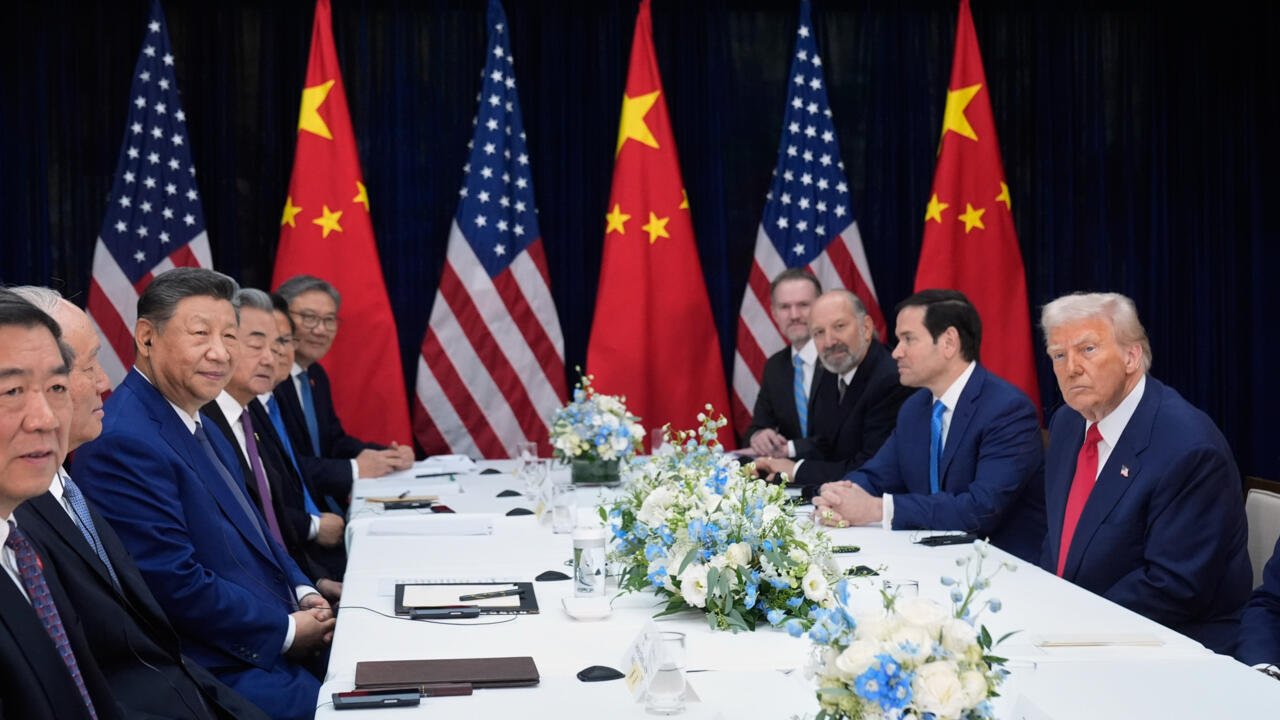
- A Truce, Not a Treaty: Trump’s tariff rollback and Xi’s fentanyl pledge signal short-term relief — but not reconciliation — between two superpowers locked in economic warfare.
- Tech Is the New Arms Race: Behind the smiles, the U.S. and China continue a silent battle over semiconductors, AI, and industrial dominance.
- South Korea’s Nuclear Leap: The Seoul submarine deal quietly redefines Asia’s defense order, giving Trump a strategic win — and Beijing a new headache.
- Managed Competition, Not Peace: The world’s biggest economies are learning to coexist through transactional cooperation, even as systemic rivalry intensifies.
When Donald Trump met Xi Jinping in South Korea this week—their first in-person encounter in six years—it wasn’t diplomacy as usual. It was theater, trade, and tectonic geopolitics rolled into one. Trump called it “a 12 on a scale of 1 to 10,” signaling what he views as a historic breakthrough between the world’s two largest economies. But beyond the smiles and photo ops, the meeting reflected a deeper attempt to rebalance power between Washington and Beijing—and perhaps, to repair a relationship that has defined global commerce for half a century.
A Tactical Truce with Strategic Depth
The Trump–Xi summit in Gyeongju produced tangible outcomes. The U.S. agreed to cut tariffs on Chinese goods from about 57% to 47%, including reducing a fentanyl-related tariff from 20% to 10%. In exchange, China pledged to crack down on precursor chemicals fueling America’s opioid crisis—a move long demanded by Washington. Beijing also promised to pause new rare-earth export restrictions, ensuring steady access to materials vital for electric vehicles, defense systems, and semiconductors.
According to Trump, the deal would “remove the roadblock to importing rare earths” and potentially “make rare earths disappear from our vocabulary for a little while.” While that optimism may be overstated, the announcement brought short-term relief to global manufacturers and markets alike.
U.S. consumers will likely see a slight dip in the cost of made-in-China goods, which have grown less competitive over the past two years due to record tariffs. China’s exports to the U.S. fell nearly 17% year-on-year in the first nine months of 2025, underscoring the pressure on Beijing’s export-driven economy.
TRUMP MET XI: The Reality Beneath the Rhetoric
Despite the celebratory tone, the structural rift between Washington and Beijing remains unresolved. The Trump–Xi agreement didn’t touch the deeper issues—China’s massive trade surplus, its state-backed industrial subsidies, and both nations’ race for technological supremacy.
“This truce is positive for now, but we should all expect tensions to escalate in the future,” warned Wendy Cutler, former U.S. trade negotiator now at the Asia Society Policy Institute.
READ MORE: Trump’s New China Doctrine—Engagement on His Own Terms
American firms caught in the crossfire agree. Many have already diversified production away from China to countries like Vietnam, Malaysia, India, and Mexico. Benjamin Jurken of ABC Group, which manages supply chains for U.S. companies in Asia, noted that “strategic diversification is irreversible—tariff reprieves won’t change that course.”
For companies such as Nicole Craft Brands, which produces most of its goods in China, the relief was limited. Senior Vice President George Thorp said the company was still expanding its supplier network to Turkey, Pakistan, and Indonesia, explaining, “It just doesn’t make sense to have all our production in one country anymore.”
Tech Wars and Industrial Sovereignty
Beyond trade, technology remains the most volatile fault line in the U.S.–China relationship. Both nations are weaponizing critical technologies—artificial intelligence, quantum computing, and semiconductor production—to secure global leverage.
ALSO READ: On Trump’s Asia Trip, Many Opportunities Were Golden
The summit partially rolled back recent punitive measures but left intact many of Washington’s export controls. Notably, the U.S. trade blacklist of Chinese tech firms accused of national-security violations will remain, though Trump temporarily suspended for one year a rule expanding the ban to subsidiaries 50% owned by blacklisted companies.
This technical concession was seen in Beijing as symbolic but insufficient. “In effect, both sides just took a time machine back to the pre-September 29 status quo,” observed Feng Chucheng of Hutong Research. “For Beijing, it reinforces confidence in industrial resilience rather than dependence.”
China is simultaneously pushing forward with a five-year national self-sufficiency plan, emphasizing breakthroughs in semiconductors and AI. In contrast, Trump’s “America First Manufacturing Revival” seeks to leverage hundreds of billions of dollars of investments from allies such as Japan and South Korea, aiming to restore U.S. industrial leadership.
Even as both leaders spoke of “friendship,” their visions underscored an enduring economic rivalry—a competition for the commanding heights of the 21st-century economy.
The Semiconductor Conundrum
Trump confirmed that Nvidia’s CEO Jensen Huang will hold direct talks with Chinese officials to resolve chip export issues. Since August, Beijing had halted certain Nvidia chip imports amid a broader dispute involving the Netherlands and ASML’s advanced lithography machines.
If resolved, it could reopen a vital channel for China’s AI sector, which has been constrained by U.S. export bans. Yet, the U.S. administration remains cautious, viewing AI hardware as a core national-security issue.
As one American official put it privately, “The AI race is the new arms race, and no tariff deal can mask that reality.”
Rare Earths and the Minerals Matrix
While the Trump–Xi handshake thawed immediate tensions, China’s rare-earth licensing regime remains opaque. American manufacturers must still apply for government licenses that take weeks—and sometimes months—to process. The bottleneck continues to delay production for industries ranging from automobiles to defense electronics.
To counter this dependence, Western nations have invested billions into alternative critical-mineral supply chains. The U.S., Canada, and Australia are developing joint extraction and refining hubs, while the European Union is drafting new legislation to reduce reliance on Chinese metals by 2030.
The Geopolitical Subtext: Submarines and Strategy
The Trump–Xi meeting coincided with another headline-grabber: Trump’s approval for South Korea to build a nuclear-powered submarine in the U.S. The vessel—expected to be manufactured at Hanwha Ocean’s Philadelphia shipyard—symbolizes the U.S. pivot to the Indo-Pacific and Seoul’s expanding strategic role.
If realized, South Korea would join an exclusive club of nuclear-submarine powers—the U.S., China, Russia, the U.K., France, and India. The move rattles Beijing and Pyongyang alike, reshaping the maritime balance of power in the region.
“The speed, range, and stealth of nuclear submarines increase deterrence by complicating Beijing and Pyongyang’s calculations,” explained Troy Stangarone of the Carnegie Mellon Institute for Strategy & Technology.
This development aligns with Trump’s broader Indo-Pacific strategy: a triad of deterrence, decoupling, and dominance. It also underscores that the economic détente with Beijing doesn’t imply strategic compromise.
The Seoul Summit’s Broader Significance
For CEOs, investors, and policy strategists, the Trump–Xi meeting signals a tactical easing, not a structural reset. Yet, it offers a short-term roadmap for stability in an otherwise volatile global system.
-
Tariff Moderation: The tariff reduction from 57% to 47% could unlock $80–100 billion in bilateral trade over the next year, according to initial projections from trade economists.
-
Fentanyl Cooperation: The fentanyl crackdown is a crucial deliverable for Trump politically and a test of Beijing’s enforcement credibility.
-
Supply Chain Fluidity: Firms will continue diversifying production, but modest tariff relief may slow the exodus of low-margin sectors.
-
Technological Cold Peace: AI and semiconductor cooperation will remain restricted, but new business dialogues could prevent escalation.
Market and Corporate Outlook
Wall Street responded cautiously but positively: the Dow Jones rose 1.3%, and Shanghai’s Composite Index climbed 2.1% on expectations of renewed trade flows. Analysts at Goldman Sachs project a 0.2% reduction in global inflationary pressure from tariff adjustments alone.
However, the structural decoupling of supply chains continues. American imports from Vietnam surged 28% in 2025, while imports from China declined sharply. Meanwhile, China’s outbound investments in Belt and Road partners rose 15%, signaling Beijing’s intent to offset lost U.S. market access with developing economies.
The Verdict: A Reset or a Pause?
Daniel Kritenbrink, a former U.S. diplomat and partner at the Asia Group, summarized it best: “There’s no change to the fundamentals of the U.S.–China relationship. It will continue to be the world’s most complex, competitive relationship.”
Indeed, Trump’s “12 out of 10” rating reflects optimism, but optimism without reform risks illusion. Both leaders gained: Trump a domestic political win and Xi breathing space for China’s slowing economy. But the systemic contest—over supply chains, silicon, and sovereignty—endures.
For global CEOs and think-tank strategists, the Seoul summit offers clarity on one point: the U.S.–China rivalry is entering a managed competition phase, where tactical deals coexist with long-term decoupling. The age of economic interdependence has given way to strategic interdependence—volatile, transactional, and tightly controlled.
Bottom Line:
The Trump–Xi summit in South Korea marked the first visible thaw in years, but it’s a truce built on calculation, not trust. Tariffs may fall, rare-earths may flow, and supply chains may breathe—but neither Washington nor Beijing has blinked. The rivalry that defines this century remains intact—simply paused for breath.