



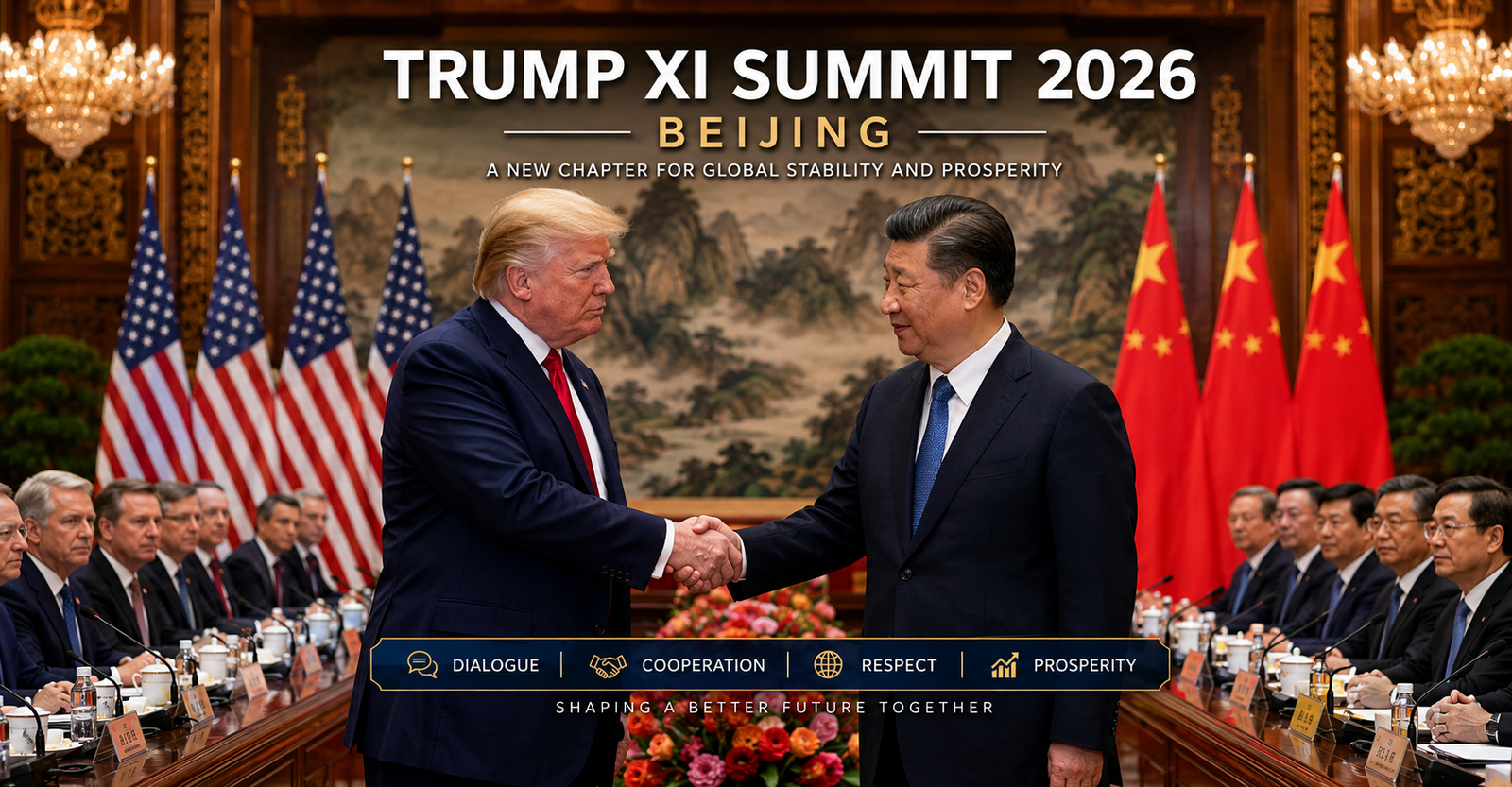
- Trump Xi Summit 2026 highlights China’s firm stance on Taiwan as a red line
- Beijing’s royal welcome signals Xi’s willingness to work with Trump
- U.S. and China explore cooperation to end Iran war and ease tensions
- Tech leaders push for reduced mistrust on chips and tariffs
The Trump Xi Summit 2026 in Beijing marks a pivotal shift in global geopolitics as Xi Jinping draws a red line on Taiwan while offering cooperation to Donald Trump on Iran, trade, and technology, signaling a potential reset in world order.
Trump Gets Royal Welcome with Strategic Intent
Beijing rolled out an extraordinary welcome for U.S. President Donald Trump, underscoring both ceremony and calculation. Chinese President Xi Jinping greeted Trump with a level of protocol often reserved for monarchs—complete with honor guards, choreographed military displays, and cheering crowds of schoolchildren waving American and Chinese flags.
Diplomatic observers described the استقبال as “imperial in tone,” reflecting Beijing’s deliberate effort to elevate the visit beyond routine statecraft. The grandeur served a dual purpose: reinforcing China’s global stature while signaling respect for Trump as a negotiating counterpart.
“The optics matter,” said a senior Asian diplomat. “China wanted to demonstrate strength, confidence, and openness—all at once.”
Trump Xi Summit Beijing Signals Diplomatic Reset Amid Global Tensions
Yet behind the pageantry lay a more complex agenda, one that would define the future of global geopolitics.
Trump Xi Summit 2026 : Taiwan Declared a Non-Negotiable Red Line
Despite the warm reception, Xi wasted no time in delivering a firm and unequivocal message on Taiwan. According to officials briefed on the talks, the Chinese leader made it clear that any U.S. support for Taiwan—military, diplomatic, or symbolic—would be viewed as crossing a red line.
“There was zero ambiguity,” said one insider. “Xi made it absolutely clear that Taiwan is central to China’s sovereignty and not open to negotiation.”
US Attack on Iran Ships Pushes War Into Dangerous Phase, Triggers Global Oil Shock
The warning comes amid growing tensions in the Indo-Pacific and concerns that the ongoing Iran war has stretched U.S. military resources thin. A confidential intelligence assessment circulating in Washington suggests that China is closely studying U.S. military operations while benefiting strategically from America’s engagement in the Middle East.
For Beijing, the Taiwan issue remains the core of its national security doctrine. For Washington, it represents a delicate balancing act between deterrence and escalation.
Cooperation on Iran and Economic Reset
Despite sharp differences on Taiwan, both leaders signaled a willingness to cooperate on pressing global issues—most notably the Iran war. Insiders reveal that Xi has offered to work with Trump to de-escalate the conflict, using China’s diplomatic channels and regional influence.
Futuristic Beijing flaunts its high-tech ambitions to Trump
“Xi is ready to play a constructive role in ending the Iran war,” a senior official said. “There is a shared understanding that prolonged conflict benefits no one.”
At the same time, the summit focused heavily on economic normalization. Years of tariff battles and technology restrictions have strained U.S.-China relations, particularly in the semiconductor sector. Now, both sides appear ready to reduce tensions.
Elon Musk, part of Trump’s delegation, emphasized the importance of collaboration. “The future of innovation depends on cooperation between the U.S. and China,” Musk said. “We need to move beyond confrontation.”
Iran–US War Nears Endgame as Tehran Sends Response via Pakistan, Breakthrough Expected Ahead of Trump’s China Visit
Jensen Huang echoed similar sentiments, warning against technological fragmentation. “AI and advanced computing require global ecosystems,” Huang noted. “Reducing mistrust is essential for progress.”
These remarks highlight a growing consensus among business leaders that economic decoupling could have far-reaching consequences.
Trump Xi Summit 2026: Toward a New World Order
Perhaps the most significant outcome of the summit is the apparent توافق between Trump and Xi to reset the global order. Both leaders acknowledged that the current trajectory of rivalry and mistrust is unsustainable in an increasingly interconnected world.
A confidential U.S. intelligence report suggests that China has gained a strategic edge during the Iran war—expanding its influence through energy diplomacy, military sales, and global messaging. While U.S. officials publicly reject this assessment, the shifting dynamics have added urgency to the Beijing talks.
“On balance, the war has created opportunities for China to expand its global role,” said one expert familiar with the report. “This summit is about managing that shift, not denying it.”
Trump, for his part, struck a conciliatory tone, calling Xi a “great leader” and emphasizing their personal rapport. The two leaders, insiders say, have agreed to pursue a framework aimed at reducing tensions, stabilizing trade, and addressing global conflicts collaboratively.
“This is not just another bilateral meeting,” a senior official observed. “It is the beginning of a new phase in international relations—one where the U.S. and China attempt to coexist as co-managers of global stability.”
Whether this ambitious vision can withstand the pressures of Taiwan, Iran, and technological rivalry remains uncertain. But the message from Beijing is unmistakable: China is ready to engage, provided its core interests are respected.