



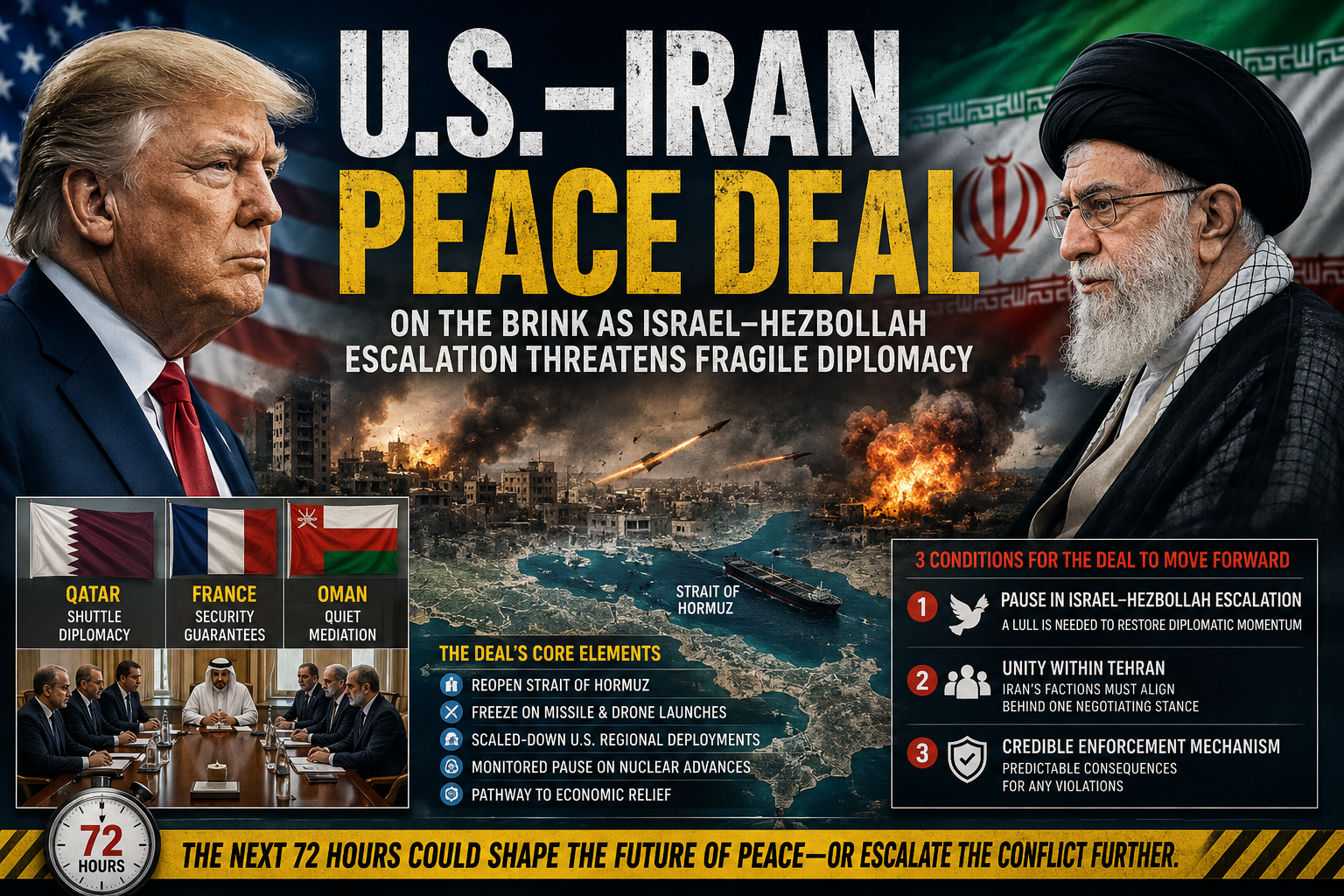
- U.S.–Iran Peace Deal faces serious disruption after Israel–Hezbollah strikes escalate tensions in Beirut
- Iran hardliners stiffen stance, citing lack of U.S. control over regional actors
- Qatar, France, and Oman intensify mediation to prevent collapse of negotiations
- Markets react cautiously as Strait of Hormuz reopening hangs in the balance
The U.S.–Iran peace framework — once described by negotiators as “within arm’s reach” — now sits in a fragile, suspended state. Washington and Tehran have spent the past week signaling cautious optimism, even as both sides publicly hedge their language. The truth is simpler and more uncomfortable: the diplomatic machinery is still moving, but the ground beneath it is shifting faster than the architects can stabilize it.
The deal is not dead. But it is no longer on a straight path.
A Negotiation Interrupted by the Region It Seeks to Calm
The most significant setback came not from Washington or Tehran, but from the region’s two most volatile actors: Israel and Hezbollah. Their latest exchange of strikes — Israel’s targeted hits in Beirut’s southern suburbs and Hezbollah’s retaliatory rocket fire — did more than escalate a familiar front. It directly undercut the diplomatic atmosphere required for a U.S.–Iran agreement to close.
US Iran Talks Bürgenstock Gain Momentum as Pakistan Mediates Breakthrough Deal
Iran’s negotiators immediately seized on the strikes as evidence that the U.S. “cannot guarantee regional restraint,” a phrase that now appears in nearly every Iranian briefing. Hardliners in Tehran, already skeptical of any deal that appears to concede under pressure, have used the Beirut attack to argue that signing now would signal weakness.
As War With U.S. Eases, Iran Steps Up Hangings of Dissidents
The result is a predictable but consequential slowdown: Iran is still at the table, but its posture has stiffened.
Washington, for its part, has been forced into an awkward public position. President Trump criticized the timing of Israel’s strike, calling it “unhelpful,” a rare rebuke that underscores how disruptive the moment truly was. U.S. officials insist the deal remains viable, but privately acknowledge that every new exchange between Israel and Hezbollah resets the diplomatic clock.
The Deal’s Core Remains Intact — For Now
Despite the turbulence, the essential components of the agreement remain unchanged:
- Reopening the Strait of Hormuz to full commercial traffic
- A freeze on Iranian missile launches and drone operations
- A U.S. commitment to scale down certain regional deployments
- A monitored pause on Iran’s nuclear advances
- A framework for future economic relief
None of these elements have been abandoned. But each now carries an asterisk: contingent on regional stability that does not currently exist.
The negotiators know this. The mediators know this. And the markets know this — which is why the Iranian rial strengthened on rumors of progress, only to stall again as the Beirut fallout spread.
The Mediators: Qatar, France, and the Quiet Work of Holding the Center
The countries working to keep the deal alive — primarily Qatar, France, and Oman — now face a more complex assignment than simply bridging U.S.–Iran gaps. They must also insulate the negotiation from the gravitational pull of the Israel–Hezbollah front.
Qatar’s delegation has been shuttling between Tehran and Washington with increasing urgency. Their task is twofold: reassure Iran that the U.S. can deliver on its commitments, and reassure the U.S. that Iran will not use the deal as cover for retaliatory strikes. It is delicate work, and the Beirut attack made it harder.
France, meanwhile, has leaned on its naval presence in the Gulf to reinforce the security guarantees embedded in the deal. Paris is positioning itself as the stabilizing force capable of deterring escalation without provoking it — a role neither Washington nor Tehran can credibly play at this moment.
Oman continues its traditional function: the quiet channel, the backroom stabilizer, the place where both sides can speak plainly without the political theater that accompanies public statements.
These mediators are not just facilitating talks. They are holding the architecture together while the region tests every joint and seam.
The Work Ahead: A Deal That Must Survive the Environment It Seeks to Change
For the peace framework to move forward, three conditions must be met:
- A freeze in Israel–Hezbollah escalationNot a ceasefire, not a breakthrough — simply a pause long enough for negotiators to regain momentum.
- A unified message from TehranIran’s internal factions must align behind a single negotiating posture. Mixed signals are slowing progress more than any U.S. hesitation.
- A credible enforcement mechanismBoth sides need assurance that violations — whether missile launches or crossborder strikes — will trigger predictable consequences. Without this, the deal is a political liability for everyone involved.
The U.S.–Iran peace effort is not failing. It is being tested. And the test is not whether Washington and Tehran can agree on terms — they largely have — but whether the region will allow the agreement to function long enough to matter.
Right now, the negotiators are still in motion, the mediators are still engaged, and the framework is still intact. But the window is narrowing, and every new strike in Beirut or the Golan Heights tightens it further.
The next 72 hours will not decide the fate of the deal. But they will determine whether the process continues on a knife’s edge — or collapses under the weight of the very conflict it is designed to end.