



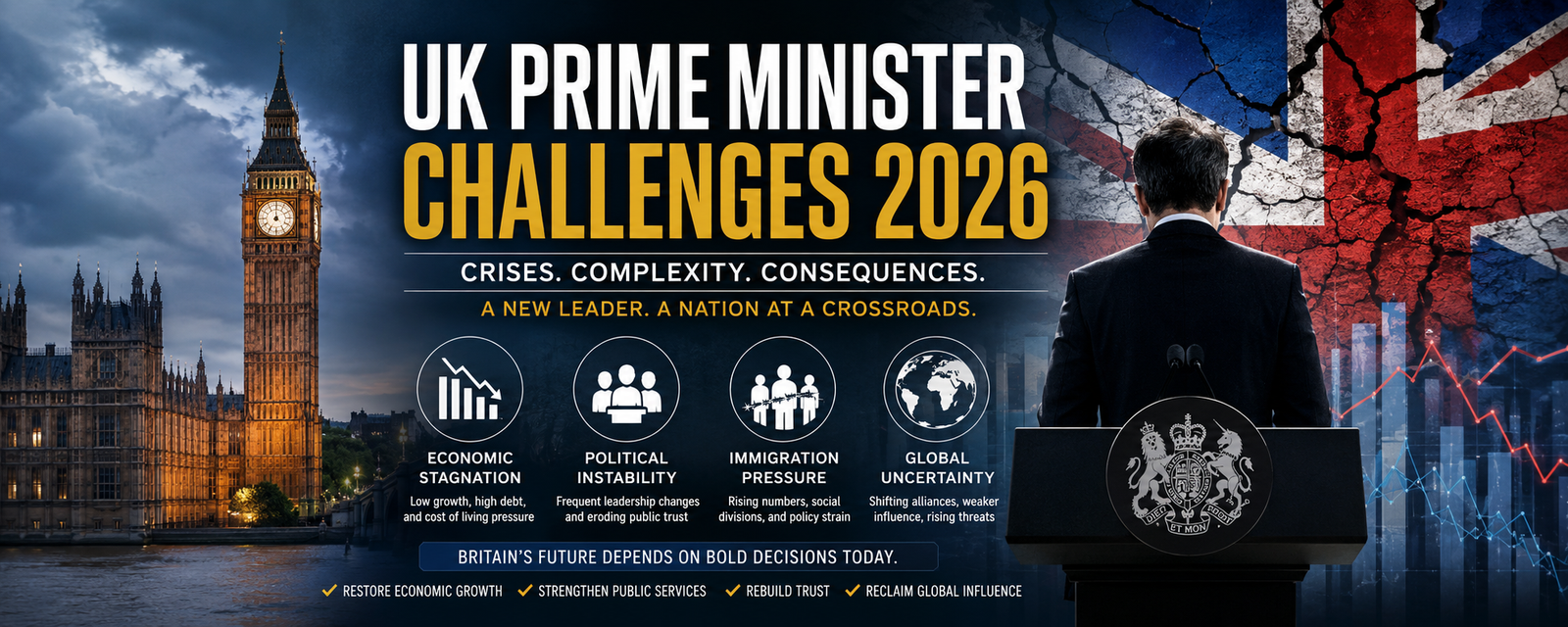
- UK prime minister challenges 2026 include rising debt, weak growth, and public service strain threatening long-term economic stability.
- Political instability and frequent leadership changes continue to weaken Britain’s governance and public trust in institutions.
- Immigration pressure, Brexit aftershocks, and social divisions are fueling domestic political tensions and electoral volatility.
- Britain’s global influence is declining as domestic crises limit its role in NATO, EU relations, and US–China geopolitical competition.
The United Kingdom is once again entering a period of political transition, with Keir Starmer stepping down after a turbulent and short-lived premiership. His resignation marks yet another chapter in Britain’s accelerating cycle of political instability. As Andy Burnham emerges as the frontrunner to enter 10 Downing Street, expectations are rising—but so are the burdens of leadership.
The country that once prided itself on steady governance is now grappling with rapid leadership turnover, economic stagnation, and a shifting global role. Whoever becomes the next prime minister will not merely inherit a government—they will inherit a state of structural stress.
The Burden of Leadership – Challenges Facing the Next UK Prime Minister
The incoming British prime minister will confront one of the most complex domestic and international environments in decades. The UK remains the world’s fifth-largest economy, yet its internal pressures increasingly contradict its global ambitions.
Domestic Economic Strain
At home, the most immediate challenge is economic fragility. Growth remains sluggish, productivity is weak, and public services are overstretched. The National Health Service continues to struggle with long waiting lists, while inflationary shocks from recent global crises have left households squeezed by a prolonged cost-of-living crisis.
Real wages have stagnated for years, and public trust in economic management is eroding. The next government will be forced to confront a difficult fiscal reality: high debt levels, limited borrowing space, and rising demand for welfare and healthcare spending.
To steer the economy forward, a new prime minister will need a credible growth strategy built on:
- Large-scale infrastructure investment
- Industrial policy focused on green energy and technology
- Reform of public sector efficiency
- A long-term skills and productivity agenda
Without structural reform, Britain risks drifting into what economists describe as “low-growth equilibrium,” where short-term fixes replace long-term transformation.
READ MORE:BREAKING: UK Prime Minister Keir Starmer Announces Resignation, Triggering Fresh Political Crisis
Immigration and Social Tensions
Immigration remains another politically sensitive fault line. Record arrivals in recent years have fueled public frustration, empowering populist movements and reshaping the national debate. The challenge is not only numerical but political—balancing economic dependence on migrant labour with public concerns over integration and infrastructure pressure.
Foreign Policy and Strategic Overload
Internationally, the UK is operating in a more volatile geopolitical environment. The post-war transatlantic order is shifting. The United States is gradually reducing its security guarantees for Europe, while tensions between Washington and Beijing are reshaping global trade.
The UK’s commitments to Ukraine, NATO, and Indo-Pacific partnerships demand sustained defence spending at a time when fiscal constraints are tightening. Strategic priorities include:
- Rebuilding European defence cooperation post-Brexit
- Maintaining credibility within NATO amid US unpredictability
- Managing economic exposure to US–China rivalry
- Strengthening cybersecurity and hybrid threat response
A successful prime minister will need to redefine Britain’s global role not as a dominant power, but as a “strategic middle power” capable of coalition-building.
Britain’s next prime minister faces deep foreign policy challenges – whether Burnham or another
UK Prime Minister Challenges 2026: Why British Prime Ministers Keep Falling – The Anatomy of Political Collapse
The UK’s recent history shows a clear pattern: prime ministers are increasingly removed not by elections alone, but by internal party revolt, economic shocks, and collapsing public trust.
1. Brexit Aftershocks
The most significant destabilising force remains Brexit. While politically settled, its economic consequences—reduced trade friction with Europe, regulatory divergence, and investment uncertainty—continue to weigh heavily on growth.
David Cameron resigned after the referendum defeat. Theresa May fell after her withdrawal agreement failed to pass Parliament repeatedly, exposing deep Conservative Party divisions.
2. Party Fragmentation and Internal Revolts
Modern British politics is marked by weakened party discipline. Leaders no longer command stable parliamentary majorities within their own parties.
- Boris Johnson was forced out after ethics scandals and mass cabinet resignations
- Liz Truss collapsed within weeks after a market crisis triggered by her fiscal agenda
- Rishi Sunak failed to rebuild Conservative unity amid declining public support
- Keir Starmer resigned amid internal Labour fragmentation and electoral backlash
Leadership survival now depends less on national elections and more on internal party stability—something increasingly absent in both major parties.
3. Economic Mismanagement and Public Backlash
Each recent resignation has also been tied to economic failure or perceived incompetence:
- Cost-of-living crisis under successive governments
- Rising tax burden and weak wage growth
- NHS crisis and public service deterioration
- Market instability during unfunded fiscal experiments
In Britain’s current political climate, economic dissatisfaction translates quickly into leadership instability.
4. Rise of Populist Pressure
The emergence of parties like Reform UK has further destabilised the system. Traditional Labour-Conservative dominance is eroding, producing fragmented vote shares and unstable mandates.
Prime ministers now govern in a climate where even minor shifts in public opinion can trigger leadership crises.
UK Prime Ministers Over the Last Decade
The last ten years have seen unprecedented turnover in British leadership, reflecting deep institutional instability.
David Cameron (2010–2016)
Resigned after the Brexit referendum, which he had called and lost.
Theresa May (2016–2019)
Struggled to implement Brexit; her withdrawal deal was repeatedly rejected by Parliament, forcing her resignation.
Boris Johnson (2019–2022)
Delivered Brexit but was forced out after a series of political scandals and cabinet resignations.
Liz Truss (2022)
Served just 49 days after her mini-budget triggered market turmoil and a collapse in financial confidence.
Rishi Sunak (2022–2024)
Attempted stabilization but failed to reverse declining Conservative popularity and economic stagnation.
Keir Starmer (2024–2026)
Elected on a promise of stability and reform but resigned amid internal party pressure and weak economic delivery.
This sequence reflects a broader transformation: Britain has shifted from predictable two-party governance to a cycle of rapid leadership turnover and political volatility.
Britain’s Global Standing – A Power Under Strain
Despite remaining the world’s fifth-largest economy, the United Kingdom’s global influence is increasingly constrained by domestic instability.
Eroding Political Credibility
Frequent leadership changes have weakened Britain’s international reliability. Allies in Washington, Brussels, and beyond increasingly view the UK as a reactive rather than strategic actor.
Diplomatic consistency—once a hallmark of British foreign policy—has been undermined by shifting priorities, leadership turnover, and internal political distraction.
Economic Competitiveness Under Pressure
Britain still retains strong financial services, global universities, and technological hubs. However, weak productivity growth and chronic underinvestment are eroding long-term competitiveness.
Foreign investors have become more cautious due to:
- Policy unpredictability
- Fiscal instability concerns
- Post-Brexit regulatory uncertainty
Declining Strategic Weight
Although Britain remains a key NATO and G7 member, its ability to shape global outcomes is increasingly dependent on alliances rather than independent influence.
The US–China rivalry, European defence restructuring, and global supply chain fragmentation require sustained strategic engagement—something domestic political turbulence has made harder to deliver.
A Power in Transition
The central reality is stark: Britain is no longer declining, but it is also no longer ascending. It is managing relative status in a more competitive world.
Domestic instability has become the primary constraint on global ambition. Without political continuity and economic renewal, Britain risks further erosion of its influence in an increasingly multipolar world.
A Leadership Moment Defined by Limits
The next British prime minister will inherit a country at a crossroads—economically constrained, politically fragmented, and strategically overstretched. The challenge is no longer simply governance, but restoration of confidence: in politics, in institutions, and in Britain’s role in the world.
Whether Andy Burnham or another figure ultimately takes office, the real test will not be winning power—but sustaining it long enough to reverse a decade of instability.