



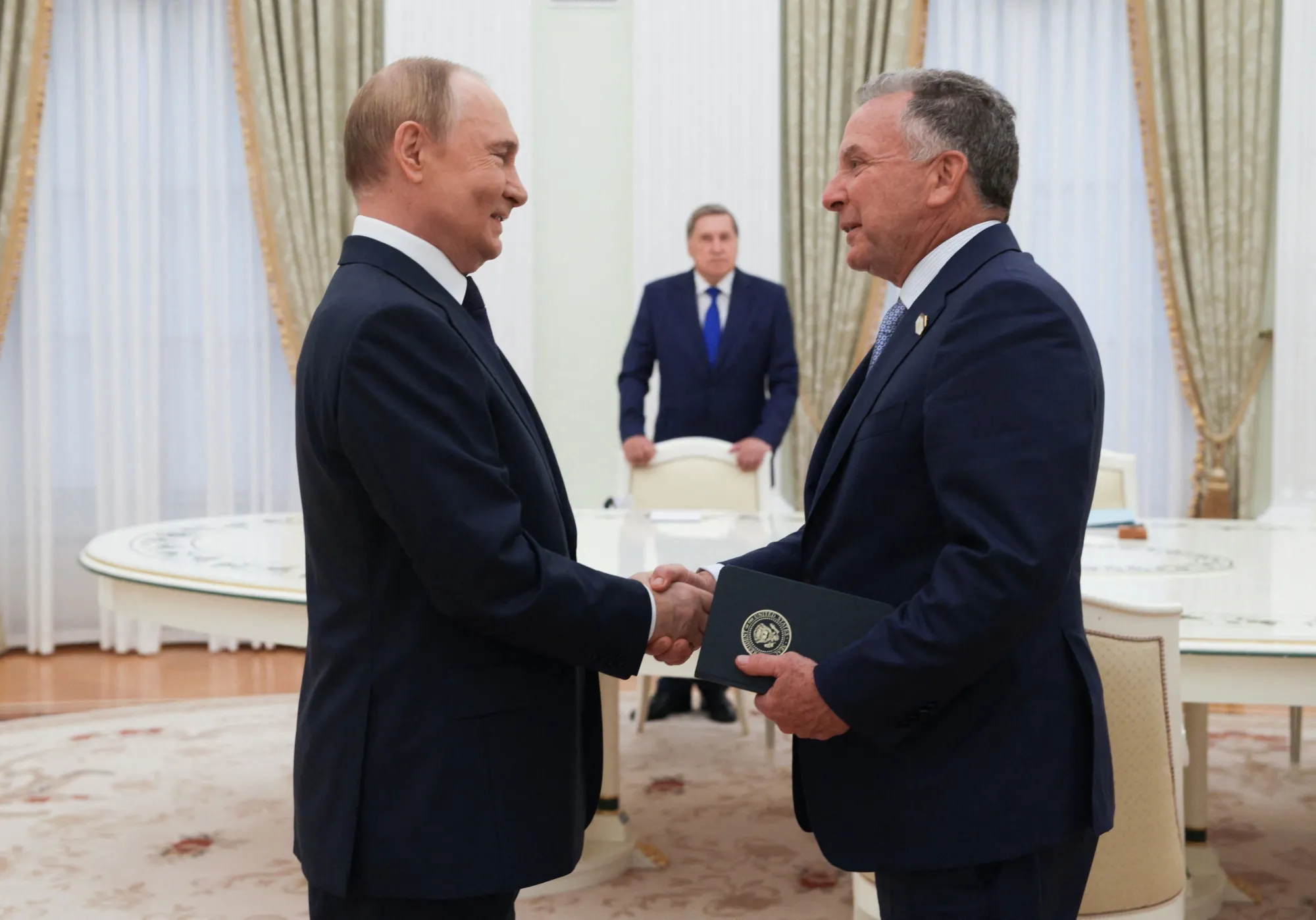
- Trump’s envoys Steve Witkoff and Jared Kushner meet Putin for breakthrough discussions on the Ukraine peace talks, triggering geopolitical tremors across Europe.
- Leaked U.S. draft proposals alarm Kyiv and EU states, appearing to concede NATO neutrality, territorial losses, and military limitations.
- Putin accuses Europe of sabotaging the peace process and warns of catastrophic consequences if EU states challenge Russia militarily.
- A new U.S.–Ukraine peace framework promises security guarantees, setting up a power contest between Washington, Europe, and Moscow over the war’s endgame.
Russian President Vladimir Putin’s meeting on Tuesday with U.S. President Donald Trump’s special envoy Steve Witkoff and adviser Jared Kushner marked one of the most consequential diplomatic engagements since the Ukraine war began in 2022.
Held inside the Kremlin’s inner chambers—and preceded by Putin’s threatening warning to Europe—the talks signal a dramatic realignment of peace efforts, one that sidelines traditional European stakeholders while empowering a Washington-Moscow channel long criticized as opaque but undeniably impactful.
For the Trump administration, which has insisted since Day One that it will “end the war,” this meeting represents Washington’s boldest attempt yet to re-engineer the geopolitical direction of Europe’s most devastating conflict since World War II.
For Moscow, it is a chance to lock in strategic gains and test Western unity. For Europe, it is a political earthquake.
Europe Alarmed as U.S. Draft Peace Plan Leaks
The talks followed a leak of 28 U.S. draft peace proposals that stunned Kyiv and infuriated several European capitals. The document, according to Ukrainian and EU officials, conceded far too much to Moscow—NATO neutrality for Ukraine, acceptance of Russian control over nearly a fifth of Ukrainian territory, and restrictions on Ukraine’s armed forces.
READ MORE: Zelensky Stresses Sovereignty as U.S. Pursues Peace Talks With Russia
While Washington later termed the leak “premature,” the political damage had already been done. European diplomats quickly crafted an alternative “counter-proposal,” hoping to limit Trump’s concessions to Russia and preserve Europe’s security architecture. But before this counter-offer could gain traction, Putin publicly dismissed it as “absolutely unacceptable,” accusing Europe of attempting to sabotage any meaningful peace process.
“They are on the side of war,” Putin declared hours before sitting down with Witkoff and Kushner. The Russian leader also issued a chilling warning: if Europe “wants a war with us,” the conflict would end so fast “there would be no one left to negotiate with.”
It was a direct message to Brussels: step aside, the adults are talking.
Ukraine peace talks: Trump’s Envoys Receive Unusually Warm Welcome
Inside the Kremlin, Putin’s tone shifted dramatically. Greeting Witkoff and Kushner, he emphasized his openness to negotiating with Washington’s envoys. The visuals alone—Witkoff and Kushner strolling through Red Square with Kirill Dmitriev, Putin’s trusted economic fixer—spoke volumes. This was not routine diplomacy; it was a choreographed signal of Kremlin approval.
ALSO READ: U.S. Asylum Crisis: Trump Halts Afghan Visas and Freezes Refugee Decisions
Putin even called the emerging framework “a basis for future agreements,” though he stressed no draft treaty yet exists. A senior Russian official later described Trump’s backchannel as “the best chance for peace since talks collapsed in 2022.”
But the question haunting Kyiv is simple: peace for whom?
Ukraine Fears Talks Behind Its Back
President Volodymyr Zelenskiy, speaking from Dublin, did not hide his apprehension. “There will be no easy solutions,” he warned, insisting that “no games” should be played without Ukraine’s involvement.
Kyiv is deeply troubled. Putin’s conditions include:
-
Permanent withdrawal of Ukraine’s request to join NATO.
-
Capping Ukraine’s military size and missile capabilities.
-
Russian sovereignty over Crimea, Donbas, Kherson, and Zaporizhzhia.
-
Formal protection for Russian-speaking populations.
Ukraine calls these terms “capitulation,” arguing they would only reward aggression and enable future Russian expansion.
European powers agree. They fear a U.S.-Russia deal that trades Ukrainian sovereignty for American access to Russian energy, rare earth minerals, and a possible re-entry of Moscow into the G8—a geopolitical victory for the Kremlin.
Russia Has Advanced—but Not Enough to Win
On the battlefield, Russian troops now control more than 19% of Ukraine—115,600 square kilometers—only a slight increase from two years ago. But 2025 has seen the fastest Russian momentum since the early months of the war. Putin recently hailed the “capture” of Pokrovsk, although Ukrainian forces insist they still hold parts of the city.
Despite marginal gains, Russia has failed in its primary objective: conquering or collapsing Ukraine. The war has cost both sides enormous casualties—U.S. officials estimate over 1.2 million killed or wounded—and caused severe economic and infrastructural damage.
Meanwhile, Putin is threatening new escalation, including cutting Ukraine off from the sea after drone strikes on Russia’s “shadow fleet” in the Black Sea. Ukraine’s foreign minister called Putin’s warning “proof he is not ready for peace.”
A Diplomatic Endgame: Who Will Shape It?
Washington’s newly refined peace framework—drafted jointly with Kyiv—adds security guarantees for Ukraine, including a possible 10-year U.S. defense commitment. But Moscow views such a guarantee as a disguised NATO presence.
Europe, fearing strategic irrelevance, wants its own role. Kyiv wants safeguards against betrayal. Washington wants the war ended on terms it can sell politically. And Moscow wants recognition of territorial gains and a permanently weakened Ukraine.
The next 60–90 days may determine which vision prevails.
What Happens Next? A Strategic Outlook
-
U.S.-Russia backchannel diplomacy will accelerate. Trump wants a foreign policy victory; Putin wants sanctions relief and Western investment.
-
Europe will harden its stance. Expect France, Germany, and Poland to push for deeper Ukrainian military support. Brussels will resist any peace terms that alter Europe’s security landscape without EU consent.
-
Ukraine may face pressure to compromise. With manpower shortages and critical energy infrastructure under attack, Kyiv risks entering negotiations from a position of weakness.
-
Pakistan, Turkey, and Gulf states will monitor closely. Any shift in Russia’s global economic re-entry affects energy markets, arms deals, and regional alliances—especially in the Middle East and South Asia.
A Peace That Redraws the Map
Trump’s envoys have revived diplomacy that could end the war—or reshape Europe in ways unseen since the Cold War. But peace built on unequal terms rarely holds. The world now watches Moscow, where geopolitical ambitions, domestic politics, and power rivalries converge.
For Ukraine, Europe, and the wider world, the stakes could not be higher.