



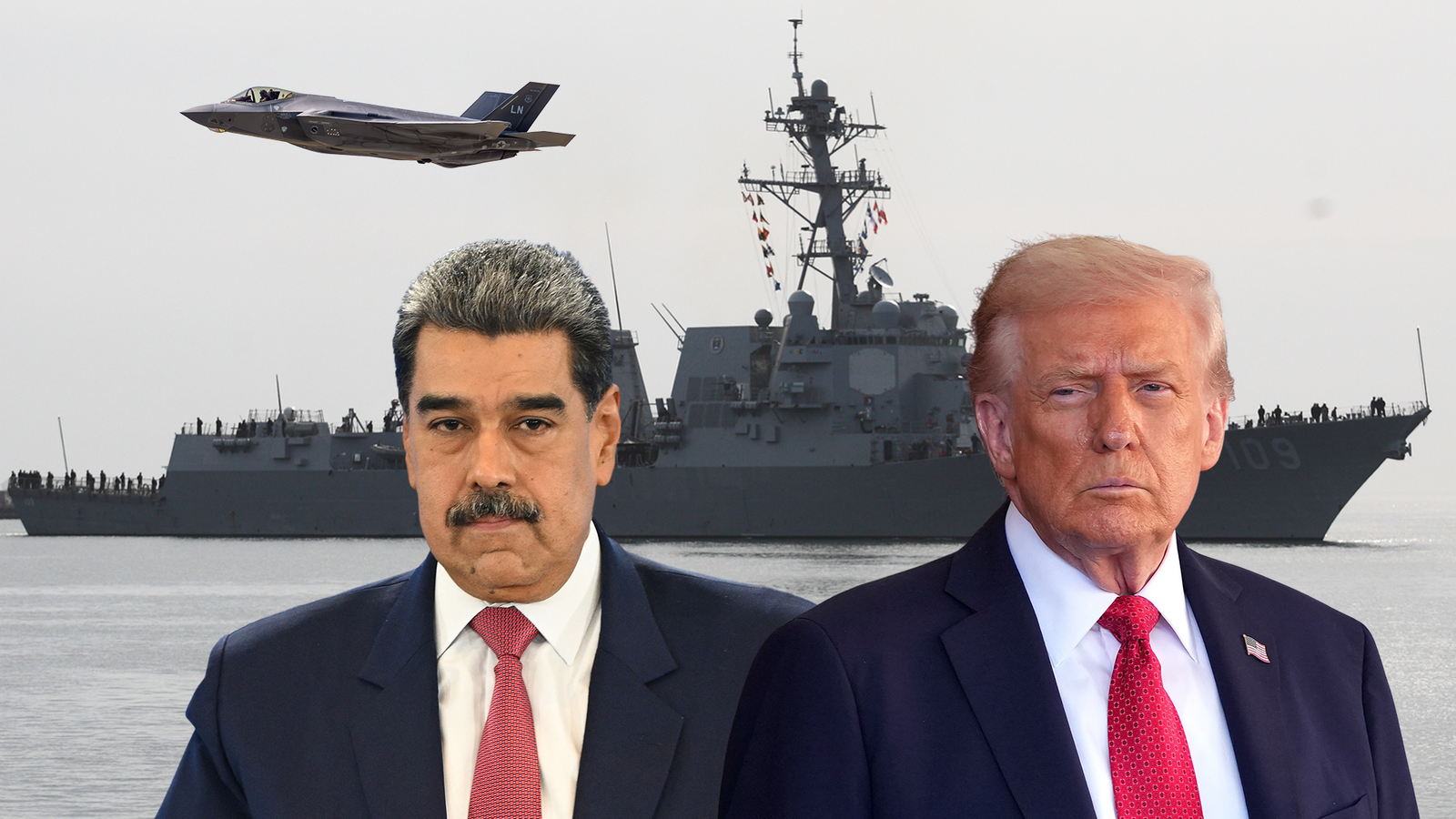
- Venezuela Crisis 2025: U.S. President Trump orders a total blockade of sanctioned oil tankers, targeting the country’s primary source of revenue.
- Venezuela Crisis 2025: Military buildup in the Caribbean includes warships, F-35 jets, electronic warfare aircraft, and aerial refueling tankers.
- Venezuela Crisis 2025: Inflation and shortages intensify as maritime and air traffic disruptions cripple the economy, impacting ordinary citizens.
- Venezuela Crisis 2025: Global powers such as Russia and China monitor the standoff silently, weighing potential geopolitical and energy market consequences.
The situation in Venezuela has reached unprecedented levels of tension as U.S. President Donald Trump escalates his campaign against President Nicolás Maduro. On December 12, 2025, U.S. warships had effectively imposed a near-total siege on Venezuela, even tracking the movement of birds across its airspace—an extraordinary measure not seen in decades of American military history, including Iraq, Vietnam, or Afghanistan.
Trump’s latest directive orders a “total and complete blockade of all sanctioned oil tankers” entering and leaving Venezuela, directly targeting the country’s primary source of revenue.
U.S. Pressure on Venezuela Intensifies: Targeting Maduro’s Family and Oil Empire
While the exact enforcement mechanisms remain unclear, reports indicate the U.S. may deploy Coast Guard vessels alongside nearly a dozen warships, including the aircraft carrier USS Gerald R. Ford, to implement the blockade. Oil prices immediately reacted, with Brent crude rising 1.2% and U.S. West Texas Intermediate up 1.3% in early Asian trading, reflecting global market anxiety over potential reductions in Venezuelan exports.
READ MORE: Trump Venezuela Patience: Why the U.S. President Is Holding Fire on Maduro
The siege is not purely military. The Trump administration has designated Venezuela’s Cartel de los Soles, which includes Maduro and senior officials, as a foreign terrorist organization. U.S. land strikes, cyberattacks on state oil company PDVSA, and a significant military buildup in the Caribbean—including F-35A stealth jets, EA-18G Growler electronic warfare aircraft, HH-60W rescue helicopters, and aerial refueling tankers—signal a comprehensive pressure campaign designed to weaken Maduro’s government both economically and militarily.
ALSO READ: Trump orders ‘blockade’ of sanctioned oil tankers leaving, entering Venezuela
Inside Venezuela, the effects are being felt immediately. Inflation is surging, essential goods are scarce, and port and airport operations are nearly paralyzed. Over 80% of flights have been canceled, and maritime traffic has come to a virtual standstill, leaving local authorities scrambling to maintain control. Venezuelan Defense Minister Vladimir Padrino vowed that the country is prepared to resist, stating, “You’re not going to intimidate us,” but analysts warn that the combined economic, military, and psychological pressure could soon overwhelm the Maduro regime.
Internationally, major powers are watching cautiously. Russia and China, both key allies and trade partners of Venezuela, have so far avoided direct confrontation, though China continues to import substantial Venezuelan crude, averaging over 600,000 barrels per day. Moscow and Beijing’s silent stance reflects both their strategic calculations and concern over a potential U.S.-led escalation in the Western Hemisphere, which could destabilize regional energy markets and political alliances.
The blockade and military buildup mark a shift in U.S. strategy. While a full-scale invasion appears unlikely, precision airstrikes, electronic warfare, and covert CIA operations remain viable options. Analysts suggest that the next phase could include targeted attacks on Venezuelan air defenses, command centers, and critical infrastructure, combined with efforts to enforce the oil embargo physically or through a de facto maritime blockade.
The domestic political landscape in Venezuela further complicates matters. Opposition leader María Corina Machado, recently awarded the Nobel Prize, is reportedly planning to return and challenge Maduro directly, heightening the internal stakes. Should Maduro falter under U.S. pressure, the country risks not only leadership collapse but a broader regional crisis that could affect Colombia, Cuba, and other neighboring states.
Experts warn that prolonged pressure could trigger massive migration, economic collapse, and inflation spiraling to unprecedented levels. David Goldwyn, former U.S. State Department energy diplomat, told analysts that a sustained blockade could push oil prices up by $5–$8 per barrel while triggering immediate humanitarian crises.
Trump’s aggressive and multifaceted approach—combining military, economic, and covert pressure—underscores a new era of U.S. foreign policy in Latin America. Venezuela is now at the center of a high-stakes geopolitical standoff where regional stability, global energy markets, and international law hang in the balance. The coming weeks may determine whether Maduro survives, whether opposition forces regain momentum, and whether the Caribbean region faces the ripple effects of a U.S.-led siege.