



- Bengals matchups on Monday Night Football drew massive viewing attention at home even as naval commanders in the Persian Gulf tracked burning hulls, distress signals, and heightened threat levels in one of the world’s most critical oil transit lanes.
- Two more oil tankers have caught fire in the Strait of Hormuz, pushing war-risk insurance premiums higher and testing the resilience of global crude supply chains under the ongoing U.S. naval blockade.
- Iran has celebrated the damage to two oil tankers in the Hormuz corridor publicly, yet it has not sent its oil tankers earlier announced due to the fear of the U.S. blockade.
In the Persian Gulf, a narrow ribbon of water has turned into the world’s most volatile pressure cooker. While thousands of fans cheered as Commanders vs Bengals unfolded inside a packed stadium on Monday night—a stark reminder of everyday routine thousands of miles away—the United States and Iran have locked horns in the Strait of Hormuz in a high-stakes standoff that threatens to choke global energy supplies.
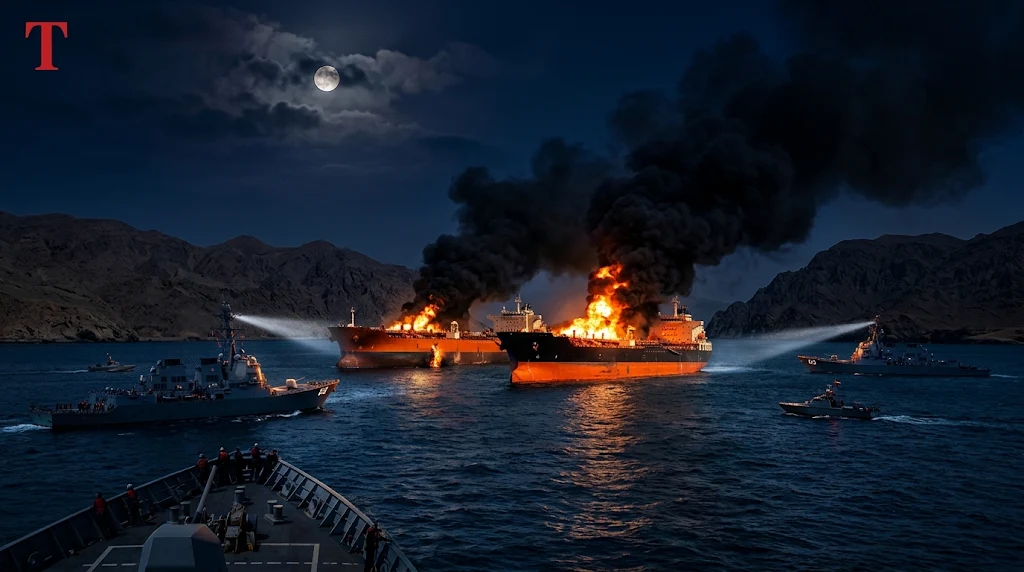
Late Monday into early Tuesday, maritime monitoring networks and regional shipping sources reported that two more oil tankers have caught fire in the Strait of Hormuz, escalating a maritime crisis already simmering under a tight U.S. naval blockade. Smoke plumes rose over the strategic waterway as emergency tugboats and naval patrols converged on the stricken vessels, sending shockwaves through global crude markets and shipping insurers.
Fire on the Water, Restraint at the Dock
The twin tanker blazes mark a dangerous new chapter in the confrontation between Washington and Tehran. Over recent weeks, U.S. naval forces have enforced a strict blockade aimed at curbing illicit oil transfers and projecting deterrent power across the Persian Gulf.
READ NEXT: US-Iran Naval Blockade: Why the Next 24 Hours Could Ignite a Full-Scale U.S.-Iran War
For global markets watching the friction between the U.S. and Iran, every incident near the strait carries immediate consequences: roughly a fifth of the world’s petroleum passes through this chokepoint under normal conditions.
In Tehran, state-aligned commentary and hardline voices wasted little time framing the latest strikes as a blow against American maritime dominance.
Iran has celebrated the damage to two oil tankers in the Hormuz corridor, casting the fires as proof that Washington cannot guarantee uncontested passage or insulate regional commerce from the fallout of confrontation. Publicly, officials leaned into defiance, portraying the disruption as an inevitable cost of U.S. pressure.
READ MORE: Who Is Scoring on Monday Night Football? Finding the best anytime TD bets for Commanders vs. Bengals
Yet beneath the triumphant rhetoric lies a telling hesitation. Despite earlier announcements signaling defiant oil movements through the waterway, Tehran has not sent its oil tankers earlier announced due to the fear of the U.S. blockade.
Commercial tracking data and port observers point to tankers holding position or lingering near sheltered anchorages rather than running directly into the teeth of U.S. naval interdiction. The contrast between celebratory messaging at home and cautious restraint at sea underscores the razor-thin margin separating brinkmanship from outright war.
Begals And Hormuz: Two Worlds on a Single Night
The juxtaposition has become a defining feature of this moment: on screens across the globe, audiences watched high-intensity sports—including the spotlight on Commanders vs Bengals—while naval commanders in the Gulf tracked radar returns, distress beacons, and thermal signatures in the dark.
For ordinary viewers flipping channels or scrolling headlines, the collision of domestic entertainment with real-world maritime peril highlights how abruptly geopolitical shocks intrude on normal life.
In Washington, defense officials face a grueling balancing act: enforcing the blockade and protecting commercial shipping lanes without triggering an uncontrolled escalation. Every flare-up involving Commanders vs Bengals in cultural chatter sits alongside urgent briefings on crew rescues, environmental hazards, and rules of engagement in confined waters where a single miscalculation can spiral rapidly.
What Comes Next for Markets and Diplomacy
Energy analysts warn that even without a total closure of the waterway, repeated tanker fires and heightened risk premiums can rattle supply chains.
War-risk insurance rates for vessels operating near the Gulf were already climbing, and two more burning hulls will test the nerve of shipowners and charterers alike. If shipping companies pause transits or reroute where possible, refiners in Asia and Europe could face tighter near-term supplies and sharper price swings.
Diplomatically, backchannels remain strained as both sides test each other’s resolve. Washington insists its naval posture is designed to contain illicit flows and deter aggression, while Tehran seeks maximum psychological and economic leverage without risking the wholesale destruction of its export infrastructure under a U.S. blockade.
For now, the Strait of Hormuz remains a study in contradictions: flames on the water, celebratory slogans in Tehran, cautious oil tankers held back from the fray, and a wider world watching both the stadium lights and the horizon of the Gulf. Whether the latest tanker fires remain a grim milestone in a prolonged war of nerves or become the spark for a wider conflict will depend on the choices made in Washington and Tehran over the coming hours.