



- Economic Statecraft as Leverage: China utilizes the massive scale of the CIIE to turn commercial access into geopolitical influence, creating long-term stakeholders among foreign businesses and nations.
- Global South Diplomacy: By expanding free exhibition spaces for developing economies, Beijing projects soft power and fosters deep economic alignment across emerging regions.
- Structural Integration: Permanent trading platforms and localized manufacturing hubs ensure that foreign corporations entrench their supply chains within China’s domestic ecosystem.
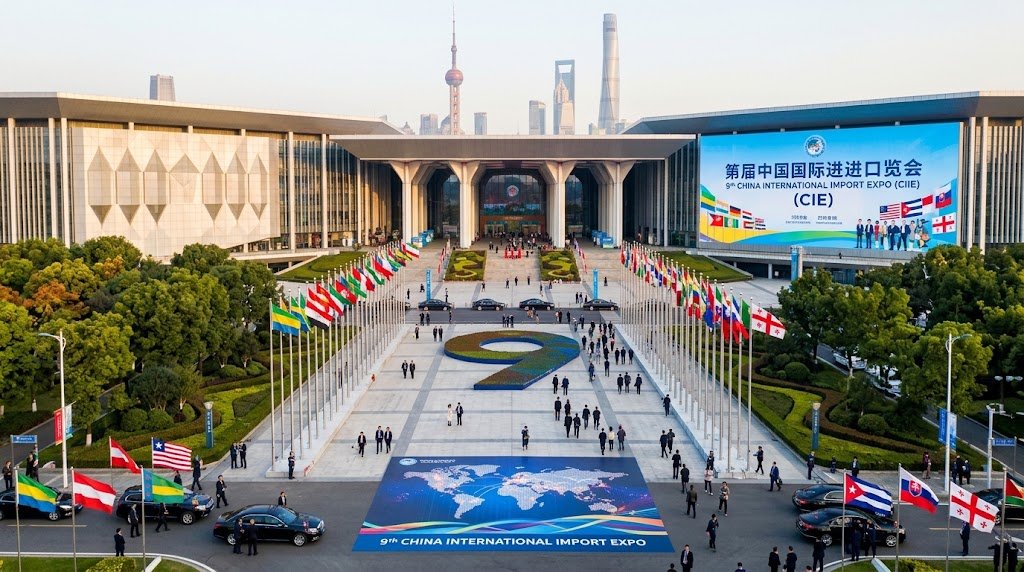
As the bustling metropolis of Shanghai prepares to open its doors for the 9th China International Import Expo (CIIE), the global spotlight is once again drawn to the intersection of commerce and geopolitics. Running from November 5 to 10, the massive trade convergence brings together thousands of exhibitors and a high-profile delegation of international leaders, including Gabonese President Brice Clotaire Oligui Nguema, Austrian Chancellor Christian Stocker, and Liberian Vice President Jeremiah Kpan Koung.
While officially framed as a celebration of free trade and multilateral cooperation, mega-exhibitions like the CIIE serve a much deeper strategic purpose. By weaponizing market access, manufacturing dominance, and production ecosystems, Beijing has turned commercial diplomacy into an effective instrument of geopolitical leverage, solidifying its central role in shaping the modern global order.
The Architecture of Commercial Attraction
Launched in 2018 as the world’s premier national-level exposition dedicated exclusively to imports, the CIIE was conceived to counter protectionist narratives and project an image of an open, welcoming Chinese market. The sheer scale of the event is staggering. This year’s exhibition spans an unprecedented area exceeding 440,000 square meters, drawing over 4,142 overseas exhibitors from 148 countries and regions.
Pakistan Shuts Airspace to Taiwan Airlines, Reinforcing Absolute Support for One-China Policy
For foreign leaders and multinational corporations alike, the temptation of access to China’s vast consumer and industrial base is difficult to resist. Even as geopolitical tensions simmer between Beijing and various Western capitals, corporate giants from the United States, Germany, Britain, and France continue to command the largest exhibition footprints.
READ MORE: Multinationals gear up for ninth edition of CIIE
By keeping the commercial gates wide open, China creates powerful economic stakeholders within foreign nations—businesses and industries that lobby their respective governments to maintain stable, cooperative diplomatic relations with Beijing.
Cultivating Global South Solidarity
Beyond courting Western capital, Beijing utilizes the CIIE to systematically expand its diplomatic footprint across the Global South. Recognizing the economic vulnerabilities of developing nations, the expo has systematically amplified support for the world’s least developed countries, expanding free exhibition spaces to incorporate diverse enterprises—from Myanmar’s community beekeepers to Tanzanian seaweed exporters.
This inclusive approach is a masterclass in soft power. By offering developing economies direct pathways into robust trade channels without the bureaucratic hurdles often imposed by Western financial institutions, China positions itself as an indispensable champion of equitable globalization.
READ NEXT: China’s Satellite Shadow Over Iran War Puts Trump-Xi Summit Under Pressure
When leaders from Africa, Latin America, and emerging Asia walk the red carpets in Shanghai, they are greeted not merely as trade partners, but as honored participants in a Sinocentric economic network designed to foster long-term dependency and mutual alignment.
Moving Beyond Trade: Industrial Integration as Leverage
What separates the CIIE from a traditional trade fair is its structural longevity. Beijing understands that true geopolitical leverage extends far beyond a six-day exhibition window. Through year-round trading platforms established by local municipal governments and specialized customs fast-tracks, temporary exhibitors are routinely incentivized to transition into permanent manufacturing and innovation hubs.
Global industrial leaders—such as German intralogistics firm Jungheinrich—have increasingly integrated their supply chains directly into China, turning local plants into export bases serving dozens of international territories. When foreign corporations embed their research, development, and manufacturing deep within Chinese borders, they effectively anchor their corporate futures to China’s economic ecosystem. This deep industrial entanglement binds foreign economic interests to Chinese policy trajectories, making economic decoupling an increasingly unviable option for major global players.
Shaping the Narrative of Global Governance
The geopolitical dimensions of the CIIE are further amplified by the concurrent high-level forums and policy rollouts that accompany the event. Events like the Hongqiao International Economic Forum do more than discuss commerce; they provide a stage for Beijing to project its vision for global governance, technological standards, and multilateral trade reform.
The unveiling of influential policy metrics—such as the World Openness Report and capacity development frameworks—allows China to set the intellectual and regulatory agenda for emerging markets. By aligning foreign state visitors with its domestic development roadmaps, such as the strategic priorities outlined in the 15th Five-Year Plan (2026–2030), Beijing ensures that foreign commercial strategies synchronize smoothly with its own long-term geopolitical ambitions.
CIIE-to-Pakistan Interlinking: Economic Statecraft and CPEC Developments
The China International Import Expo (CIIE) functions not merely as a commercial showcase, but as a critical instrument of China’s broader economic statecraft—anchoring partner economies into Beijing’s trade and manufacturing orbit. Within this framework, direct logical links can be drawn to ongoing developments under the China-Pakistan Economic Corridor (CPEC).
As CPEC transitions into its advanced phases (focusing on industrial cooperation, green energy, and regional connectivity), platforms like the CIIE provide Pakistan with vital export conduits to integrate local industries into Chinese supply chains. By utilizing Beijing’s economic statecraft mechanisms, Pakistani enterprises can leverage the CIIE to translate infrastructure investments into tangible, export-led growth, directly aligning national economic stabilization with the evolving multi-sectoral goals of CPEC.
CIIE-to-US/China Strategic Stability: Western Corporate Presence and the Trump-Xi Summits
The high-profile participation of Western and multinational corporations at the CIIE serves as a commercial barometer for broader geopolitical currents, providing a direct lens into the dynamics of US-China strategic stability. This corporate hedging and ongoing engagement must be anchored to the diplomatic outcomes of the high-level Trump-Xi summits (including the engagements in Beijing and Washington).
Even as strategic competition persists across technology, trade, and security domains, robust Western attendance at premier Chinese state platforms like the CIIE demonstrates how commercial actors navigate great-power rivalry. It highlights a pragmatic decoupling boundary: while governments grapple with strategic stability and regulatory guardrails, multinational capital continues to seek pragmatic alignment, utilizing trade events to signal continuity amid shifting diplomatic weather vanes.
Economic Statecraft: Final Word
As world leaders gather under the dazzling lights of Shanghai’s exhibition centers, the 9th CIIE highlights a sophisticated reality of 21st-century statecraft: economic production and market gravity are among the most potent instruments of national influence. By framing commercial enterprise as an “international public good”, China successfully masks the profound strategic calculus underlying its openness. In doing so, Beijing reinforces its central architecture within global supply chains, ensuring that all roads of international trade ultimately run through its dynamic domestic market.