



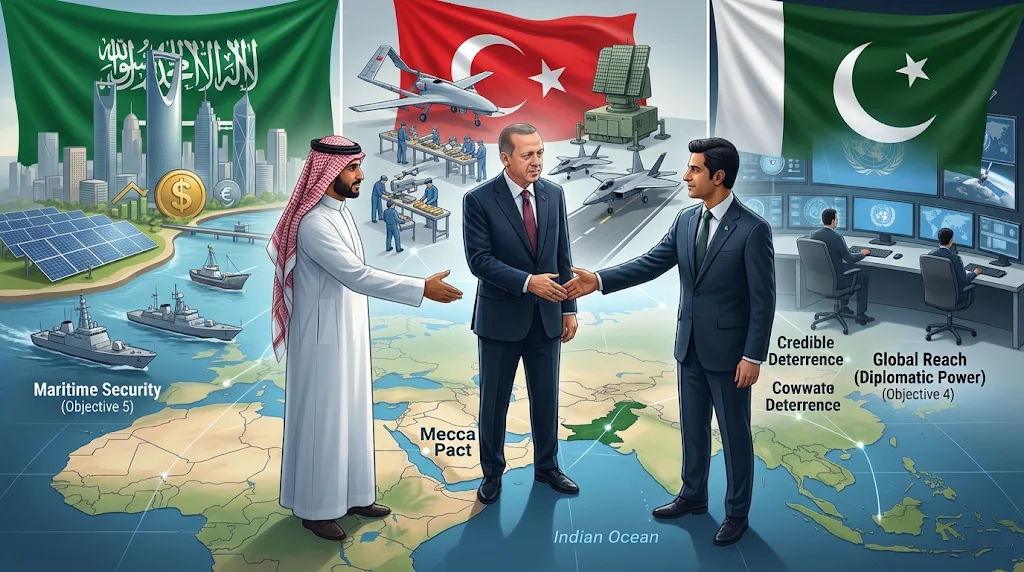
- Mecca Pact aims to establish a self-reliant regional security framework and credible deterrence system linking Saudi Arabia, Türkiye, and Pakistan without over-relying on external powers.
- Joint defense-industrial manufacturing, drones, air defense, and artificial intelligence can reduce reliance on foreign suppliers while boosting technological sovereignty.
- Broader economic integration, strategic investment funds, and coordinated diplomacy across global institutions can expand influence across Africa, Central Asia, South Asia, and the Indian Ocean.
The Mecca Pact, bringing together Saudi Arabia, Türkiye and Pakistan, represents an important opportunity for the emergence of a new regional security framework led by influential Muslim-majority states.
Signed on 7 August 2026, the agreement seeks to strengthen collective defence, strategic cooperation and deterrence. Its significance, however, extends beyond military cooperation. It could become the foundation of a broader geopolitical partnership capable of influencing the Middle East, South Asia, Africa and the wider international system.
The strategic ambitions of the three nations can be understood through the following objectives.
1. Establish an Independent Regional Security Architecture
The first major objective should be to develop a regional security framework in which regional powers take greater responsibility for their own security rather than relying excessively on external powers. Key goals include:
- Establishing permanent joint defence and security institutions.
- Developing mechanisms for collective consultation and crisis response.
- Coordinating military planning and strategic assessments.
- Strengthening intelligence-sharing and counterterrorism cooperation.
- Developing joint military exercises and operational interoperability.
The long-term ambition could be to establish a regional security arrangement connecting the Eastern Mediterranean, the Middle East, the Persian Gulf, North and East Africa, and South Asia.
2. Create a Credible Deterrence Mechanism
A second objective is to establish a credible deterrence mechanism against external aggression and threats to national sovereignty.
The three countries possess diverse strategic assets. Saudi Arabia brings financial and strategic power, economic resources, energy influence, diplomatic weight, geographic importance and a pivotal position in the Gulf and the Muslim world.
READ NEXT: Mecca Defence Alliance Shift: Saudi-Led Ground Offensives Force Houthi Retreat
Türkiye contributes considerable military and technological capabilities, defence manufacturing, military experience, NATO membership and strategic access between Europe and Asia.
Pakistan brings strategic and nuclear capabilities, nuclear deterrence, substantial conventional military strength, strategic geography and extensive experience in regional security.
Combining these strengths could create a more balanced regional deterrence system. However, the countries would need clearly defined consultation procedures, crisis-response commitments and safeguards against unintended escalation.
READ MORE: Indonesia and the Mecca Pact: a new security direction, or more room to manoeuvre?
The pact should not be interpreted as automatically extending Pakistan’s nuclear deterrent to the other members.
3. Develop a Joint Defence-Industrial Complex
The three countries could transform the pact into a major defence-industrial partnership. Strategic priorities should include:
- Joint production of fighter aircraft and military drones.
- Missile defence and air defence systems.
- Cybersecurity and artificial intelligence.
- Satellite technology and space-based surveillance.
- Naval capabilities and maritime security.
- Joint research, development and technology transfer.
Saudi investment could provide financial resources, Türkiye could contribute industrial and technological expertise, while Pakistan could offer engineering capabilities, defence production experience and military expertise.
The ultimate objective would be to reduce dependence on foreign defence suppliers and establish a competitive regional defence industry.
4. Become a Leading Diplomatic Power in the Muslim World
The Mecca Pact could provide a platform for coordinated diplomacy on major issues affecting Muslim countries. Its members could work together to:
- Promote a just and lasting resolution of the Palestinian question.
- Support stability and reconstruction in Syria, Iraq, Yemen and other conflict-affected countries.
- Facilitate dialogue between Iran and Arab states.
- Strengthen diplomatic support for Muslim communities facing conflict and humanitarian crises.
- Promote peaceful settlements of disputes among Muslim-majority nations.
- Coordinate positions at the United Nations, the Organisation of Islamic Cooperation and other international institutions.
5. Expand Influence Across Africa, Central Asia and the Indian Ocean
The Mecca Pact’s geographic significance is particularly important. Saudi Arabia, Türkiye and Pakistan occupy strategically complementary positions connecting the Gulf, the Middle East, the Mediterranean, Central Asia and South Asia.
Their collective engagement could focus on several strategic regions:
Africa: Security cooperation, infrastructure development, peacekeeping and investment partnerships.
Central Asia: Trade corridors, counterterrorism and regional connectivity.
South Asia: Regional stability, economic integration and diplomatic engagement.
Indian Ocean: Maritime security, protection of shipping routes and anti-piracy operations. The Mecca Pact nations must maintain a strategic focus on the Indian Ocean and its growing geopolitical importance.
Eastern Mediterranean: Energy security, maritime cooperation and diplomatic stability.
The objective should be to establish a network of strategic partnerships rather than create competing military blocs.
6. Strengthen Economic and Geopolitical Influence Globally
Military strength alone cannot establish lasting international influence. The pact should therefore develop a strong economic dimension.
Potential initiatives could include:
- A trilateral strategic investment fund.
- Joint infrastructure and transport projects.
- Energy cooperation and long-term energy security.
- Technology partnerships and digital infrastructure.
- Greater trade in local currencies where commercially viable.
- Coordinated investment in emerging markets.
- Cooperation in food security and critical mineral supply chains.
A particularly important opportunity lies in connecting Saudi financial resources, Turkish industrial capabilities and Pakistan’s geographic position and human capital. This could create a powerful economic partnership with influence extending beyond the traditional Middle Eastern political system.
Houthi Strike on Riyadh Signals Urgent Test for the Mecca Defence Agreement
The three founding countries could gradually develop a wider network of partnerships with other nations based on geography, strategic importance and economic strengths.
Potential partners could include Egypt, Qatar, Indonesia, Malaysia, Bangladesh and Azerbaijan, alongside countries across Africa that offer continental strategic access.
One important consideration is that any expansion should be based on shared interests, mutual obligations and respect for national sovereignty.
Increase Influence in Global Institutions
The Mecca Pact countries could coordinate their positions in international organisations to influence global decision-making.
The greatest opportunity for the Mecca Pact is to develop into a regional strategic power centre with global diplomatic, economic, technological and security influence.
Its success should be measured against five strategic achievements: greater security independence, industrial and technological strength, competitive defence capabilities, stronger economic influence and a meaningful role in international decision-making.
Ultimately, the greatest achievement would be to transform the Mecca Pact from a trilateral defence agreement into a durable regional institution that connects Muslim-majority countries with other international partners, strengthens regional stability and gives its members a meaningful voice in shaping the emerging multipolar world.