



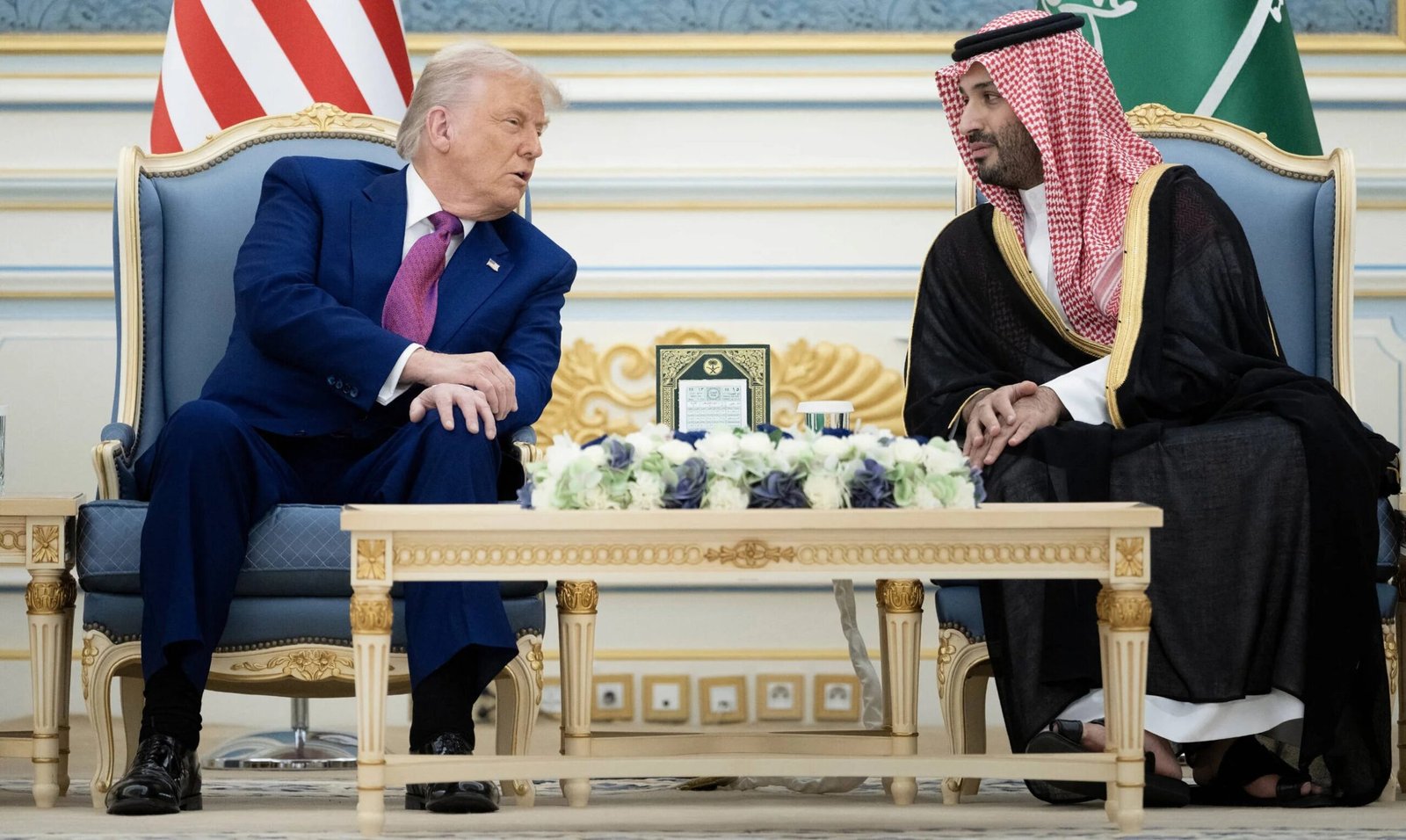
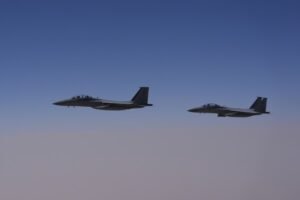
- Royal Saudi Air Force Escort: Six F-15 fighter jets flanked Air Force One as it entered Saudi airspace — a rare, sky-high gesture reserved for only the most significant guests.
- Crown Prince’s Personal Reception: Mohammed bin Salman, the kingdom’s most powerful figure, broke protocol by personally receiving Trump at the airport.
- A $600 Billion Salute: Massive investment and defense deals were unveiled during the visit, symbolizing the depth of Saudi-U.S. strategic ties.
- Symbolic Power Play by MBS: The grand welcome served as a bold display of MBS’s influence, projecting Saudi Arabia’s ambitions under his transformative leadership.
Saudi Arabia didn’t even wait for U.S. President Donald Trump to land before launching one of the most grandiose welcomes in diplomatic history — not just on the tarmac, but in the skies.
As Air Force One approached Riyadh on Tuesday, six Royal Saudi Air Force F-15 fighter jets soared up to flank the presidential plane in a rare and dramatic ceremonial escort. The maneuver, reminiscent of a military honor guard but on a far grander scale, is virtually unheard of in Saudi diplomatic protocol. A senior White House official, Margo Martin, captured the moment and posted it online, writing, “Saudi F-15’s providing honorary escort for Air Force One!”
The significance wasn’t lost on diplomatic observers. While aerial escorts are common in military or ceremonial occasions, they are extremely rare in Saudi protocol — and virtually unprecedented for foreign heads of state. In recent history, only a handful of leaders — among them Chinese President Xi Jinping and Russian President Vladimir Putin — have received anything remotely similar, and even then, not with the same level of aerial precision and power.
Trump’s $843 Billion Power Play: Deals in Saudi Arabia and Qatar Redefine U.S. Diplomacy
The spectacle in the sky was just the beginning. On the ground, Trump received what can only be described as a royal embrace. Crown Prince Mohammed bin Salman (MBS), the de facto ruler of Saudi Arabia and one of the most powerful men in the Muslim world, personally received the American president at the King Khalid International Airport. Amid red carpets, golden reception halls, and military salutes, the Crown Prince’s gesture stood out: he had chosen not only to welcome Trump personally but to offer the full weight of his economic, military, and political arsenal in a public show of alliance.
Perhaps the most striking symbol of that alliance was the so-called “$600 billion salute” — a series of proposed investment and trade agreements, defense contracts, and strategic memoranda signed between the U.S. and Saudi Arabia during the visit. The figure, while yet to be fully realized, includes long-term Saudi commitments to American defense companies, infrastructure projects, and technology firms, as well as plans for future joint ventures in artificial intelligence and energy. It is one of the largest single packages ever proposed between the two nations, solidifying Saudi Arabia’s status as one of Washington’s most strategic allies.
A Calculated Gesture by MBS
The grand reception was more than diplomatic theater. It was a carefully orchestrated message from Crown Prince Mohammed bin Salman to the world — and particularly to Washington — that Saudi Arabia under his leadership is not just open for business, but ready to shape the global order on its own terms.
MUST READ:$600 Billion Deal of the Century: Trump and Saudi Crown Prince Reshape Global Trade
MBS has been building toward this moment for years. Since assuming de facto control of the kingdom in 2017, he has recast Saudi Arabia from a conservative oil state into a dynamic, if controversial, player on the world stage. His Vision 2030 initiative has sought to transform the Saudi economy by reducing its dependence on oil, embracing high technology, and opening up its deeply conservative society to tourism, entertainment, and international investment.
While his domestic reforms — such as allowing women to drive and loosening restrictions on public gatherings — have garnered international praise, they have also come with accusations of authoritarian overreach. The killing of journalist Jamal Khashoggi in 2018 cast a long shadow over MBS’s image in the West. Yet, through strategic partnerships, energy diplomacy, and major investments in global tech and defense markets, he has rebuilt his stature — not as a conventional monarch, but as a powerful statesman who is unafraid to play on the global chessboard.
MBS’s approach to leadership marks a departure from the traditional, behind-the-scenes diplomacy once favored by Saudi royalty. He is bold, media-savvy, and strategically aggressive. Whether forging a rapprochement with Iran under Chinese mediation, brokering peace overtures with Israel, or hosting global entertainment giants, MBS has positioned Saudi Arabia as a power that cannot be ignored — particularly in a region where influence is constantly in flux.
Trump’s Riyadh Reception: Symbolism and Strategy
For Donald Trump, the reception in Riyadh represents more than just a diplomatic honor. It is a testament to his continued influence on the global stage despite the political controversies surrounding his second bid for the presidency. It also underscores a shared worldview between Trump and MBS — one that prioritizes transactional diplomacy, mutual economic benefit, and a strong stance against Iran.
MUST READ:Trump gets the royal-purple-carpet treatment in the Middle East, belying thorny geopolitical challenges
The extraordinary welcome may also be seen as a calculated bet by MBS on Trump’s political future. By giving Trump the kind of reception that even sitting U.S. presidents rarely receive, Saudi Arabia is signaling its desire to maintain strong personal ties regardless of shifts in American political leadership.
In a region where optics matter as much as policy, the F-15 escort and princely greeting send a clear message: under MBS, Saudi Arabia is ready to project power — and play favorites.
Final Thoughts
Saudi Arabia’s reception of Donald Trump was more than an act of hospitality. It was a message from Crown Prince Mohammed bin Salman that he sees himself not just as a steward of the kingdom, but as a global influencer capable of commanding attention and forging bold partnerships.
In welcoming Trump with such grandeur, MBS not only reinforced his relationship with a powerful American figure but also underscored his own ascent as one of the most consequential leaders of the 21st century — one who knows that in diplomacy, symbolism is often half the battle.