



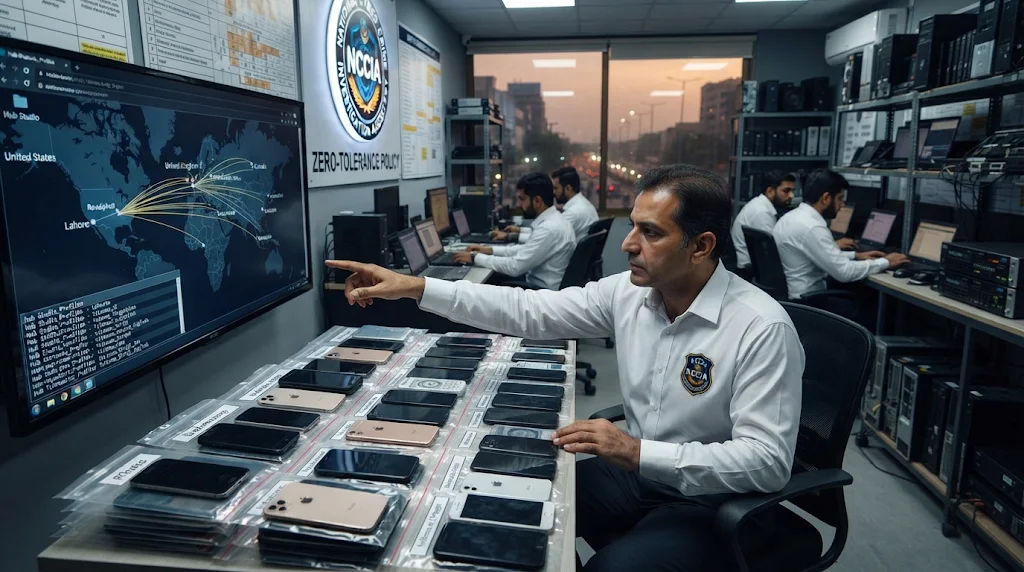
- Pakistan cybercrime crackdown teams from the NCCIA arrested 130 suspects in Lahore and seized 276 digital devices used to defraud victims across the U.S., Canada, the U.K., and Southeast Asia.
- Raids in upscale neighborhoods of Lahore, Islamabad, and Rawalpindi dismantled illegal call centers running fake stock-trading platforms, romance scams, and telecom impersonation schemes.
- Investigators recovered over Rs30.17 million ($108,000) and detained a private bank operations manager accused of selling confidential customer data to scam syndicates.
- Court filings reveal foreign syndicates systematically exploited Pakistan’s online visit-visa regime and local shell IT companies to establish scam compounds undetected.
ISLAMABAD—Pakistani law-enforcement authorities arrested 130 people in Lahore over the past 48 hours, including Chinese and Nigerian nationals, in the latest sweep against transnational cyber-fraud syndicates using Pakistani cities as bases to defraud victims in the U.S., Canada, the U.K., and Southeast Asia.
The National Cyber Crime Investigation Agency, or NCCIA, seized 276 digital devices—including servers, laptops, desktop computers, and smartphones—during coordinated raids on illegal call centers and front offices in Lahore’s upscale Defence Housing Authority, according to Atif Ameer, additional director for the agency’s Lahore zone. Officials said the agency has recovered roughly 30.17 million Pakistani rupees ($108,000) for fraud victims in the current sweep.
The arrests underscore a broader geographic shift in global cybercrime. Following sustained law-enforcement pressure on scam compounds in Cambodia, Myanmar, and Laos over the past three years, foreign criminal networks have increasingly relocated operations to Pakistan, drawn by inexpensive commercial office space, high-speed internet, and a large pool of English-speaking recruits.
READ MORE: Pakistan Malaysia Diplomatic Engagement Awaits Key Meeting Over Detained Nationals in Rawalpindi
In Lahore, investigators raided a facility operating under the name Prime Link in DHA Phase VIII, detaining 34 Pakistani operators and one Chinese national. A parallel raid in DHA Phase VI netted 23 suspects, including three Chinese nationals. Five additional sweeps across illegal call centers yielded 62 arrests.
Forensic reviews of the seized hardware indicate the syndicates operated using distinct, compartmentalized methods:
-
Investment and Romance Scams: Operators at Prime Link used specialized software known as Hub Studio to generate hundreds of fictitious Facebook profiles featuring stolen photographs of women. Callers groomed foreign targets over weeks before funneling them into WhatsApp groups and steering them toward rigged stock-trading platforms and Ponzi schemes.
-
Telecom Impersonation and Carding: Call-center employees impersonated customer-service representatives from major U.S., Canadian, and British telecommunications providers. Offering fraudulent mobile upgrades and internet packages, operators harvested credit-card credentials and fed them into automated dialer software to execute unauthorized transactions.
-
Insider Data Theft: In a related Lahore raid, authorities arrested private bank operations manager Arsalan Ahmed on suspicion of harvesting and selling confidential customer records—reportedly at 150 rupees per profile—to feed scam call lists.
The Lahore operations follow a series of major busts across Pakistan’s urban centers over the past year. In October, NCCIA officers raided a call center in Rawalpindi’s Bahria Town Phase VIII and detained 130 Malaysian nationals accused of posing as bank officials and uniformed Malaysian police officers on video calls to extort money from victims in Malaysia. Investigators traced the Rawalpindi ring to a Malaysia-based supervisor operating out of Cambodia and a Chinese financial handler in Islamabad who converted e-wallet proceeds into cryptocurrency.
READ MORE: 130 suspects arrested for cyber fraud
In September, raids in Islamabad’s E-11 and G-10 sectors resulted in 212 arrests, including Chinese nationals, over fake Google “tasking” job scams and romance fraud linked to networks in India and Brazil. Earlier sweeps included the arrest of 273 suspects in Karachi in November, 258 foreign nationals—mostly Chinese and Vietnamese—at an Islamabad commercial plaza in August, and 149 suspects across seven nationalities in Faisalabad in July 2025.
The scale of the arrests has prompted scrutiny in Islamabad over how hundreds of foreign operatives entered the country and leased commercial properties without triggering regulatory alarms.
Visa records submitted in court filings show that the vast majority of detained foreign nationals entered Pakistan through its liberalized online visit and tourist visa system. In the Rawalpindi case, nearly all 130 Malaysian detainees arrived on standard visit visas; 98 had overstayed their permitted duration by the time of their arrest without triggering automated immigration alerts.
To secure premises, foreign handlers typically rely on local facilitators who register shell information-technology or business-process-outsourcing companies with the Securities and Exchange Commission of Pakistan. Those corporate credentials allow syndicates to lease entire floors in gated residential and commercial developments while bypassing local police tenant-registration checks.
NCCIA Director General Syed Ali Nasir Rizvi said the agency has instituted a zero-tolerance policy, registering formal criminal cases under Pakistan’s Prevention of Electronic Crimes Act and the Foreigners Act rather than quietly deporting foreign suspects. Authorities say forensic teams are tracing cryptocurrency wallets and cross-border financial flows to identify overseas ring leaders, though officials acknowledge that curbing the influx will require tighter visa vetting and stricter oversight of local shell companies.