



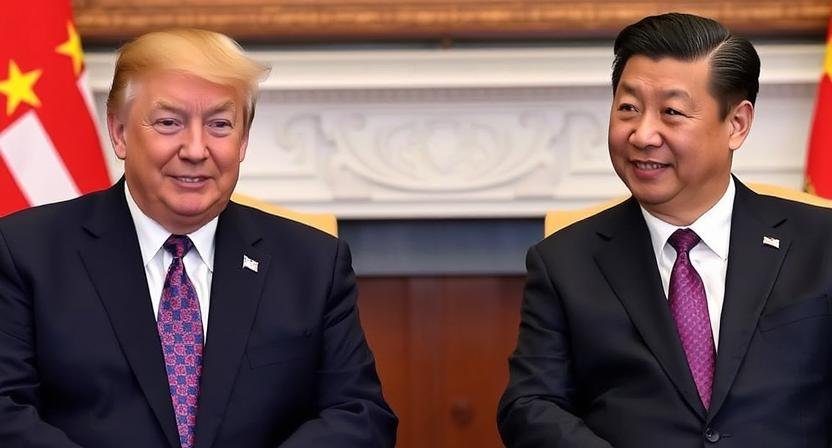
- Trump and Xi held their first phone call since Trump’s second-term inauguration, signaling a temporary thaw in U.S.-China tensions.
- Key topics included rare earth exports, Chinese student visas, tariff rollbacks, and future trade negotiations.
- Trump declared victory on minerals, but China omitted any such concession from its official statement.
- The call set a positive diplomatic tone but fell short of addressing deep structural divides in the bilateral relationship.
In what was arguably the most anticipated bilateral interaction of 2025, U.S. President Donald Trump and Chinese President Xi Jinping spoke for over 90 minutes on Thursday in a phone call that attempted to set the course for the world’s most complex and consequential relationship. It was not just another diplomatic exchange—it was a long-awaited recalibration between two global powerhouses whose rivalry increasingly defines this century.
The importance of this conversation cannot be overstated. It was the first direct contact between the two leaders since Trump’s return to office, coming on the heels of the Geneva mini-summit in May that had temporarily lowered trade tensions.
In that meeting, U.S. and Chinese negotiators agreed to drastically cut tariffs and imposed a 90-day freeze on any new economic measures, giving both sides time to hammer out a broader agreement. But the truce had begun to fray almost as quickly as it was declared, with both countries reverting to their strategic instincts—Washington moved to choke China’s tech sector, while Beijing weaponized its grip on rare earth exports.
Thus, this call was not simply routine diplomacy—it was a critical checkpoint in what many have termed the “new Cold War.” It was an opportunity to pause the economic skirmishing and test whether dialogue could reintroduce some predictability into a deteriorating relationship.
A Relationship Defined by Unease
The mood leading up to the call was frosty, bordering on hostile. Trump, emboldened by a second-term mandate and a more loyalist administration, had adopted an aggressive economic nationalism. China, wary of Washington’s unpredictability, had started asserting itself with more visible countermeasures. The mutual distrust has festered not only in trade but in global governance, AI standards, and maritime affairs in the South China Sea and Taiwan Strait.
Yet, both leaders know they need each other more than they admit. Trump’s America seeks supply chain security, especially in critical industries like semiconductors, electric vehicles, and defense manufacturing—all dependent on Chinese rare earths. China, with slowing growth and rising youth unemployment, cannot afford to alienate its largest export market.
That contradiction—rivalry and interdependence—was the subtext of Thursday’s phone call.
Xi, Trump Call: From Students to Supply Chains: What Was Discussed?
While no joint statement was released, both governments issued their respective readouts. According to senior White House officials, the two leaders covered a “wide range of critical issues,” from trade policy to academic exchange, from tech restrictions to military de-escalation in the Pacific.
READ MORE:Trump confirms China trip after ‘very good’ call with Xi
The Chinese rare earths issue was reportedly at the top of Trump’s agenda. His post-call declaration on Truth Social—“There should no longer be any questions respecting the complexity of Rare Earth products”—was vintage Trump: triumphalist and vague. The Chinese readout made no mention of minerals at all, a silence that speaks volumes. Whether the call leads to an actual loosening of export controls remains to be seen. If ports in Shenzhen and Tianjin start moving rare earth shipments to the U.S. in the coming weeks, that will be the true litmus test.
Another unexpected outcome was on the subject of Chinese students in the U.S. Trump appeared to reverse an earlier hardline policy announced by Secretary of State Marco Rubio, who had vowed to “aggressively revoke visas.” Trump, speaking alongside German Chancellor Friedrich Merz, said, “Chinese students are coming—no problem. It’s our honor to have them.” The Chinese media ran this quote prominently, portraying it as a diplomatic win for Beijing.
That symbolic olive branch was perhaps aimed at resetting the tone ahead of what both leaders confirmed would be a new round of trade talks. Whether those talks yield substantive progress is another matter. The core structural issues—China’s export-centric model and Washington’s desire to reshore manufacturing—are fundamentally at odds.
Reading Between the Lines
Despite the upbeat language, the underlying picture is far less optimistic. What emerged was less a breakthrough and more a tactical pause in a long and grinding competition. The Trump-Xi call, while significant in tone, offered few concrete outcomes.
READ MORE:Trump Warns of Russian Retaliation Amid Stalemate in Ukraine Peace Talks
The rare earth issue remains murky. Trump’s post-call remarks suggest that he either extracted a concession or believes he did. But Beijing’s silence and continued use of non-tariff tools signal that China is unwilling to surrender leverage without reciprocity. Analysts have noted that China’s new export control framework allows for tight, selective enforcement—Beijing can ease the flow one day and restrict it the next, based on geopolitical mood swings.
The Chinese student issue may have more immediate clarity. Reversing visa restrictions is low-hanging fruit for Trump—it costs little politically, earns goodwill, and symbolically counters the narrative of a hard decoupling. For China, it restores a key soft power channel and reduces domestic pressure from elite families whose children study in American institutions.
Perhaps the most telling aspect of the call was the choreography itself. Beijing’s readout emphasized that the call occurred “at the request of the United States.” It was a subtle jab, aimed at signaling that Washington had blinked first. This rhetorical sleight-of-hand underscores Beijing’s desire to control the optics of great power diplomacy, even when the substance is ambiguous.
A Strategic Pause, Not a Reset
In evaluating the significance of the Trump-Xi call, it’s essential to separate narrative from reality. The positive tone was notable—both sides issued invitations for in-person visits, and neither accused the other of betrayal or bad faith. That’s an improvement. But it is a far cry from strategic alignment.
The geopolitical chessboard remains fundamentally unchanged. The U.S. continues to strengthen alliances in Asia, boost semiconductor independence, and scrutinize Chinese capital. China is pursuing a dual circulation strategy that reduces its reliance on the West while doubling down on Belt and Road partnerships.
The call, therefore, was not a pivot—it was a pause. A necessary one, perhaps, but insufficient to resolve the deep structural antagonisms between the two nations. What it did achieve was to lower the temperature temporarily, offer some short-term relief to jittery markets, and give both leaders an opportunity to portray themselves as statesmen.
But the real test lies ahead. If the trade talks falter, if Chinese ships continue to restrict rare earth flows, if new tech restrictions come into play, the mood will sour quickly. As history has shown, the Trump-Xi dynamic is volatile: friendly today, adversarial tomorrow.
Bottom line: The Trump-Xi call was essential, overdue, and cautiously productive. But it did not alter the trajectory of U.S.-China rivalry. For that to happen, both sides would need to move beyond rhetorical wins and begin crafting a new framework for peaceful competition—something that remains elusive in today’s multipolar world.