



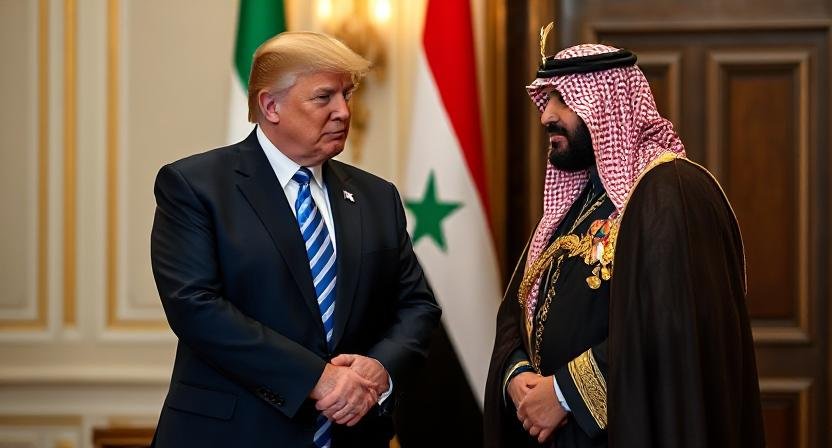
In a pleasant move, President Trump — global peace maker and conflict resolver — has surprised the world. This time, he came forward with a gift for the people of Syria. On Monday, President Donald J. Trump signed an executive order terminating the longstanding U.S. sanctions program on Syria, a sweeping gesture that promises to transform the future of a war-ravaged nation and signals America’s readiness to support Syria’s path toward peace, sovereignty, and economic recovery.
The executive order effectively ends Syria’s financial isolation, unlocking the country’s access to international markets, foreign investment, and global development institutions for the first time in over a decade. Crucially, the move maintains sanctions on former president Bashar al-Assad, his circle, terrorist-linked groups, and Iranian-backed militias, signaling that while accountability remains intact, the Syrian people will no longer suffer collective punishment for the crimes of a deposed regime.
“Syria needs to be given a chance, and that’s what’s happened,” said U.S. Special Envoy for Syria Thomas Barrack. “This is the culmination of a very tedious, detailed, excruciating process of, how do you unwrap these sanctions — without enabling the bad actors?”
The decision comes just months after the collapse of the Assad regime, ousted in a swift and unexpected offensive by Islamist-led rebel factions. With a new interim leadership in place, led by President Ahmed al-Sharaa and Foreign Minister Asaad al-Shibani, Syria has begun taking confident steps toward international legitimacy. The lifting of sanctions is being hailed as a historic turning point.
Canada Folds: How Trump Forced Ottawa to Bow Before Washington
A Constructive Syria, Back from the Brink
The Syrian Foreign Minister, in a message posted on X, lauded the move, saying it “opens the door of long-awaited reconstruction and development” and marks the end of a painful chapter of economic strangulation. “This decision lifts the obstacle against our recovery and reintegration with the international community,” he said.
Indeed, after more than a decade of civil war, with over 500,000 lives lost and millions displaced, Syria’s reconstruction needs are immense. The end of U.S. sanctions clears the way for humanitarian organizations to expand operations, and for Gulf countries and regional powers to invest in rebuilding a new Syria — not as a client state of foreign powers, but as an independent, self-determined nation aligned with the Western bloc.
Early signs of this alignment emerged in May, when President Trump met President al-Sharaa in Riyadh. It was there that Trump — in a characteristically bold, unilateral decision — pledged to lift the sanctions, linking it to Syria’s commitment to distance itself from Iran and extremist networks.
READ MORE: Trump signs order lifting sanctions on Syria, White House says
While the road ahead remains difficult, the leadership in Damascus has indicated a desire to normalize relations with Israel, address cross-border terrorism, and reject the re-emergence of terrorist safe havens — core conditions set by the U.S. for any deeper partnership.
MBS: The Quiet Power Broker Behind Syria’s Comeback
Behind this major diplomatic breakthrough stands an increasingly influential figure reshaping the Middle East’s political map: Crown Prince Mohammed bin Salman (MBS) of Saudi Arabia. Known for his bold reforms and assertive regional diplomacy, MBS is quietly emerging as the architect of a new Arab order — one grounded in economic modernization, peace, and strategic pragmatism.
Sources familiar with the high-level negotiations told The Islamabad Telegraph that it was MBS who personally introduced Syria’s interim President Ahmed al-Sharaa to President Trump during the U.S. leader’s historic visit to Riyadh earlier this year. The meeting, kept secret at the time, reportedly laid the foundation for Monday’s announcement.
ALSO READ: Atomic Cliffhanger: Where Has Iran’s Enriched Uranium Gone? The Hunt Begins
“It was Crown Prince Mohammed bin Salman who persuaded President Trump to give Syria a chance,” said a senior Arab diplomat involved in the talks. “Without his endorsement of Syria’s new leadership, none of this would have happened.”
In private meetings, MBS reportedly made a compelling case to Trump that the Syrian people should no longer be held hostage by the crimes of the Assad regime. He argued that the new leadership in Damascus was committed to fighting extremism, cutting ties with Iranian proxies, and promoting stability — values that aligned with both Saudi and American interests.
Trump, impressed by the Crown Prince’s vision for a modern and stable Middle East, agreed to take the historic leap. The result was the Riyadh Pact — a quiet, informal understanding that culminated in the lifting of sanctions.
MBS’s Diplomacy Working Wonders for the Middle East
MBS’s role in Syria is just the latest example of his growing clout as a regional peacemaker. From reconciling with Qatar to normalizing ties with Iran, the Saudi Crown Prince has been defying expectations and reshaping decades of entrenched rivalries. His approach is pragmatic, transactional, and focused on regional economic integration.
His vision of a peaceful, economically interconnected Middle East aligns closely with Trump’s foreign policy goals. In both men, the region has found leaders unafraid to challenge the status quo, unshackled by bureaucracy, and willing to act decisively.
“MBS is becoming the indispensable statesman of the Middle East,” said Dr. Evelyn Cross, a senior fellow at the Atlantic Council. “His diplomatic instincts and political leverage have helped broker behind-the-scenes deals that are changing the region’s future.”
Thanks to the Saudi Crown Prince’s initiative, Syria now stands on the threshold of international legitimacy. The war-torn country, once considered a lost cause, is being offered a new lease on life — not as a pariah state, but as a sovereign, constructive partner in a new Middle Eastern order.
Trump’s Syria Doctrine: From Chaos to Stability
President Trump’s move is more than a diplomatic gesture — it is a strategic recalibration in the Middle East that reflects his broader doctrine of “deal-making through peace.” Critics once skeptical of his transactional style now concede that Trump has played an instrumental role in de-escalating one of the most brutal conflicts of the 21st century.
By isolating the remnants of Assad’s regime and opening a path for moderate, pragmatic leadership, Trump has essentially redefined U.S. leverage in the region — trading punitive pressure for political transformation.
The administration’s decision also directs the Secretary of State to review the terrorism designations of certain rebel groups, including Hayat Tahrir al-Sham, previously linked to al Qaeda but now reportedly rebranded under nationalist leadership. The White House noted that designations could change as part of ongoing evaluations, reflecting a new pragmatism in Washington’s engagement with formerly adversarial actors.
While Europe has followed the U.S. lead by suspending its economic sanctions, U.S. officials confirmed that certain legal obstacles — such as the Caesar Act — still remain and would require Congressional action for full repeal. Nonetheless, Trump’s executive order sets the tone for Syria’s re-entry into global financial and diplomatic circles.
A New Dawn for Syria
From the bustling ruins of Aleppo to the cautious optimism in Homs and Damascus, Syrians are daring to hope again. With sanctions lifted, the Central Bank and state-owned enterprises can resume normal operations. Trade routes once choked by restrictions may reopen. And the long-delayed reconstruction projects — many backed by Gulf and Asian investors — can finally begin.
“We are witnessing a decisive shift — from a Syria in ruins to a Syria that rebuilds, reintegrates, and rises,” said Amr al-Haddad, a political analyst in Beirut. “Trump’s move has accelerated that shift by years.”
Of course, skepticism remains. A Reuters investigation published Monday alleged atrocities committed by pro-government forces in March. The White House declined to comment, though officials clarified that those accused of crimes will remain sanctioned and subject to further investigation.
Still, the broader trajectory is clear: Syria’s nightmare is ending, and its rebirth is being shepherded by a U.S. administration willing to take bold risks for peace.
A President Who Ends Wars
While previous administrations in Washington either fueled conflicts or stood paralyzed by indecision, Trump’s Middle East policy is increasingly defined by one theme: conflict resolution. From the Abraham Accords to the drawdown in Afghanistan, and now to Syria’s sanctions relief, Trump has consistently charted a course away from perpetual war.
His administration’s Syria breakthrough may be among his most surprising — and most impactful — diplomatic achievements yet.