


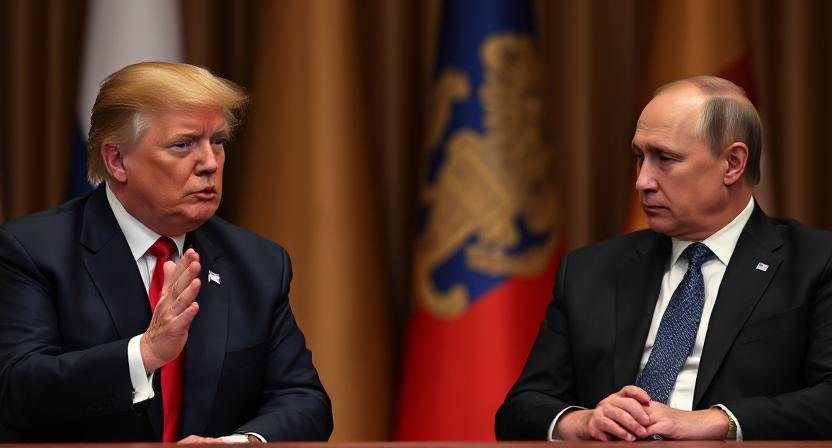
- President Trump threatens sweeping sanctions on Russia and its energy buyers unless Ukraine war ends by August 8.
- Putin signals no major shift, boasting that Russian momentum on the battlefield is growing.
- Analysts argue Trump waited too long; Putin repeatedly dismissed U.S. warnings and escalated attacks.
- Ukraine urges direct peace talks, but Moscow continues airstrikes and delays negotiations.
With the war in Ukraine grinding into its fourth year, U.S. President Donald Trump has warned that sweeping new sanctions on Russia—and on nations buying its energy exports—will come into effect by August 8 unless Moscow agrees to a meaningful end to the conflict. The warning, delivered in stark terms earlier this week, signals a shift in Washington’s tone after what critics describe as excessive leniency towards Russian President Vladimir Putin.
“The United States has proposed this. Ukraine has supported it. What is needed is Russia’s readiness,” Trump said, expressing frustration over Moscow’s reluctance to engage in genuine peace efforts. “Putin’s bullshit won’t fly anymore,” he added, referencing Russia’s continued airstrikes and slow-moving peace negotiations.
Background of the War
The war in Ukraine began in February 2022, when Russian forces launched a full-scale invasion, claiming security threats from NATO’s eastern expansion. What Putin initially hoped would be a quick operation turned into a grinding war with enormous human and geopolitical costs. More than 300,000 people have been killed or wounded, cities have been flattened, and millions displaced.
While Ukraine has received strong Western support, including weapons, financial aid, and diplomatic backing, Russian troops have maintained control over swathes of eastern Ukraine. In recent days, Moscow claimed to have taken control of Chasiv Yar, a strategic town in the Donetsk region after a prolonged 16-month battle. Ukraine disputes the claim, calling it propaganda aimed at boosting Russian morale.
Putin, speaking alongside Belarusian President Alexander Lukashenko at the historic Valaam Monastery in Russia, made no reference to Trump’s looming sanctions. However, he reiterated that Russia’s military has the upper hand and described the recent peace talks as “yielding positive results”—even as airstrikes on Ukrainian cities, particularly Kyiv, continue unabated.
READ MORE:Putin, facing Trump deadline, signals no change in Russia’s stance on Ukraine
“In order to approach the issue peacefully, it is necessary to conduct detailed conversations. Not in public, but calmly, in the quiet of the negotiation process,” Putin said.
Trump’s Tougher Stance
Trump’s administration had initially taken a less confrontational approach, seeking backdoor diplomacy and economic levers to curb Russian aggression. But analysts argue that this patience allowed Putin to entrench his military gains.
“Trump has given Russia more than enough time to reconsider its aggression,” said Dr. Amelia Roth, a geopolitical analyst at the Atlantic Institute. “But it’s Putin who has repeatedly dismissed American warnings, testing the limits of U.S. restraint.”
ALSO READ: Trump’s Global Tariffs Shockwave Rattles World Economy
The new sanctions will reportedly target Russian oil and gas exports—Russia’s main source of revenue—and penalize countries like China and India if they continue large-scale energy imports. This marks a significant escalation, particularly in light of the growing global dependence on Russian energy amid fluctuating global oil prices.
“Washington’s strategic calculus has shifted,” noted Colonel (Ret.) James Cartwright, a former Pentagon advisor. “We’re now seeing the Trump administration willing to hit Russia where it hurts—its wallet. And not just Russia’s, but those who keep buying from them.”
A Stalled Peace Process
Ukrainian President Volodymyr Zelenskiy has repeatedly called for a direct meeting with Putin, stating that Russian negotiators lack real decision-making authority. “We understand who makes the decisions in Russia and who must end this war. The whole world understands this too,” Zelenskiy said on social media.
Russia, for its part, has said a summit between the two leaders can only occur to finalize a deal—not to negotiate terms. This has led Kyiv and its European allies to accuse Moscow of using negotiations as a stalling tactic.
Despite the diplomatic deadlock, Trump has given Moscow until August 8 to change course. If not, the White House says sanctions will be “severe and irreversible.”