



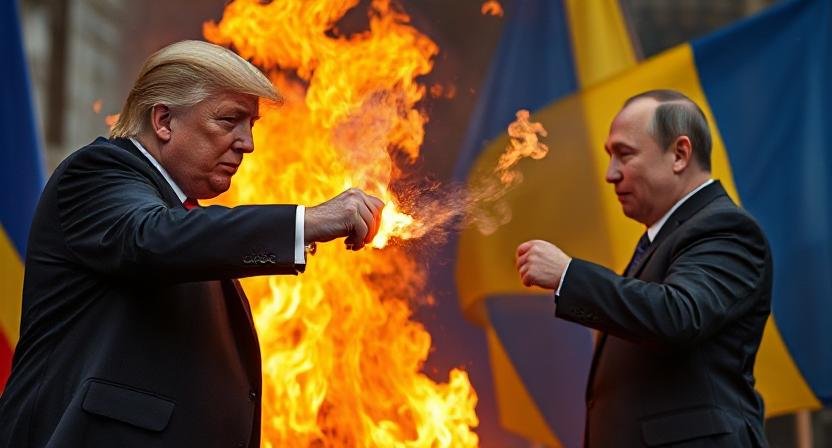
- Trump’s Alaska summit with Putin sparked fresh momentum toward ending the Ukraine war, though no cease-fire was secured.
- Insiders revealed Putin agreed to discuss Western security guarantees for Ukraine, a remarkable shift in Moscow’s position.
- European leaders fear Trump may pressure Zelensky to cede territory in exchange for peace, rewarding Russian aggression.
- Monday’s White House meeting with Zelensky and top EU leaders will be pivotal in determining whether peace or appeasement prevails.
Against all odds, President Donald J. Trump has once again thrust himself into the heart of global diplomacy, claiming the role of peacemaker in the world’s bloodiest conflict. After a dramatic summit with Russian President Vladimir V. Putin in Alaska, insiders revealed to The Islamabad Telegraph that Trump is closer than ever to engineering an end to the Ukraine war — though the terms being floated raise uneasy questions about peace, sovereignty, and the balance of power in Europe.
The high-stakes Trump-Putin meeting, described by one U.S. official as “the most consequential diplomatic gamble of his presidency,” produced no cease-fire but opened the door to direct negotiations over a final peace deal. Putin, who for two years resisted compromise, appears to have softened under Trump’s personal pressure. Russian officials hinted that Moscow might agree to freeze frontline fighting in exchange for territorial concessions — namely, Ukraine ceding the Donetsk region.
“Trump’s charisma and deal-making instinct worked wonders,” one European diplomat who attended a follow-up call said. “He convinced Putin to consider security guarantees for Ukraine — something unheard of until now.”
Trump, Putin End Alaska Summit Without Ukraine Deal Despite Spectacle of Red-Carpet Welcome
But there’s a catch. Putin refuses to halt combat operations during talks. The war, now in its fourth year, continues to grind on, exacting a horrific toll on Ukrainian civilians while battering the global economy.
Zelensky’s Counteroffensive — at the Negotiating Table
On Monday, Ukrainian President Volodymyr Zelensky will arrive at the White House carrying new proposals drafted with European leaders. This time, Zelensky will not walk into the Oval Office alone. Leaders from Germany, France, Britain, Italy, Finland, and the European Union will accompany him — a rare show of unity designed to prevent Trump from cutting a deal on Moscow’s terms.
“It’s very important that we speak to America together,” Zelensky said in Brussels before boarding his flight. “Europe must stay united. Our unity is our strength against Russia’s aggression.”
READ MORE: Trump Tells Europeans He Is Open to U.S. Security Guarantees in Ukraine
The stakes could not be higher. European officials fear Trump might pressure Zelensky to accept territorial losses in exchange for a security pact modeled on NATO’s Article 5. Such an agreement, Trump has privately told allies, could involve U.S.-backed guarantees but not formal NATO membership. That delicate distinction is precisely what Putin wants: a weakened Ukraine tethered to Western promises but outside NATO’s protective shield.
A High-Wire Act of Diplomacy
Trump’s about-face stunned Washington. Just days earlier, he vowed “severe consequences” if Putin refused a cease-fire. But after hours of closed-door talks in Anchorage, Trump reversed course, declaring that peace must come first, cease-fire second.
“It was determined by all that the best way to end the horrific war between Russia and Ukraine is to go directly to a Peace Agreement,” Trump posted on Truth Social, echoing Putin’s long-standing position.
ALSO READ: Trump’s Strategic U-Turn on Ukraine: A Calculated Move That Secures U.S. Influence Without Confronting Putin
To critics, this was appeasement disguised as pragmatism. “Putin has broken every promise ever made — from the Budapest Memorandum to the Minsk agreements,” said a senior European security official. “Giving him Donetsk is rewarding aggression at the negotiating table.”
But Trump’s aides insist he is rewriting the rules of diplomacy. “The president believes cease-fires often collapse,” one White House adviser said. “He wants a comprehensive peace that ends the war permanently.”
What Putin Wants — and What He Offers
Russian sources say Putin made three core demands during the Alaska summit:
-
Full control of Donetsk in exchange for freezing the conflict elsewhere.
-
A halt to NATO expansion, particularly Ukraine’s accession.
-
Recognition of Russian sovereignty over occupied areas — though details remain murky.
In return, Putin reportedly pledged to stop further offensives and allow Western “security guarantees” for Ukraine, including the possible deployment of European-led forces backed by U.S. intelligence and air power.
That last concession is extraordinary, if true. For years, Putin rejected any Western presence in Ukraine. His apparent willingness to accept it now may reflect both battlefield exhaustion and a desire to end Russia’s international isolation.
Europe Pushes Back
European leaders, while skeptical of Putin’s sincerity, are determined to shape the negotiations. Their fear: that Trump, eager for a legacy-defining peace deal — perhaps even a Nobel Prize — will hand Putin strategic victories disguised as compromise.
“We are clear that Ukraine must have ironclad security guarantees,” a joint European statement said Saturday. “We welcome President Trump’s openness, but the integrity of Ukraine’s sovereignty is non-negotiable.”
Privately, however, European officials admit they expect Ukraine to lose some territory. “The question is how much, and under what conditions,” said one French official.
The Zelensky-Trump Showdown
Monday’s White House meeting could be explosive. In February, Trump and Zelensky clashed bitterly in the Oval Office, with shouting matches over sanctions and security guarantees. This time, both sides are under more pressure.
Zelensky knows Ukraine’s constitution forbids ceding land. He faces fierce resistance at home against trading territory for peace. Trump, meanwhile, faces political peril if he is seen as capitulating to Putin. Any deal that undermines Ukraine’s sovereignty could haunt him at home and abroad.
“Zelensky’s main task is to persuade Trump there are alternatives to Putin’s terms,” said Steve Witkoff, Trump’s special envoy. “But the president’s patience is limited. He wants results now.”
Peace or Pretense?
Trump has made his self-styled role as “the world’s greatest dealmaker” a centerpiece of his second term. Ending the Ukraine war would cement that legacy. Yet history warns that peace with Putin is never simple.
Cunning adversaries can sense when American presidents crave breakthroughs. For Putin, extracting concessions from Trump while keeping his military pressure intact would be a victory in itself.
The coming week could therefore define the trajectory of the war — either toward an imperfect peace or toward deeper fractures in the transatlantic alliance.
“Trump may indeed end the Ukraine war,” one senior NATO official told The Islamabad Telegraph. “But the real question is: will it be peace at any price?”