



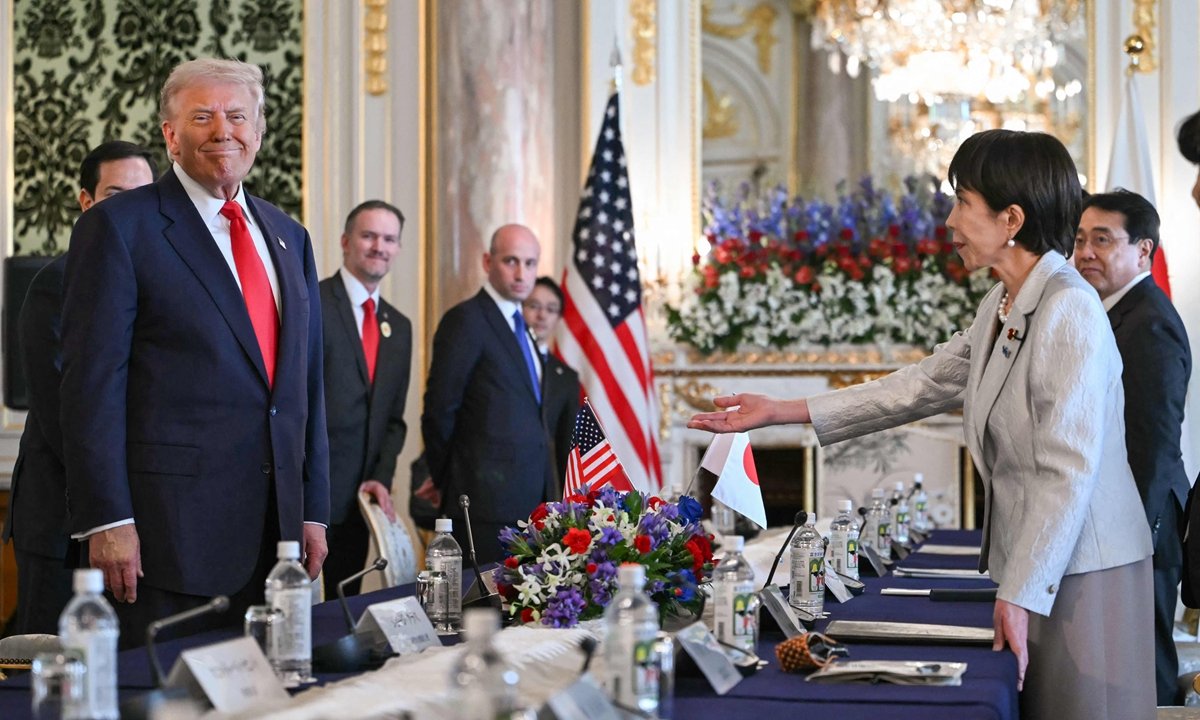
- Optics Over Outcomes: The Trump–Takaichi summit showcased friendship but produced few tangible results beyond symbolic agreements.
- Trade Tensions Persist: Japan’s $550 billion investment pledge masks deeper U.S. protectionism and long-term trade frictions.
- Security Paradox: Washington wants Japan to spend more on defense but resists Tokyo’s push for full strategic autonomy.
- China Factor Looms: Beijing’s wary response highlights how U.S.-Japan cooperation is increasingly seen through a China-containment lens.
When U.S. President Donald Trump met Japan’s new Prime Minister Sanae Takaichi at Tokyo’s stately Akasaka Palace this week, the images were choreographed to perfection: flags fluttering, hands clasped, and warm smiles echoing a “beautiful friendship.” But beneath the carefully staged optics of camaraderie, the meeting exposed the delicate fault lines running through one of the world’s most consequential alliances.
The visit — Trump’s first to Japan since Takaichi’s rise to power — was billed as an affirmation of U.S.-Japan ties, with both leaders eager to project unity amid rising global uncertainty. Standing before U.S. troops at Yokosuka Naval Base, Trump wrapped his arm around Takaichi’s shoulder, declaring their partnership a “foundation of peace and security in the Pacific.” Yet for all the rhetoric, analysts say the summit produced more symbolism than substance.
A Show of Strength, Not Strategy
Over the course of 40 minutes, the two leaders signed several agreements, most notably one on “critical minerals and rare earths” — a move aimed at securing supply chains that are currently dominated by China. The deal, hailed in Washington as a strategic breakthrough, commits Japan to a $550 billion investment fund in the United States while giving Trump room to impose a 15 percent tariff on Japanese goods.
The Trump–Xi Showdown: Seoul Summit Tests the Future of the Global Order
The tone was celebratory, but the content recycled long-standing talking points. Xiang Haoyu, a researcher at the China Institute of International Studies, noted that “many outcomes were reiterations of existing issues,” describing the meeting as “an act of showing closeness” rather than advancing new policy.
Indeed, the Trump administration’s push to decouple from China’s rare-earth dominance faces practical barriers. Both Washington and Tokyo depend heavily on Chinese processing facilities, and experts doubt that either nation can restructure their supply chains in the short term. The White House’s pledge to create “diversified and fair markets” for these minerals reads more like a geopolitical aspiration than an immediate plan.
The Trade Tensions Lurking Beneath
While the alliance appeared cordial, structural contradictions remain. Japan’s exports to the U.S. have fallen for six straight months, even as its economy posted a modest rebound. To retain market share, Japanese companies have been slashing prices — eroding profits and deepening domestic concerns about overdependence on the American market.
READ MORE: US-Japan first summit following Takaichi’s inauguration seeks to show ‘close alliance’ but structural contradictions persist: experts
Trump, meanwhile, seems determined to preserve his “America First” trade posture. The 15 percent import tax on Japanese goods underscores a lingering tension: Washington wants Japanese investment but remains wary of Japan’s export-driven economy. The economic partnership, though touted as mutually beneficial, continues to tilt in America’s favor.
At a dinner later in the evening, attended by Apple’s Tim Cook and other corporate elites, Trump reveled in the fresh investment pledges, casting them as proof of U.S. economic leadership. Yet behind the scenes, Japanese executives voiced quiet unease about the rising unpredictability of Trump’s trade policies.
Security Promises and Political Theater
Defense topped the agenda during Trump’s Japan stop, with both leaders invoking shared threats in the Indo-Pacific. Speaking aboard the USS George Washington, Takaichi warned of an “unprecedented severe security environment” and vowed to make Japan a “proactive contributor to regional peace.” Her administration is accelerating plans to raise defense spending to 2 percent of GDP — a move that aligns with Washington’s long-standing demand for greater burden-sharing.
ALSO READ: Historic Moment: Takaichi Becomes Japan’s Prime Minister, Markets React Sharply
But experts note that Japan’s pursuit of “autonomous defense” could soon test the limits of U.S. tolerance. Trump welcomes increased spending but remains cautious about Japan gaining full strategic independence. For Washington, a stronger Japan is useful — but only within the bounds of American command structures.
This paradox — of encouraging military strength while maintaining control — defines much of the modern U.S.-Japan alliance. Takaichi’s ambition to “restore strong Japanese diplomacy” hints at a subtle recalibration of Japan’s identity: a desire to be seen not merely as a junior ally but as a self-reliant regional power.
China Watches Closely
Beijing’s reaction to the Trump–Takaichi summit was swift and skeptical. Chinese Foreign Ministry spokesperson Guo Jiakun reminded both nations that the Asia-Pacific “should remain a region of peace and development,” warning that enhanced military cooperation must not undermine regional stability.
Guo’s remarks carried an implicit warning about Japan’s historical baggage. This year marks the 80th anniversary of the victory over Japanese militarism, a sensitive milestone in China’s national memory. Beijing’s message was clear: Japan’s increasing military posture will be closely scrutinized by its neighbors, especially if it is seen as part of a broader U.S. containment strategy.
Between Loyalty and Leverage
The deeper question emerging from the Trump–Takaichi meeting is not about policy but power. Can Japan sustain its loyalty to Washington while asserting greater independence in Asia? And can Trump, facing election pressures at home, afford to alienate a crucial ally while courting nationalist applause?
Takaichi’s rhetoric about a “new golden age” of alliance mirrors the optimism of Shinzo Abe’s era, but her challenge is more complex. With China’s economic gravity pulling the region eastward, and U.S. unpredictability pushing partners toward strategic hedging, Japan finds itself walking a tightrope.
For Trump, the optics of friendship matter as much as the outcomes. A warm handshake, a photo with troops, and the appearance of global leadership serve his domestic narrative. But for Tokyo, the stakes are existential — securing energy, markets, and autonomy in a world where the U.S. no longer guarantees unflinching support.
The Optics of an Uneasy Alliance
Ultimately, the Tokyo summit revealed more about the performance of alliance than its progress. The lavish ceremonies and mutual praise obscured unresolved trade disputes, unrealistic economic promises, and growing anxieties over defense sovereignty.
The U.S.-Japan relationship endures, but it is evolving from dependence to delicate negotiation — a partnership increasingly shaped by optics, not trust. As the two leaders toasted to a “beautiful friendship,” one could sense the careful diplomacy at play: a friendship scripted for the cameras, yet shadowed by the realities of an uneasy future.