



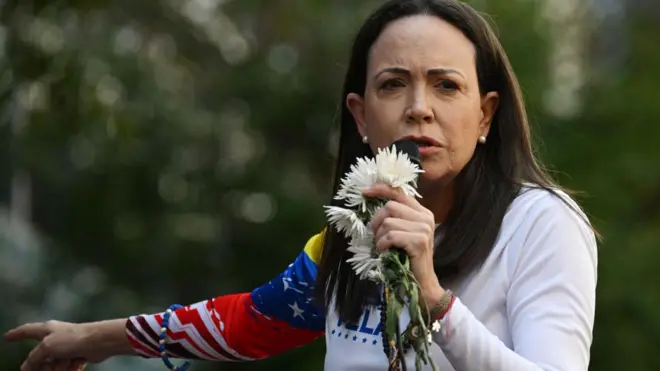
- María Corina Machado reunited emotionally with her daughter Ana Corina Sosa in Oslo after years of separation.
- The Nobel Peace Prize laureate vowed to bring her award back to Venezuela despite political risks.
- Millions of Venezuelans privately celebrate Machado’s courage, unable to express pride publicly due to regime repression.
- Unlike previous laureates from Pakistan and India, Machado faces a unique struggle to return home safely with her prize.
ISLAMABAD — Nobel Peace Prize laureate María Corina Machado reached Oslo on Thursday, ending a tense and secretive journey that captivated the world. After spending over a year in hiding in Venezuela to avoid arrest, Machado’s arrival was marked not by grand ceremonies, but by raw emotion, a personal reunion, and an unwavering declaration of her mission: to bring the Nobel Prize back to the Venezuelan people.
Dressed in white, Machado emerged from her private transport at Oslo’s Grand Hotel and immediately embraced her daughter, Ana Corina Sosa, in a moment of heartfelt relief.
The two had been separated for nearly two years amid political persecution and threats, and their reunion was a testament to both personal resilience and maternal love. “I cannot describe the emotions of finally seeing my mother,” Sosa told reporters, her voice breaking. “This is not just her victory; it belongs to every Venezuelan who has endured so much and dared to hope.”
Machado herself addressed the gathered journalists and supporters, her voice calm but charged with determination. “I came to Oslo to receive this honor not for myself, but for the Venezuelan people,” she said. “And when the time is right, this prize will return to Venezuela. It will carry the message of hope, courage, and the unwavering demand for democracy.”
READ MORE?: Trump’s Ukraine Peace Plan Marks a Historic Breakthrough in Ending the War
Unlike previous Nobel Peace laureates from South Asia—most recently, when individuals from Pakistan and India jointly received the award and were able to bring it home—Machado’s case is uniquely fraught. The political realities in Venezuela mean that public celebrations of her prize in her homeland could carry severe consequences. Fear, repression, and a regime intolerant of dissent prevent the majority of Venezuelans from openly expressing pride, even as they celebrate her courage in private.
“Millions of Venezuelans are proud of María,” said a Venezuelan human-rights activist speaking from Caracas on condition of anonymity. “But they cannot stand on the streets, they cannot wave the flag openly. They fear retaliation. This prize is theirs as much as it is hers—it is a symbol of resilience under oppression.”
ALSO READ: Nobel Peace Prize winner Machado vows to bring award back to Venezuela
During her remarks, Machado highlighted the broader struggles that have shaped her journey. She spoke of the widespread human-rights violations, systemic corruption, and criminal networks she believes sustain the Maduro regime. “Venezuela has become a hub of crime that stretches beyond our borders,” she said. “We cannot allow fear to silence us, and we cannot abandon the fight for justice, freedom, and dignity.”
The laureate’s Oslo schedule included a series of press conferences, public addresses, and meetings with international dignitaries. Yet her focus remained singular: how to ensure that the Nobel Peace Prize becomes a beacon for the Venezuelans who continue to suffer under political repression. She stressed that the award is a tribute to their courage and an encouragement for their continued struggle.
Machado’s emotional union with her daughter symbolized not only personal relief but also a broader narrative of resilience in the face of adversity. Sosa, who had taken the stage at the Nobel ceremony on her mother’s behalf, described the moment as a culmination of years of fear, hope, and sacrifice. “Seeing her again gives me strength,” Sosa said. “It reminds me why we continue to fight—for our family, for our country, and for a future where freedom is not a privilege, but a right.”
Despite the warmth of Oslo, Machado is acutely aware of the dangers that remain. Traveling outside Venezuela renders her a fugitive in the eyes of the regime, while returning home carries the risk of arrest. Yet she remains resolute. “This prize is not mine alone. It belongs to every Venezuelan who has suffered, to every citizen who has dared to dream of democracy,” she said. “And we will carry it back home when the time is right.”
Observers in the international community noted that Machado’s case is unprecedented. The Nobel Prize has occasionally highlighted struggles in authoritarian contexts, but rarely has a laureate faced such immediate personal risk in bringing the award back to the country that inspired it. Her decision to prioritize a future return, rather than immediate fanfare, underscores both prudence and commitment.
For Venezuelans, Machado’s achievement offers a rare moment of collective pride. Families across the country whisper of her courage, share messages of solidarity on private platforms, and celebrate in homes where fear cannot intrude. The Nobel Peace Prize has become a symbol of what is possible even under repression—a quiet, powerful affirmation that resistance and hope endure.
María Corina Machado’s Oslo appearance, her emotional reunion with Ana Corina Sosa, and her steadfast vow to bring the award back to Venezuela highlight the intersection of personal courage, political struggle, and national aspiration. Her story is a testament to how one individual’s determination can carry the hopes of millions, even when the world seems silent and the journey home is fraught with peril.