



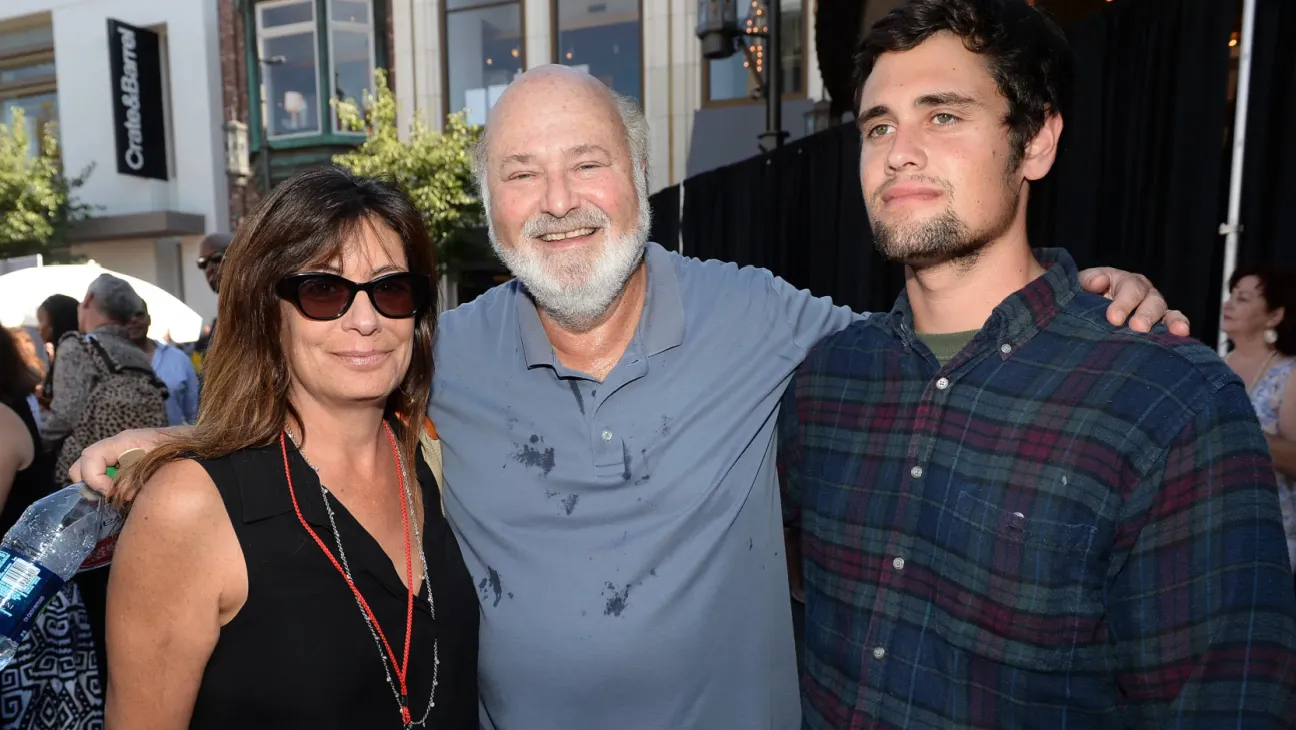
- Hollywood in Shock: The Rob Reiner murder case has silenced an entire industry, with A-list celebrities expressing disbelief and grief over the brutal killings.
- A Crime Beyond Violence: Investigators describe the Brentwood stabbing as an intimate, deliberate act—more than murder, a total annihilation of a family.
- Celebrity Pressure on Washington: Prominent actors and directors have reportedly urged President Trump’s administration to ensure transparency and accountability.
- Addiction, Redemption, and Rupture: The tragedy reignites urgent national debate over addiction, mental health, parental responsibility, and warning signs ignored too long.
Rob Reiner was pleading.
The voice that once commanded movie sets and filled theaters with laughter collapsed into something raw and broken. His screams were not those of a celebrity, not of a director, but of a father facing the unthinkable. His eyes were wide, flooded with disbelief. His hands were raised—not in defiance, not in anger, but in surrender. In that final, unbearable moment, the man who gave Hollywood romance, courage, and joy begged for his life. Mercy never arrived. The blade did. Again. And again. And again.
What detectives walked into hours later was not a home.
It was a mausoleum.
The Brentwood house—once alive with political debates, script readings, camera gear, family arguments, and laughter—stood frozen, as if time itself had recoiled. The air felt bruised. Furniture had been moved but not overturned, suggesting a violence that was deliberate, controlled, intimate. There were no broken windows. No signs of forced entry. No burglary. This was personal. Surgical. Devastatingly close.
Hollywood in Shock: Inside the Chilling Homicide Case Linked to Rob Reiner’s Family
Blood told the story no one wanted to hear.
It streaked across the hardwood floor in uneven arcs, tracing desperation. Investigators believe someone tried to move, to escape, to crawl away from a fate already sealed. Near the entryway, Rob Reiner collapsed. His posture suggested he was standing when the attack began. Defensive wounds spoke in a language older than fame or film—proof that he fought, not as a filmmaker, not as an icon, but as a husband and father trying to survive.
Deeper inside the house lay Michele Singer Reiner.
READ MORE: How Nick Reiner struggled with addiction, and his parents
The scene around her was quieter, almost reverent, which made it unbearable. Her final moments appeared swift, brutal, and merciless. There was no sign she had a chance to flee. The knife did not hesitate. The attacker did not pause. This was not blind rage. It was resolve.
Veteran homicide officers reportedly stepped outside to steady themselves.
“This wasn’t an ordinary murder,” one law enforcement source said quietly. “This was the annihilation of a family.”
Only then did the shock reach Hollywood.
Phones lit up across Beverly Hills, Malibu, Manhattan, and London. Studio heads froze mid-meeting. Production offices went silent. Sets shut down. Scripts were dropped. Grown men and women—hardened by an industry built on illusion—cried openly. No one knew what to say, because no one knew how this could happen.
ALSO READ: Pentagon’s Command Shake-Up Signals U.S. Retreat from CENTCOM: What It Means for Pakistan and Regional Security
Hollywood is mourning.
America is trembling.
As the news spread, grief poured in from every corner of the entertainment world. Tom Cruise. Angelina Jolie. Scarlett Johansson. Dwayne Johnson. Samuel L. Jackson. Chris Hemsworth. Zoe Saldaña. Chris Evans. Robert Downey Jr. Margot Robbie. Jennifer Lawrence. Leonardo DiCaprio. Meryl Streep. Keanu Reeves. Denzel Washington. Tom Hanks. Chris Pratt. Vin Diesel. An industry addicted to spectacle fell silent—because no script could prepare it for this.
This was not just the killing of two beloved figures.
It felt like an execution of American family norms. A public dismemberment of the belief that love, wealth, influence, and access to help could shield a family from total collapse. The Reiners were supposed to be proof that compassion mattered, that intervention worked, that redemption was possible.
Within hours, some of Hollywood’s most powerful figures quietly reached out to Washington.
According to industry insiders, prominent actors and directors personally contacted President Donald Trump’s office, urging federal attention and transparency. They demanded answers—not favors, not interference—but truth. How could a family so visible, so vocal about addiction recovery and mental health, end in such absolute devastation?
“This case has shaken us to the bone,” said an Oscar-winning director, speaking anonymously. “If it can happen to the Reiners, it can happen to anyone.”
The disbelief deepened as details about Nick Reiner emerged.
The same man who spoke candidly about recovery. Who was embraced by podcast audiences for brutal honesty. Who collaborated creatively with his father in an act of reconciliation. The same son now charged with murdering both parents in cold blood.
The word allegedly echoed across headlines. Emotionally, Hollywood was already drowning.
Candlelight vigils formed outside the Brentwood home. Flowers piled high. Handwritten notes appeared—from neighbors, strangers, aspiring filmmakers, recovering addicts—people who said Rob and Michele made them believe compassion could save lives.
“This was supposed to be a redemption story,” one mourner whispered through tears. “Not a crime scene.”
Inside court filings, prosecutors described a dangerous and deadly weapon and multiple acts of violence. Outside the courthouse, cameras captured stunned faces—people who had watched Rob Reiner for decades now watching a judge read charges tied to his death.
Hollywood demanded more details.
America demanded meaning.
Was addiction ignored too long? Was “tough love” misunderstood? Were warning signs missed because fame dulls danger? These questions now dominate late-night conversations, emergency meetings, and whispered phone calls between parents suddenly afraid in ways they never imagined.
Rob Reiner once said storytelling was about understanding human pain.
In his final chapter, pain became the story.
This was not just a double homicide. It was a rupture—of trust, of legacy, of the American myth that success can insulate a family from darkness. The blood spilled in that Brentwood home did not stain only the floorboards. It stained the conscience of a nation forced to confront an unbearable truth:
Sometimes love is not enough.
Sometimes help comes too late.
And sometimes, the greatest tragedies are born not of strangers—but of those we tried hardest to save.
Hollywood remains in shock.
America remains in mourning.
And as the investigation continues, one question hangs heavier than any verdict yet to come:
How did a family that symbolized creativity, compassion, and hope become the scene of one of the most chilling crimes in modern American memory?