



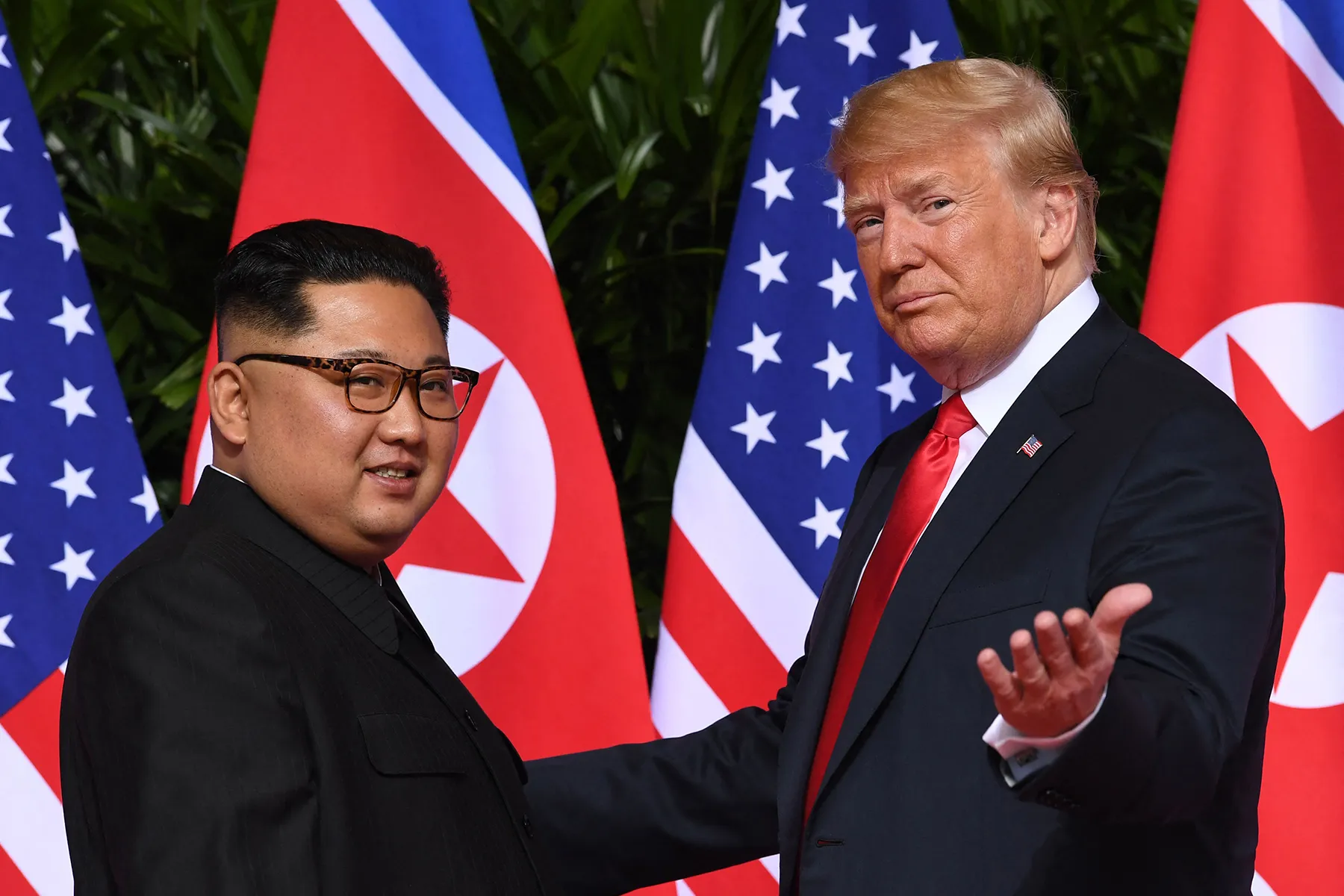
- Trump-Kim meeting 2026 could revive U.S.-North Korea summit diplomacy.
- Previous meetings: Singapore 2018, Hanoi 2019, DMZ 2019.
- Seoul and Washington coordinate for realistic denuclearization steps.
- Beijing, Moscow, and Seoul closely monitor strategic developments.
- Incremental “small deal” approach may pave the way for lasting peace.
As global attention increasingly turns to East Asia, the possibility of a U.S.-North Korea summit in 2026 between President Donald Trump and North Korean leader Kim Jong Un is generating cautious optimism among policymakers, analysts, and international observers. According to the Korea National Diplomatic Academy’s 2026 International Situation Outlook, coordinated efforts between Washington and Seoul could create conditions favorable for renewed dialogue and a historic diplomatic breakthrough on the Korean Peninsula.
Historically, the Trump-Kim relationship has been unprecedented. The two leaders met three times: in Singapore (June 2018), Hanoi, Vietnam (February 2019), and at the Korean Demilitarized Zone (June 2019). The Singapore summit marked the first-ever meeting between a sitting U.S. president and a North Korean leader, producing a joint statement focused on denuclearization and the normalization of bilateral relations. The Hanoi summit ended abruptly over disagreements regarding sanctions relief, while the DMZ meeting was largely symbolic, aimed at building trust and sustaining dialogue momentum.
Trump, Kim, and the Return of Strategic Signaling in Northeast Asia
Despite the historical ups and downs, analysts note that the framework laid by these meetings provides a foundation for future engagement. Min Jeong-hoon, senior professor at the Korea National Diplomatic Academy’s Institute for Foreign Affairs and National Security (IFANS), emphasized that next year’s agenda will focus on creating concrete preconditions for Kim to return to negotiations. “Seoul and Washington could step up communication around April, coinciding with President Trump’s planned visit to China, to facilitate a potential U.S.-North Korea summit,” Min said, highlighting the strategic timing.
READ MORE: If Trump Wants to Meet Kim Again, He’s Got One Big Opportunity in Early 2026
Trump’s overtures toward Pyongyang have been active this year, contrasted by Kim’s measured and cautious responses. While a potential summit discussion around the Asia-Pacific Economic Cooperation (APEC) meetings in Gyeongju last October did not materialize, Washington’s persistent engagement signals that Trump remains committed to direct diplomacy with North Korea. Analysts see this as a potential turning point for realistic, step-by-step denuclearization negotiations.
ALSO READ: Why the U.S. Should Worry About North Korea — Again
A key element in the success of a 2026 summit is the adoption of a “small deal” approach, which allows incremental progress toward denuclearization while offering Pyongyang tangible incentives. Min pointed to Trump’s public comments about easing certain sanctions and Seoul’s three-step roadmap for denuclearization, initiated during the Lee Jae-myung administration, as essential frameworks to create a mutually acceptable agreement. “If conditions are created for North Korea to come to the table through a small deal, the likelihood of a U.S.-North Korea summit rises significantly,” Min said.
Globally, Beijing, Moscow, and Seoul are closely monitoring developments. China, which continues to wield significant influence over Pyongyang, is expected to watch U.S. diplomatic efforts carefully, balancing its regional interests while safeguarding North Korea as a buffer state. Moscow, meanwhile, assesses strategic implications for its role in Northeast Asia, especially regarding security partnerships and sanctions coordination. Seoul has positioned itself as a mediator, ensuring that dialogue advances denuclearization goals without destabilizing regional security.
Choi Woo-sun, another IFANS professor, noted that Washington’s renewed focus on Asia signals a broader shift in U.S. foreign policy. “The Trump administration is likely to strengthen regional security partnerships with South Korea, Japan, and the Philippines while maintaining strategic ambiguity regarding Taiwan. This approach underscores the importance of proactive diplomacy with North Korea,” Choi said.
Analysts believe that careful timing could maximize diplomatic impact. Coordinating with Trump’s visit to China in April 2026, Seoul and Washington may leverage Chinese influence to encourage Pyongyang’s participation. Historically, Beijing has acted as a key intermediary in facilitating communication between Washington and Pyongyang, providing assurances to North Korea while signaling U.S. seriousness. Experts suggest that even symbolic gestures, such as easing humanitarian sanctions or opening limited economic cooperation, could significantly increase the probability of Kim agreeing to a summit.
Optimists argue that a 2026 summit could establish a durable peace architecture for the Korean Peninsula. Unlike the previous summits, which faced abrupt halts over unilateral expectations, the next engagement could emphasize incremental progress, transparency, and verification. Coordinated diplomacy between Washington and Seoul, coupled with Beijing’s engagement and Moscow’s strategic interest, may create a rare convergence of international support for negotiations.
In addition to denuclearization, the summit could signal a broader recalibration of U.S. policy in Asia. Choi noted that Washington is expected to gradually reduce engagement in Europe and the Middle East while expanding its diplomatic and military footprint in Asia. By strengthening alliances with regional partners and employing strategic deterrence alongside dialogue, the Trump administration may enhance stability while keeping North Korea engaged in constructive negotiations.
South Korea, under President Lee Jae-myung’s guidance, continues to advocate for a realistic, phased approach to denuclearization. By offering small, verifiable concessions, Seoul hopes to bring Pyongyang into dialogue, which could eventually lead to a comprehensive peace treaty to formally end the Korean War—a goal long sought but never realized.
Optimists highlight that the 2026 summit could also improve regional economic integration. With North Korea partially opening to international trade under controlled conditions, investment in infrastructure, energy, and logistics could offer a pathway toward gradual economic normalization. Trump’s experience in negotiating trade deals and leveraging sanctions relief could provide a mechanism for incremental engagement, demonstrating tangible benefits for Pyongyang while reinforcing denuclearization commitments.
Ending Note (50 words, Google-optimized):
With Beijing, Moscow, and Seoul closely monitoring, the Trump-Kim meeting in 2026 represents a rare strategic opportunity. By combining step-by-step denuclearization, targeted incentives, and coordinated U.S.-South Korea diplomacy, the summit could break years of stalemate, offering Northeast Asia a new chapter of peace, stability, and regional cooperation.