



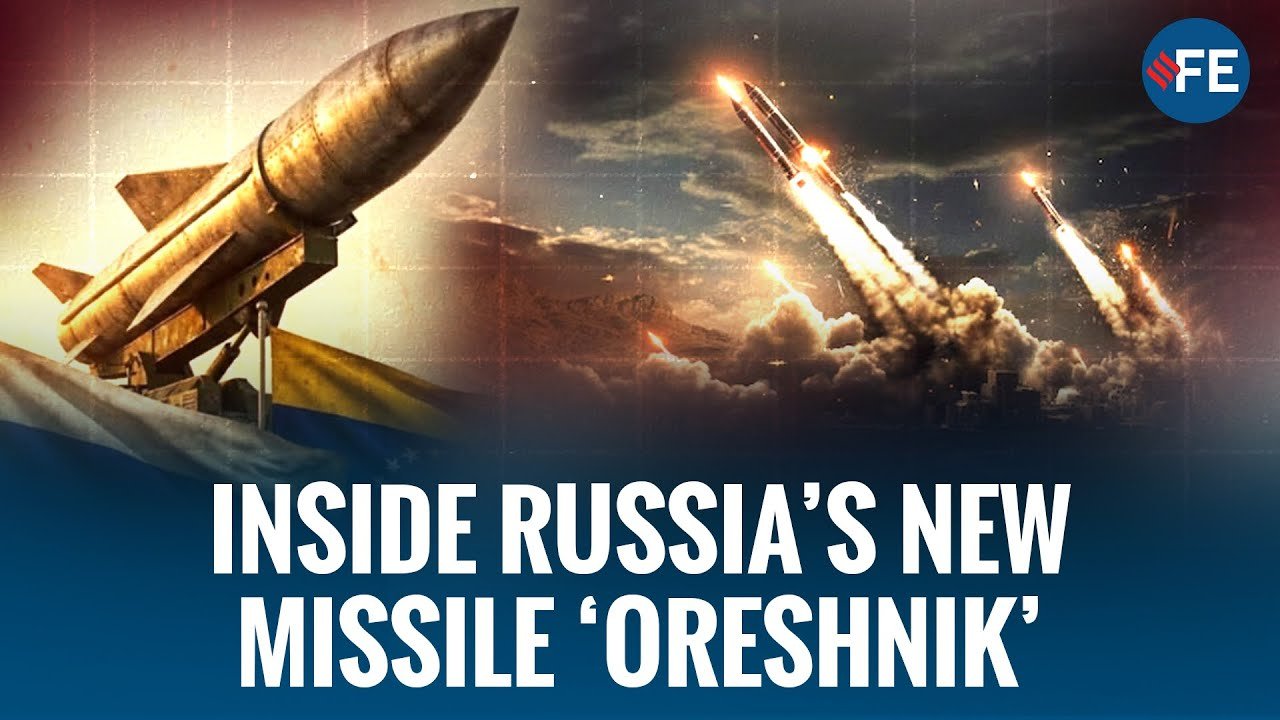
- Russia hypersonic missile launch signals Kremlin’s willingness to escalate the Ukraine war using its most advanced weapons
- Putin deploys the Oreshnik missile to intimidate Ukraine and warn Europe amid shifting battlefield setbacks
- Growing fears that Russia may expand the conflict beyond Ukraine into NATO-linked states
- Western governments brace for a prolonged and potentially wider war as Russia abandons earlier restraint
Russia’s overnight launch of the Oreshnik hypersonic missile into western Ukraine marks a decisive shift in the Ukraine conflict and signals Moscow’s willingness to push the war toward a far more dangerous frontier. The strike, the first deployment of the Oreshnik since late 2024, underscores not only Russia’s growing frustration with stalled diplomacy but also President Vladimir Putin’s intent to use advanced and potentially devastating weapons to shape the military and diplomatic landscape.
The Oreshnik is one of Russia’s most powerful strategic tools—capable of travelling more than ten times the speed of sound, designed to evade missile defenses, and engineered to carry either conventional or nuclear warheads. For two years, its operational use has been rare, reserved largely for highly symbolic moments. Its reappearance now is no coincidence.
A Missile Message to the World
The strike on Lviv came at a moment of acute geopolitical tension. Over the previous week, Russia suffered several strategic blows that rattled the Kremlin’s confidence. In Washington, President Donald Trump ordered U.S. special forces to seize Venezuelan President Nicolás Maduro—one of Moscow’s closest allies. U.S. naval forces also intercepted a Russian-flagged oil tanker in the North Atlantic, disrupting a critical energy-supply route.
At the same time, European capitals signaled their willingness to intervene more directly in the Ukraine conflict. Britain and France announced that they may deploy troops into Ukraine should a ceasefire be reached—an unprecedented step that would place NATO-trained militaries on Ukrainian soil for the first time.
Putin reacted swiftly. Moscow warned that it would treat any European deployment as legitimate military targets, effectively erasing the distinction between supporting Ukraine and joining the war. The Oreshnik’s launch days later made that warning louder, faster, and much harder to ignore.
A Weapon for Military Use — And Psychological Warfare
Experts agree that the Oreshnik strike carried a symbolic function as much as a military one. Analysts say that Russia’s message is clear: ignore us at your peril.
For months, the United States and Europe have held intense ceasefire negotiations directly with Kyiv, while Moscow has found itself increasingly sidelined. Russian officials believe the West is trying to craft an endgame without Russia’s involvement—an outcome Putin sees as unacceptable.
Launching the Oreshnik, therefore, serves as a reminder that Russia still possesses tools capable of reshaping the battlefield, destabilizing Europe, and raising the stakes of the war. It is also a way of forcing Western governments—particularly Trump’s administration—to engage seriously with Moscow’s demands.
Several military analysts have suggested that the latest strike likely used inert or even dummy warheads—the same method Russia employed when first firing the missile in 2024. The intent, they argue, was signaling rather than destruction.
Still, the psychological impact is undeniable. Ukraine now faces a weapon that few air-defense systems can intercept. Europe, watching a hypersonic missile land near NATO borders, receives the message that Russia’s evolving arsenal is not limited to eastern Ukraine—or to Ukraine at all.
A War That Could Spread Beyond Kyiv
The Oreshnik’s deployment brings new urgency to a reality long whispered by diplomats: the war may not remain confined to Ukraine. Putin has repeatedly indicated that nations he views as “co-combatants”—Poland, the Baltic states, and increasingly France and Britain—could become targets if they cross certain red lines.
The fear now is that those red lines are moving.
Putin’s own rhetoric has hardened. Russian insiders—speaking privately to regional outlets—suggest that the Kremlin has given the military formal authorization to use “every available weapon,” and that Russia is prepared to widen the conflict into Europe if provoked. Whether this is a bluff or a battle plan matters less than the fact that it must be taken seriously.
Moral Boundaries Erode
Russia once maintained certain norms in warfare—even in Chechnya, Syria, and Georgia, where civilian casualties were high, Moscow sought to claim some form of ethical justification. In Ukraine, however, those boundaries appear to be collapsing.
Hypersonic strike weapons, used against infrastructure in populated areas, blur every line of humanitarian law. Destroying power grids in winter, disrupting water and energy supply, and targeting dual-use facilities directly affects civilians. These are tactics aimed not just at armies but at societies.
What Comes Next
If the Oreshnik becomes a recurring feature of Russia’s campaign, two outcomes loom:
A darker phase of the conflict, with Russia leveraging its most advanced weapons to force talks on its terms.
A broader regional confrontation, with NATO states increasingly drawn into the line of fire—whether they choose it or not.
Either way, Putin has made his position unmistakable. He has no intention of ending the war on Western terms. He will escalate, widen and intensify the conflict—even if that means pushing Europe to the brink.
The Oreshnik missile’s blaze over the Ukrainian sky may not have caused catastrophic destruction—but its political shockwave may prove just as explosive.