



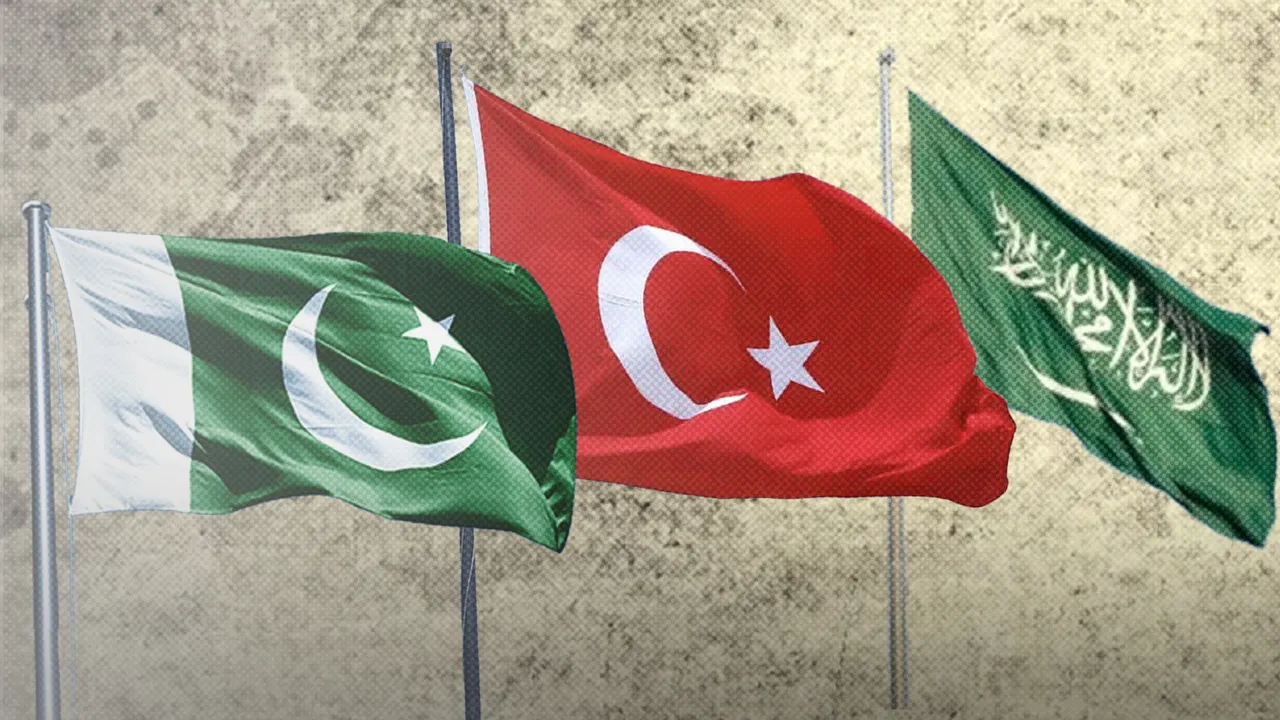
The historical relationship between the decline of major Islamic powers and the subsequent rise of Europe is often viewed as a “hijacking of destiny”. While the Islamic world was the global leader in science, trade, and statecraft during its Golden Age (8th–14th centuries), the 15th century marked a pivotal shift in global dominance. From a traditional Muslim worldview, the decline was not merely a loss of territory but a loss of the “dynamic force” that once integrated faith with rational inquiry.
Scholars like Ibn Khaldun attributed the fall of dynasties to a natural cycle where “young, energetic tribes” (like the early Muslims or later Europeans) eventually overcome “old, decaying civilizations”. Many historians argue that the Islamic world was slow to recognize that Europe—long perceived as primitive and disorganized—had begun to surpass it through the Scientific Revolution and maritime exploration. The 19th-century intellectual movement saw Muslim thinkers grappling with why their societies had fallen behind, leading to a drive for modernization and a re-evaluation of Islamic role in politics.
The “Rise of Europe” was significantly fuelled by the very civilization it eventually superseded. Muslim scholars preserved and translated ancient Greek texts that were lost to Europe during the “Dark Ages.” These works, along with original Muslim advancements in mathematics, astronomy, and medicine, became the foundation for the European Renaissance. The Fall of Constantinople in 1453 drove Byzantine scholars to Italy, triggering the Renaissance, while simultaneously blocking traditional European trade routes to the East, forcing Europeans to seek new routes that led to the discovery of the Americas.
While empires like the Ottomans initially thrived through gunpowder technology, the subsequent European industrialization and military decentralization allowed them to eventually outpace the more centralized, slave-based military systems of the Islamic world (like the Mamluks). By the 18th and 19th centuries, the shift in power was complete, leading to widespread European colonization of Muslim lands. Major regions including Egypt, India, and North Africa fell under British, French, or Russian control, leading to a period of “protection” policies that many Muslim leaders resisted or navigated through strategic cooperation. Today, the perspective often shifts toward “reclaiming” this lost history to understand contemporary cultural and religious identities in a globalized world.
A New Muslim Military Alliance? Why Turkiye Wants Into the Pakistan–Saudi Defence Pact
The dissolution of the Union of Soviet Socialist Republics (USSR) took place at the end of the last century, culminating on December 26, 1991. The collapse was driven by economic stagnation, ethnic separatism, and the failure of reforms (Glasnost and Perestroika) initiated by Mikhail Gorbachev, which inadvertently weakened central authority. The catalyst event was the invasion of Afghanistan that was an attempt to divert attention from its crumbling economy and unrealistic power exposure to avoid the demise of USSR. After a failed coup attempt in August 1991, power shifted rapidly to nationalist leaders like Boris Yeltsin.
On December 8, 1991, the leaders of Russia, Ukraine, and Belarus signed the Belovezha Accords, declaring the USSR no longer existed. As far as NATO is concerned, as of early 2026, NATO (North Atlantic Treaty Organization) has not experienced a demise. It is, however, experiencing significant strain and internal debate regarding its future relevance, funding, and US involvement.
A Potential Alliance Between Saudi Arabia, Pakistan, and Turkey… Who Is the Target?
Furthermore, India as a tool of hegemony for West was badly exposed during 96-hour May 2025 war with Pakistan. After this humiliating defeat, India has lost its credibility not only in military standpoint but also big time in economic standpoint. India is not relevant anymore from strategic perspective. The chain of events started from Feb 2019 air skirmish with Pakistan where Indian pilot Abhinandan was captured and two Indian planes were destroyed. Also, India was standing with Armenia in Karabakh war and Pakistan and Turley were standing with Azerbaijan and as a result, Karabakh was liberated.
India and its equipment were badly exposed in Karabakh war. Ousting of India from Bangladesh couple of years ago was one of the major strategic defeats of India and it triggered further demise of Indian hegemony that shattered the Indian myth of drowning the two nations theory in Bay of Bengal. Indian establishment was not even able to anticipate such big uprising in Bangladesh and blamed Pakistan for supporting this uprising. The Climax of this Indian hegemony demise was the 96-hour war with Pakistan that ultimately nailed in the coffin of Indian so called military myth.
Türkiye is aggressively expanding its geopolitical footprint through a “forward defence” doctrine, utilizing military, diplomatic, and energy-focused strategies to secure influence. In 2026, Ankara is heavily involved in mediating the post-Assad, post-PKK landscape in Syria, strengthening maritime and energy deals in Libya and Somalia, and building a security axis against rivals in the Red Sea. Following the collapse of the Assad regime, Türkiye is leveraging its influence to manage the transition, aiming to eliminate the PKK/SDF presence in the north and shape the new political order.
Türkiye is consolidating its 2019/2022 maritime and military agreements to secure long-term energy exploration rights and stabilize the Tripoli-based government against rivals. In 2026, Türkiye is launching oil and gas exploration off the Somali coast and has secured deep-sea drilling capabilities, strengthening its economic and security presence in the Horn of Africa. Turkey has joined a strategic partnership with Sudan, Egypt, and Somalia to counter rival influence in the Red Sea and Horn of Africa, integrating its security strategies across North Africa and the Gulf.
Pakistan and Saudi Arabia signed a “Strategic Mutual Defence Agreement” (SMDA) on September 17, 2025, significantly deepening their security ties. The pact reinforces a long-standing partnership, with both sides committing to mutual security and viewing aggression against one as against both. It covers defence cooperation, training, and potential military support, though it is not a NATO-like treaty. The SMDA, signed by Saudi Crown Prince Mohammed bin Salman and Pakistani PM Shehbaz Sharif, formalizes security cooperation, emphasizing joint deterrence and regional stability.
While covering military means and intelligence sharing, the agreement is believed to maintain “strategic ambiguity” regarding the specific nature of military interventions. While the agreement enhances security, analysts note it does not formalize a “nuclear umbrella” over Saudi Arabia. However, the agreement is seen as a move to deter threats against the Kingdom. As of January 2026, reports suggest that Turkey is in advanced talks to join this agreement with Pakistan and Saudi Arabia, potentially creating a new, stronger trilateral security bloc. This partnership allows Saudi Arabia to diversify its security partners and allows Pakistan to boost its defence industry through cooperation and potential, such as the reported $2bn sale of JF-17 fighters.
The pact signals a shift toward a more active role for Pakistan in Gulf security and reinforces the long-standing military-to-military relationship between Riyadh and Islamabad. As of January 2026, Pakistan, Türkiye, and Saudi Arabia are in advanced negotiations to finalize a trilateral defence agreement. Often referred to as a “Muslim NATO,” this pact aims to formalize decades of security cooperation and establish a new regional security bloc.
Turkey and Pakistan are deepening strategic defence ties, focusing on co-production of advanced unmanned aerial vehicles (UAVs), 5th-gen fighter jets, and naval systems. Turkey is establishing drone manufacturing facilities in Pakistan and involving Pakistani engineers in the KAAN fighter jet project, enhancing Pakistan’s aerial capabilities while boosting Turkey’s defence exports. Turkey has developed a reputable edge with advanced drones like the Bayraktar TB2, Akinci, Anka-3, and the Kizilelma, which features 6th-gen loyal wingman capabilities.
Turkey is developing the KAAN 5th-gen fighter jet, the “Steel Dome” AI-augmented air defence system, and various missiles (Atmaca, Hisar). The MİLGEM project, producing ADA-class corvettes, has bolstered regional maritime capabilities. Turkey is expanding its drone production by setting up assembly facilities for combat drones in Pakistan. Pakistani engineers are involved in the development of Turkey’s 5th-generation KAAN fighter jet, and both nations are cooperating on beyond-visual-range (BVR) missile technology. Pakistan has acquired MİLGEM corvettes, which include significant technology transfer to develop indigenous frigates.
Turkey has upgraded Pakistan’s F-16 fleet and Agosta 90B submarines. This partnership aims for, and is achieving, higher levels of technological self-reliance, with Pakistan benefiting from Turkey’s rapid innovation in drone warfare, and Turkey leveraging Pakistan’s expertise for, among other things, reducing the cost of its 5th-generation fighter project.
Pakistan and Turkey are deepening their strategic, defence, and economic ties to create a significant, independent power bloc, potentially altering the Eurasian and Middle Eastern geopolitical landscape. By merging Turkey’s advanced defence industry and regional influence with Pakistan’s military capacity and nuclear deterrence, this alliance seeks to reduce reliance on the West and reshape security dynamics.
Based on such alignments and security pacts mentioned above, and global rapid changing geopolitical landscape where Europe is trying to survive and is on backfoot first time in many hundreds of years, situation in Middle east and American continent is developing either this is Greenland scenario or Gaza peace board, the strategic ground is being lost by rival forces. Pakistan Türkiye and Saudi Arabia are rapidly advancing to counter the strategic outcome of such geopolitical and economic gap. The countries in central Asia will also like to join such alliance along with Indonesia Malysia Qatar Egypt Algeria etc.
It is visible that global geopolitical scenario is changing and we will see in our life time that our renaissance has been started lead by Türkiye and Pakistan. Our friends and colleagues ask often that we should not lose such opportunity and should not wait for another 100 years because big events often take 100 years’ time to occur. My final words are that “we will not wait for another 100 years, we will see this renaissance in our life time, God willing”.