



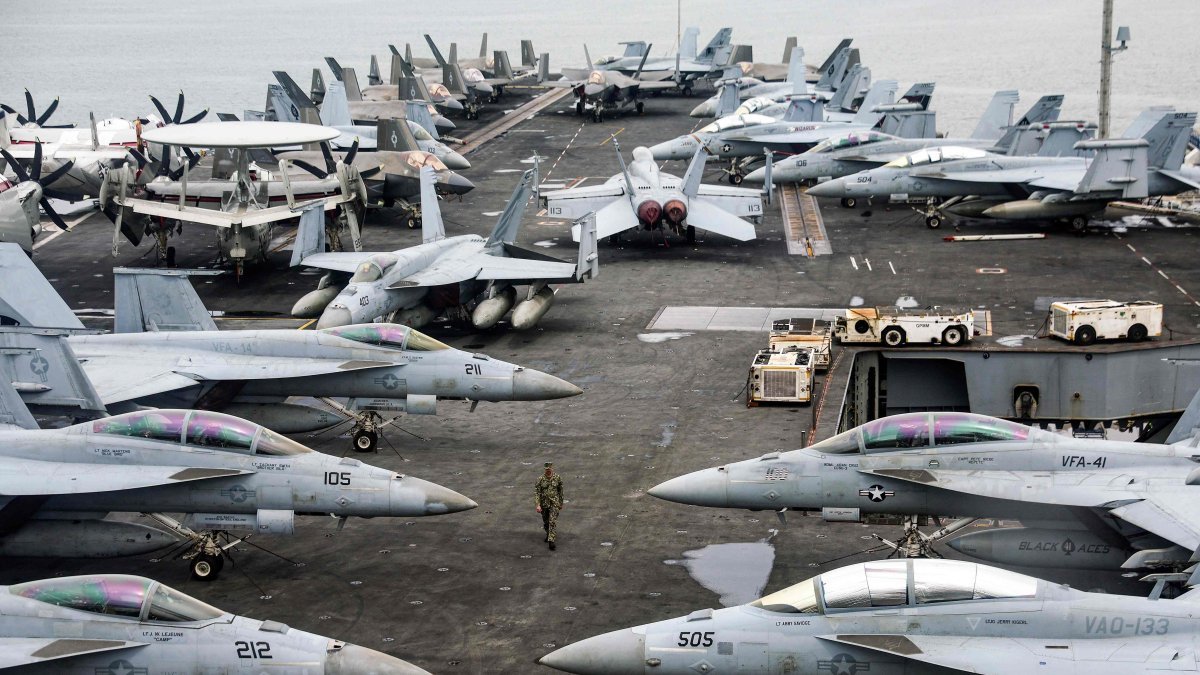
- • U.S Iran tensions surged after an Iranian drone was shot down near the U.S aircraft carrier Abraham Lincoln in the Arabian Sea
- • The dramatic incident unfolded just as Washington and Tehran were preparing for critical nuclear talks in Turkey
- • Iranian Revolutionary Guard boats also harassed a U.S-flagged tanker in the Strait of Hormuz, raising fears of maritime escalation
- • Oil prices spiked immediately as markets reacted to the growing risk of a full-scale U.S Iran military confrontation
The U.S. military on Tuesday shot down an Iranian drone that “aggressively” approached the Abraham Lincoln aircraft carrier in the Arabian Sea, the U.S. military said, in an incident first reported by Reuters.
The incident came as diplomats sought to arrange nuclear talks between Iran and the United States, and U.S. President Donald Trump warned that with U.S. warships heading toward Iran, “bad things” would probably happen if a deal could not be reached.
Oil futures prices rose more than $1 per barrel after news the drone was shot down.
The Iranian Shahed-139 drone was flying toward the carrier “with unclear intent” and was shot down by an F-35 U.S. fighter jet, the U.S. military said.
“An F-35C fighter jet from Abraham Lincoln shot down the Iranian drone in self-defense and to protect the aircraft carrier and personnel on board,” said Navy Captain Tim Hawkins, a spokesperson at the U.S. military’s Central Command.
The shootdown of an Iranian drone near the U.S aircraft carrier Abraham Lincoln in the Arabian Sea this week offered a stark illustration of how precarious the current U.S.–Iran standoff has become. The incident unfolded just as Washington and Tehran were laying the groundwork for renewed nuclear negotiations in Turkey, exposing the fragile coexistence of diplomacy and confrontation that now defines relations between the two adversaries.
According to U.S Central Command, the Iranian Shahed-139 drone approached the carrier “with unclear intent” before being destroyed by an F-35 fighter jet in what U.S officials characterized as a defensive action. No casualties were reported. Yet the strategic significance of the encounter far outweighed the brief exchange of fire. In recent years, such close encounters have repeatedly served as flashpoints in an increasingly crowded maritime battlespace stretching from the Arabian Sea to the Strait of Hormuz.
The Abraham Lincoln strike group forms the centerpiece of a visible U.S military buildup in the region following Iran’s violent suppression of anti-government demonstrations last month. President Donald Trump has since hardened his position, publicly demanding major nuclear concessions and warning that failure to reach an agreement could lead to serious consequences. Warships moving closer to Iran’s coastline have reinforced that message.
At the same time, Iranian officials, including senior security figures, have confirmed that negotiations with Washington are being prepared, with Turkey expected to host the talks. The simultaneous pursuit of diplomacy and calibrated military pressure reflects Tehran’s long-standing approach to negotiations—testing red lines while signaling openness to dialogue.
Financial markets immediately responded to the drone incident. Oil prices rose more than $1 per barrel, underscoring concerns that even limited clashes could disrupt shipping through the Strait of Hormuz, a chokepoint vital to global energy flows. Nearly 20 percent of the world’s oil passes through the narrow waterway each day, making it a persistent vulnerability in any U.S.–Iran confrontation.
Iran’s official reaction was muted. Its U.N mission declined to comment, while Iranian media reported the loss of contact with a drone over international waters without elaborating on the cause. The ambiguity aligns with Tehran’s broader strategy of maintaining plausible deniability while demonstrating its operational reach.
The tension intensified further when, only hours after the shootdown, Iranian Revolutionary Guard naval units harassed a U.S-flagged tanker in the Strait of Hormuz. According to U.S military officials, Iranian boats ordered the vessel to stop and prepare for boarding before a U.S Navy destroyer intervened, escorting the tanker to safety.
The episode highlighted how maritime encounters are becoming an increasingly central arena for signaling between Washington and Tehran. Over the past decade, Iran has frequently used fast boats, drones, and proxy operations to challenge U.S presence without triggering outright conflict.
Regional actors are responding with growing unease. Gulf states remain concerned that escalation could imperil energy exports and domestic stability. Israel continues to warn that Iran’s expanding drone capabilities represent a serious strategic threat. European governments, meanwhile, have urged restraint, emphasizing that renewed hostilities would likely derail any chance of reviving nuclear diplomacy.
China, heavily reliant on Gulf energy supplies, has quietly encouraged de-escalation, wary that prolonged instability could disrupt global markets.
Analysts broadly view Iran’s actions as part of a calculated effort to enhance leverage ahead of negotiations.
“Tehran is signaling that it retains the capacity to impose costs—on U.S forces and on the global economy—without crossing into open war,” said one former Western diplomat involved in previous nuclear talks. “But that form of brinkmanship always carries the risk of unintended escalation.”
For Washington, the decision to limit its response to defensive measures reflects an attempt to balance deterrence with diplomatic engagement. The Biden administration’s predecessors faced similar dilemmas, as each provocation raised pressure to respond forcefully while risking a wider conflict.
As talks in Turkey approach, the broader strategic environment remains highly volatile. Military assets from multiple powers are operating in close proximity, while political pressure is rising on both sides to avoid appearing weak.
The latest incidents serve as a reminder that the U.S.–Iran relationship is now being shaped as much by actions at sea and in the air as by negotiations at the table.
Whether upcoming diplomacy can stabilize the situation—or merely manage it temporarily—remains uncertain. What is clear is that the margin for error in the Middle East is shrinking, and even routine encounters now carry the potential to trigger consequences far beyond their immediate scope.