



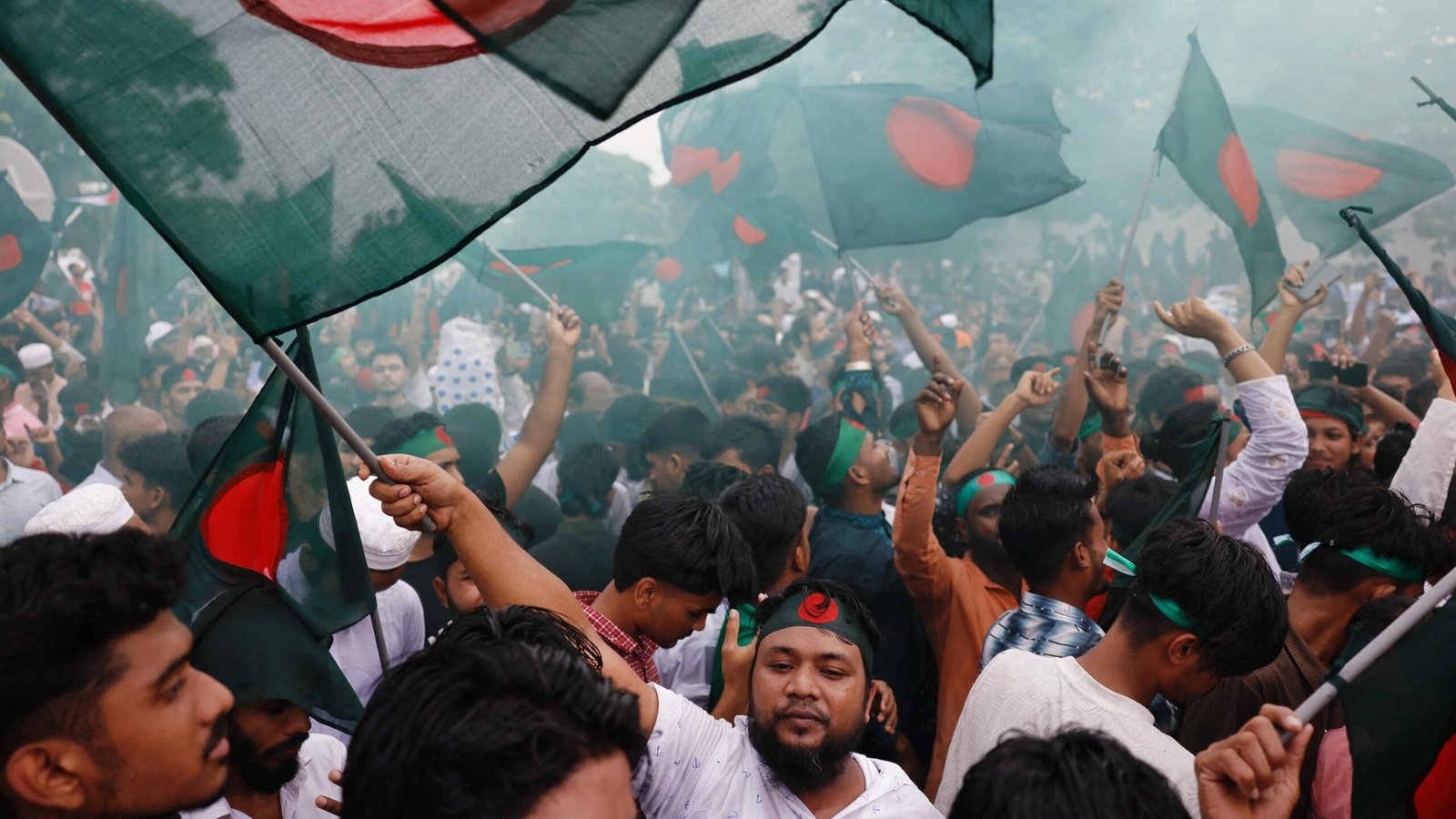
- BNP landslide victory in Bangladesh election reflects a historic rejection of authoritarian rule.
- Generation Z voters decisively ended Sheikh Hasina’s 15-year iron-fisted leadership.
- The Awami League’s collapse signals Bangladesh’s first competitive election since 2009.
- The verdict reshapes regional power dynamics involving Pakistan, India, and China.
Today’s election in Bangladesh marks one of the most consequential democratic moments of the 21st century. For the first time in modern history, a deeply entrenched, authoritarian-style prime minister has been removed not by foreign pressure or palace intrigue, but by a generational uprising that refused to accept fear as a political destiny.
As ballots are cast on February 12, the world is witnessing what few believed possible: Generation Z has effectively ended the iron-fisted rule of Sheikh Hasina, a leader who dominated Bangladesh’s political life for nearly fifteen years.
The Bangladesh Nationalist Party (BNP) is now widely expected to secure a decisive—if not historic—landslide victory. This election is not merely a change of government; it is a referendum on authoritarianism, enforced silence, and the weaponization of state institutions against dissent.
For years under Hasina’s Awami League, elections were exercises in inevitability. Opposition parties were either boycotted, hollowed out by mass arrests, or sidelined by intimidation. Senior BNP leaders were jailed, exiled, or silenced. Media space narrowed, civil society suffocated, and dissent became synonymous with disloyalty. Bangladesh functioned less like a pluralistic democracy and more like a one-party security state.
That political order collapsed in 2024, when sustained youth-led protests—driven overwhelmingly by Gen-Z activists—shattered the illusion of permanence around Hasina’s rule. These young Bangladeshis, born after the democratic optimism of the 1990s, rejected a system that offered economic growth without political freedom. Their uprising forced Hasina into exile in India and reset the country’s political trajectory.
Now, with the Awami League banned and discredited, the electoral terrain has flipped entirely. Streets once dominated by the ruling party’s “boat” symbol are now covered with BNP’s “sheaf of paddy” and Jamaat-e-Islami’s “scales.” Campaign shacks, posters, and rallies signal something Bangladesh has not seen since 2009: genuine electoral competition.
The BNP, contesting 292 of the 300 parliamentary seats, enters the vote with unmatched organizational reach, grassroots loyalty, and public sympathy built over years of repression. Party chief Tarique Rahman has expressed confidence in forming the next government, and analysts agree that only an overwhelming BNP mandate can restore stability after months of unrest that disrupted Bangladesh’s economy, particularly its globally vital garment industry.
Crucially, Generation Z—nearly a quarter of the electorate—has emerged as the decisive force. While a Gen-Z-driven new party failed to translate street mobilization into electoral machinery and aligned with Jamaat-e-Islami, the broader youth vote is expected to punish the political system that denied them voice, accountability, and dignity. This election is the culmination of their revolt.
Beyond Bangladesh’s borders, the verdict will reshape South Asian geopolitics. India’s influence, long amplified through its close alignment with Hasina, is visibly waning. New Delhi’s decision to shelter the former prime minister has reinforced perceptions of interference rather than partnership. China, meanwhile, has quietly expanded its diplomatic footprint, engaging both Islamist and youth-aligned actors.
Pakistan stands to benefit from this democratic reset. A post-Hasina Bangladesh offers Islamabad an opportunity to rebuild relations on the basis of mutual respect, shared Muslim identity, and non-interference—principles long undermined by Dhaka’s India-centric foreign policy. A BNP-led government, and even more so a parliament less dominated by New Delhi’s preferences, opens space for regional balance rather than hegemony.
This election is not about ideology alone. It is about whether a nation of 175 million can reclaim democratic agency after years of enforced compliance. A fractured outcome would prolong instability. A decisive BNP landslide, by contrast, would send an unmistakable message: authoritarian rule, no matter how entrenched, can be undone by a politically awakened generation.
Bangladesh today stands where history bends. And this time, it bends toward democracy.