



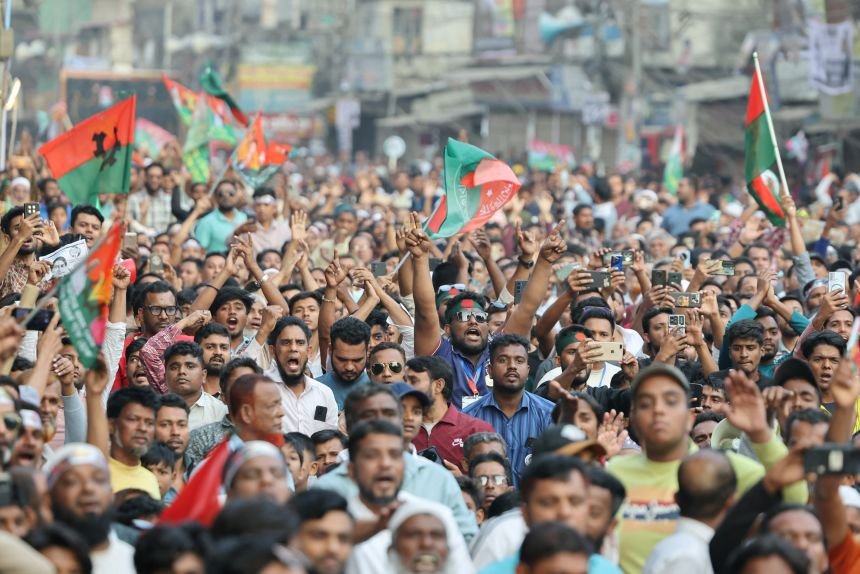
A political renaissance has swept across South Asia as the Bangladesh Nationalist Party (BNP) secured a decisive two-thirds majority in Bangladesh’s most competitive election in years, marking a historic return to power after two decades and signaling a dramatic reset in the region’s political landscape.
The parliamentary election, held in the 300-member Jatiya Sangsad, or House of the Nation, delivered an overwhelming mandate to the BNP and its allies, who captured more than 209 seats according to domestic television projections, with later counts suggesting the bloc could secure at least 212 of the 299 declared seats. The scale of the victory surpasses the party’s 2001 triumph and firmly establishes it as the dominant political force in the Muslim-majority nation of 175 million people.
For Bangladesh, this was more than a routine change of government. It was the first national vote since the dramatic 2024 Gen Z-driven uprising that toppled long-time premier Sheikh Hasina and forced her into exile in neighboring India. Months of unrest had disrupted everyday life and rattled key industries, particularly the garment sector, where Bangladesh ranks as the world’s second-largest exporter. Stability was urgently needed. The electorate delivered it emphatically.
Across Dhaka and other major cities, scenes of restrained jubilation unfolded. Although party leaders urged supporters to avoid victory rallies and instead offer prayers at mosques, temples, churches, and pagodas, the sense of relief was unmistakable. After years of political polarization and allegations of flawed electoral processes, voters appeared energized. Turnout was estimated to exceed 60 percent—significantly higher than the 42 percent recorded in the previous election.
At the center of this resurgence stands Tarique Rahman, the 60-year-old son of former Prime Minister Khaleda Zia and former President Ziaur Rahman. Having returned to Dhaka in December after 18 years abroad, Rahman is widely expected to be sworn in as prime minister. His family name carries powerful historical symbolism: Ziaur Rahman was a central independence figure who ruled from 1977 until his assassination in 1981. Now, the BNP appears poised to shape Bangladesh’s next chapter.
The victory also marks a clear ideological shift. Historically, the BNP has positioned itself as a democratic force advocating balanced relations with all regional powers. Party leaders have repeatedly emphasized the importance of constructive engagement not only with India and China but also with Pakistan and other South Asian neighbors. In a region often defined by rivalry and suspicion, the BNP’s return is being interpreted by many analysts as an opportunity to recalibrate regional diplomacy.
The election was widely described as Bangladesh’s first truly competitive vote in years. More than 2,000 candidates from over 50 parties contested—a national record. Sheikh Hasina’s Awami League, which had governed for more than 15 years, was barred from participating following her ouster. In exile in New Delhi, Hasina denounced the vote as illegitimate and demanded fresh elections under a neutral caretaker government. Her critics, however, argue that elections under her tenure were frequently marred by boycotts and intimidation.
Adding further weight to the historic moment was a parallel constitutional referendum. Proposed reforms included establishing a neutral interim government during election periods, restructuring parliament into a bicameral legislature, enhancing judicial independence, increasing women’s representation, and imposing a two-term limit on the prime minister. Early media reports indicated that roughly 73 percent of voters supported the reforms—an outcome that, if confirmed, could permanently alter Bangladesh’s political architecture.
The BNP’s campaign platform combined populist economic pledges with structural reform. It promised financial aid for low-income families, anti-corruption initiatives, a ten-year cap on an individual serving as prime minister, and policies to attract foreign investment to revive growth. After months of instability that hit exports and investor confidence, the promise of economic normalization resonated strongly with voters.
Internationally, the implications are significant. Relations between Dhaka and New Delhi had frayed in the aftermath of Hasina’s departure to India, opening space for Beijing to expand its influence. A BNP government committed to diversified partnerships could seek to rebalance ties, reducing overreliance on any single power while reaffirming Bangladesh’s strategic autonomy.
Meanwhile, Shafiqur Rahman of Jamaat-e-Islami conceded defeat, pledging “positive politics” rather than obstruction. That tone may help consolidate stability in a country fatigued by confrontation.
For many Bangladeshis, this election represents closure and renewal at once—a decisive break from prolonged unrest and a hopeful beginning. The restrained celebrations and calls for national prayers reflected a collective understanding of the stakes. After years of political turbulence, voters have chosen continuity through change.
In South Asia, where democratic reversals and contested mandates are not uncommon, Bangladesh’s landmark vote stands out. A powerful mandate, high turnout, constitutional reform, and generational political transformation together form the contours of what many are calling a renaissance. Whether the BNP can translate electoral triumph into durable governance will determine if this historic moment becomes a lasting turning point—not only for Bangladesh, but for the broader region watching closely.