



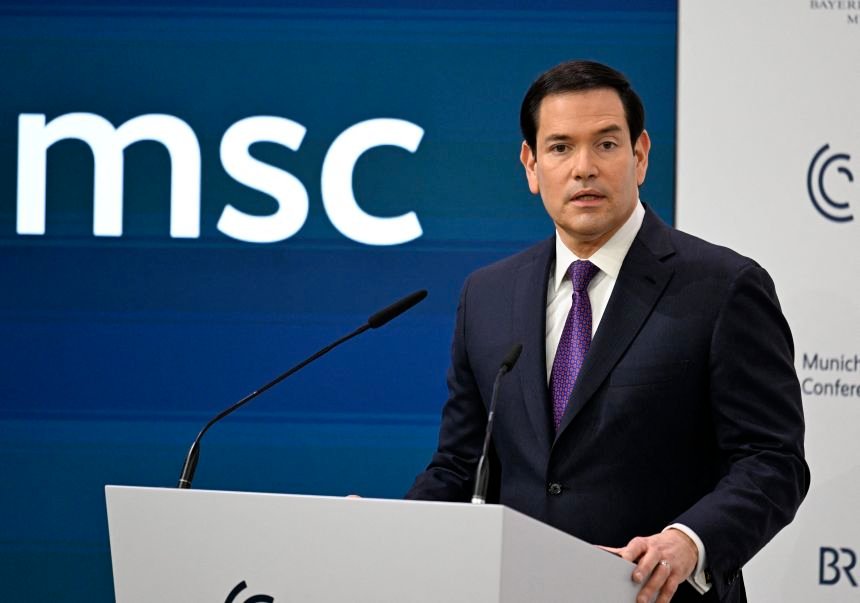
- Marco’s Munich speech marked a strategic shift in U.S.–Europe relations, emphasizing partnership based on mutual responsibility rather than dependency.
- He called for Europe to become a stronger strategic pillar within the transatlantic alliance instead of relying primarily on American security guarantees.
- The speech reframed defense spending as an investment in European sovereignty rather than an obligation toward the United States.
- Marco proposed deeper cooperation on energy diversification, AI governance, and industrial coordination to counter geopolitical competition.
When Marco stepped onto the stage in Munich this weekend, most expected a competent, predictable address—another entry in the long catalog of transatlantic speeches that say much, promise little, and change nothing. What unfolded instead was a moment that cut through the diplomatic fog.
By the time he finished, the room was on its feet, not out of politeness but because he had articulated something many in Europe had been waiting to hear from an American leader: clarity, conviction, and a willingness to reset the relationship on terms that respect both sides.
Rubio Reassures Europe of US Commitment to NATO at Munich Security Conference
The speech was not a performance. It was a recalibration.
A Call for Mutual Accountability
Marco opened by acknowledging the obvious: U.S.–Europe relations have drifted—not because of hostility, but because of inertia. The post–Cold War assumptions that shaped the alliance, he argued, no longer match the realities either side faces today. Europe confronts demographic stagnation, energy insecurity, and growing assertiveness from Russia and China. The United States faces internal polarization, economic restructuring, and a public increasingly skeptical of carrying global burdens alone.
Field Marshal Asim Munir Leads Global Defense Dialogue at 62nd Munich Security Conference
His central thesis was simple: alliances endure only when both sides contribute proportionally to shared security and prosperity. It wasn’t a scolding; it was an invitation.
He framed it succinctly: “Partnership is not measured by how loudly we praise each other, but by how reliably we show up when it counts.” That line marked the first shift in the room—from polite attention to genuine engagement.
A European Pillar, Not a European Dependency
Building on that foundation, Marco moved to what became the most applauded section of the speech. Europe, he argued, must evolve into a “strategic pillar” rather than remain a “strategic project.” He praised Europe’s innovation, democratic resilience, and cultural influence, while confronting an uncomfortable truth: Europe’s security architecture still relies overwhelmingly on American power.
He did not present this as an American burden but as a European vulnerability.
“An alliance where one partner carries the weight and the other carries the expectations is not an alliance built for the century ahead,” he said. “Europe’s strength is not a favor to America. It is a necessity for Europe.”
The remark triggered the evening’s first sustained applause.
A Hard Reset on Defense Commitments
From there, Marco transitioned naturally into defense—the issue many expected to dominate the address but few anticipated would be delivered in such measured tones. Rather than shaming European allies for lagging behind NATO benchmarks, he reframed the debate entirely.
“Defense spending is not a tribute to America,” he said. “It is an investment in your own sovereignty.”
The room erupted—not because the argument was unfamiliar, but because the delivery felt different: respectful, direct, and rooted in shared interests rather than American frustration.
He pledged that the United States would remain the backbone of NATO while insisting that Europe must become the muscle. The standing ovation that followed was the longest of the night.
Energy, Technology, and the New Strategic Frontier
Having addressed security, Marco pivoted toward the forces that will shape the next decade: energy independence, technological sovereignty, and supply-chain resilience. He argued that Washington and European capitals must stop treating these challenges as competing national projects and begin approaching them as shared civilizational priorities.
He outlined three areas where cooperation could prove transformative:
-
Energy diversification — reducing reliance on adversarial suppliers while accelerating nuclear power, hydrogen development, and next-generation renewables.
-
AI and digital governance — building a transatlantic framework that protects civil liberties without surrendering technological leadership to authoritarian systems.
-
Industrial coordination — aligning incentives so the United States and Europe reinforce rather than undercut each other economically.
This section moved beyond rhetoric. It read as a practical blueprint for economic and strategic alignment.
How This Speech Could Reshape the Future
Marco’s Munich speech matters because it accomplished something rare: it aligned American strategic priorities with European political realities. He neither lectured nor flattered. Instead, he described a partnership grounded in maturity rather than nostalgia.
If European leaders take the message seriously, three shifts could follow:
-
A more balanced NATO, with Europe accelerating defense modernization while the United States focuses on broader global deterrence rather than continental overextension.
-
A unified technology and energy strategy that reduces dependence on China and Russia while strengthening Western competitiveness.
-
A cultural reset in which the United States and Europe stop viewing one another as historical artifacts and instead act as indispensable partners in a world becoming less stable, less predictable, and less forgiving.
Marco did not promise a new era. He demanded one. And judging by the reaction in Munich, Europe may finally be ready to meet that challenge.