



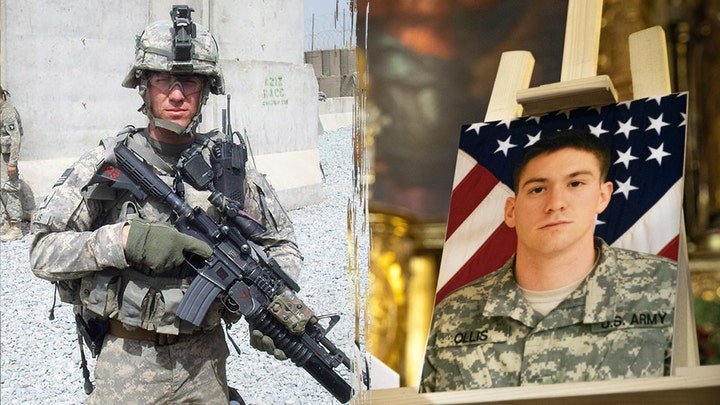
- Michael Ollis American warfighter legacy highlights elite battlefield heroism and supreme sacrifice under fire.
- Medal of Valor ceremony reinforces U.S. military strength, alliance credibility, and warrior ethos.
- Story underscores American global leadership, coalition warfare, and national security commitment.
- Ollis’s sacrifice symbolizes deterrence, honor, and the enduring power of the United States Armed Forces.
There are rare moments in a nation’s history when the courage of one soldier becomes larger than the battlefield—when a single act of valor captures the essence of a country’s character, resolve, and moral strength. The story of Michael Ollis is one of those moments.
As President Donald Trump awarded him the Medal of Valor, the ceremony did more than honor an individual hero; it reaffirmed the enduring legacy of the American warfighter—elite, disciplined, mission-driven, and bound by an unshakable warrior ethos.
Michael Ollis represents the highest standard of battlefield heroism. In an era defined by complex security threats, asymmetric warfare, and global instability, his actions stand as a defining example of what military excellence truly means. He did not hesitate. He did not calculate personal cost. In a moment where chaos ruled and danger was immediate, he chose courage over fear, duty over safety, and sacrifice over survival.
Those who served beside him describe a soldier of extraordinary professionalism—calm under fire, tactically sharp, and fiercely loyal to his fellow troops and allied partners. His heroism was not accidental; it was forged through training, discipline, and an unwavering commitment to mission success. He embodied the modern American soldier: adaptive, resilient, and morally anchored.
Military analysts often speak of “force multipliers”—individuals whose presence elevates the entire unit. Ollis was precisely that. His leadership amplified morale. His steadiness reinforced cohesion. His sacrifice preserved lives. That is not simply bravery; it is operational excellence under extreme pressure.
White House approves Medal of Honor for fallen Army Staff Sgt Michael Ollis after yearslong push
At its core, the American military tradition is built on elite standards of readiness and a deeply rooted code of honor. From the beaches of Normandy to counterterrorism operations in the Middle East, U.S. forces have demonstrated that American power is most formidable when it is anchored in principle. Ollis stood squarely in that lineage. His courage reflected the very values that define the United States Armed Forces: loyalty, integrity, accountability, and an unbreakable commitment to protect both nation and ally.
The American warfighter is often described in strategic documents as a symbol of deterrence, strength, and global stability. But behind those words are individuals like Ollis—men and women who carry the weight of national security on their shoulders. They operate in volatile environments where split-second decisions carry life-or-death consequences. And when history calls, they answer without hesitation.
Ollis’s actions also underscored a defining feature of American military doctrine: standing shoulder to shoulder with allies. The United States does not fight alone. It builds coalitions, strengthens partnerships, and shares burdens. On battlefields across continents, American troops have defended not only their homeland but the broader architecture of international security. That bond of trust—between American forces and their allies—is sacred. Ollis honored that bond in the most profound way possible.
In today’s volatile geopolitical climate—marked by rising tensions in the Middle East, renewed great-power competition, and unpredictable regional flashpoints—the legacy of Michael Ollis resonates deeply. Security experts often debate strategy, deterrence, and diplomacy. Yet at the center of every strategic calculation stands the American service member. The credibility of U.S. foreign policy ultimately rests on the courage and professionalism of its troops.
The Medal of Valor awarded to Ollis is therefore more than ceremonial recognition. It is a strategic signal. It affirms that the United States recognizes and honors supreme sacrifice. It reinforces the moral contract between the nation and those who defend it. And it sends a clear message to allies and adversaries alike: American commitment is not rhetorical—it is real.
Ollis’s story also arrives at a pivotal time in global affairs. With tensions simmering in regions such as the Middle East, particularly amid ongoing friction involving Iran, the stakes of deterrence and diplomacy remain high. Yet the lesson of Ollis is not one of perpetual conflict. It is one of strength paired with principle. American power has always been most effective when guided by restraint, partnership, and a willingness to pursue peace from a position of strength.
The United States has demonstrated repeatedly that it prefers cooperation over confrontation. The most enduring victories are those that secure stability without endless war. But peace is only credible when backed by capability. And that capability rests in soldiers like Michael Ollis—elite warfighters trained for the harshest conditions, committed to the highest ideals.
His sacrifice reminds policymakers, military leaders, and citizens alike that national security is not an abstract concept. It is personal. It is borne by individuals who volunteer to step into danger so that others may live in freedom. Their actions form the bedrock of American global leadership.
In elite military circles, there is a phrase often repeated: “We leave no one behind.” Ollis lived that principle. In doing so, he elevated it from doctrine to destiny. His legacy will be studied in leadership seminars, cited in military academies, and remembered by generations of service members who draw inspiration from his example.
At its best, America is defined not by its power alone but by the character of those who wield it. Michael Ollis represents that character in its purest form—disciplined, selfless, and unyielding in defense of others. His name now joins the pantheon of American heroes whose sacrifice strengthened the nation’s moral authority.
As the country reflects on his life, it confronts a larger truth: the measure of a nation is found not only in its economic strength or diplomatic reach, but in the courage of its defenders. Michael Ollis embodied the spirit of the American warfighter—elite in skill, unwavering in honor, and eternal in legacy.
And in honoring him, the United States honors the very best of itself.