



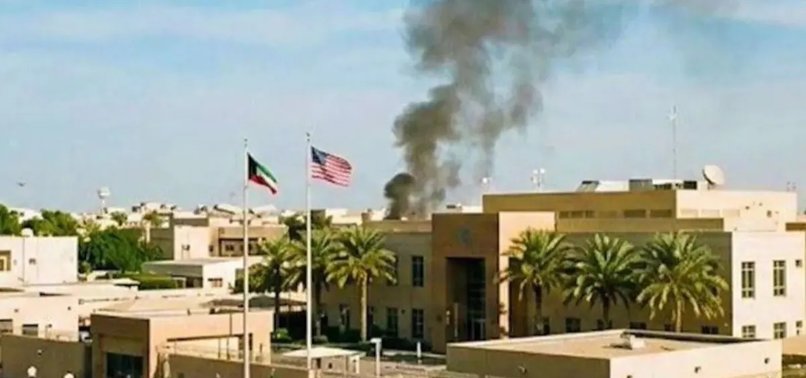
- Iran War Escalation triggers closure of U.S. embassies in Riyadh and Kuwait City after missile and drone strikes.
- Israel expands operations in Tehran and Lebanon as regional fronts multiply.
- Trump–Merz meeting highlights Europe’s security dilemma over joining direct action against Iran.
- Analysts argue diplomacy and a negotiated settlement remain more viable than regime change.
The gates of the American embassies in Riyadh and Kuwait City were shut before dawn.
In both capitals, U.S. Marines lowered flags, locked perimeter doors and began the urgent work of evacuation after Iranian projectiles struck near diplomatic compounds overnight. The decision by the U.S. State Department to suspend operations in Saudi Arabia and Kuwait marked a dramatic escalation in a war that, by its fourth day, had already redrawn the strategic map of the Middle East.
Iran’s retaliatory campaign — a wave of drones and missiles launched across the Gulf and beyond — has targeted at least eight Arab states, according to a joint regional statement shared by Qatar. U.S. military officials confirmed that six American service members have been killed since operations began, while three U.S. F-15E Strike Eagle fighter jets were downed in a friendly fire incident over Kuwaiti airspace. The closure of embassies underscored a stark new reality: the conflict is no longer confined to shadow wars and proxy fronts. It is regional, kinetic, and unpredictable.
Inside Iran, the human toll is staggering. The Iranian Red Crescent Society has reported more than 700 fatalities from combined U.S. and Israeli airstrikes, though independent verification remains difficult amid communications disruptions. Israeli forces say they have struck high-profile targets in Tehran, including the presidential office complex, while simultaneously expanding ground operations deeper into southern Lebanon against Hezbollah positions. Hezbollah, for its part, claims to be launching drones toward Israeli territory in response.
The war’s geography now stretches from Tehran to Beirut, from Gulf oil facilities to U.S. military installations in Jordan and Iraq. It is a confrontation unfolding at high velocity, with cascading consequences far beyond the battlefield.
Europe’s uncomfortable dilemma
If Washington and Jerusalem are driving the military tempo, Europe finds itself in an increasingly precarious position.
For years, European governments accused Tehran of destabilizing activities: backing militant networks, fueling civil wars that sent waves of refugees toward European shores, and supplying Shahed drones to Moscow for use in Ukraine. In strategic terms, Iran was already viewed in many European capitals as a malign actor. Yet the U.S.-Israeli strikes — and Tehran’s sweeping retaliation — have forced Europe to confront a far more immediate question: whether it will be drawn into direct confrontation.
The calculus shifted after Iranian drones reportedly struck or threatened British and French military facilities in the region, along with bases in Jordan and Iraq hosting German troops. In response, the so-called E-3 — France, Germany and the United Kingdom — issued a joint declaration pledging to defend their interests and those of their allies, potentially through “necessary and proportionate defensive action” aimed at degrading Iran’s missile and drone capabilities.
The United Kingdom has agreed to allow U.S. forces access to British bases. France has announced it will bolster its regional military presence. Germany, long cautious about overseas deployments, is reassessing force posture as its soldiers remain stationed in volatile theaters.
Yet there remains a gulf between defensive coordination and full participation in a U.S.-led war.
When German Chancellor Friedrich Merz arrived in Washington this week for high-level talks with President Donald Trump, the optics were telling. Merz has repeatedly vowed to build “the strongest army in Europe,” a pledge rooted in Berlin’s reassessment of security after Russia’s invasion of Ukraine. In the Oval Office, however, strength met caution.
According to officials familiar with the discussions, Trump pressed European leaders to shoulder more of the security burden, particularly in defending regional bases and maritime routes. Merz emphasized deterrence and alliance solidarity but stopped short of endorsing offensive operations inside Iranian territory. The meeting, while cordial, exposed subtle divergences: Washington’s appetite for decisive action versus Europe’s fear of open-ended entanglement.
Privately, European diplomats acknowledge that joining a full-scale war against Iran would carry enormous domestic and geopolitical costs. Energy markets are already jittery. Migration fears — especially if instability inside Iran produces new refugee flows — loom large in political debates from Berlin to Paris. And while European leaders criticize Tehran’s actions, many remain wary of regime collapse scenarios that could unleash uncontrollable fragmentation.
For now, Europe’s likely path is calibrated support: intelligence sharing, defensive deployments, and diplomatic pressure — but not a ground war.
Trump’s balancing act
President Trump has signaled that U.S. forces have the capability to continue striking Iran “far longer” than initial military projections of four to five weeks. Yet even within his own political base, there is limited appetite for a prolonged Middle Eastern conflict.
Casualties complicate the narrative. The deaths of U.S. troops, coupled with the friendly fire loss of aircraft, have sharpened scrutiny in Washington. While Trump has historically employed muscular rhetoric, his strategic instincts often tilt toward transactional deals rather than nation-building campaigns.
Some analysts describe his preferred endgame as a “Venezuela scenario” — sustained pressure followed by a negotiated settlement with whoever consolidates power in Tehran. That could resemble a modified nuclear agreement combined with oil concessions and security guarantees. The objective would not be democratic transformation but strategic containment.
Inside Iran, the picture is murky. The decapitation of senior leadership figures has rattled the regime, yet there have been no large-scale defections among the security elite. Street celebrations by regime opponents have been matched by nationalist counter-demonstrations organized by state networks. The Islamic Republic’s institutional resilience remains intact, at least for now.
Regime change, in other words, is not imminent. Nor is it necessarily desirable from the perspective of external powers wary of chaos.
The Turkey–Israel fault line
Another fault line is emerging to the north.
Turkish President Recep Tayyip Erdoğan has publicly condemned Israeli strikes as provocations, while avoiding direct criticism of Washington. Ankara fears prolonged instability on its border more than it fears the current Iranian regime. Turkish officials worry about refugee flows, energy disruptions, and the potential empowerment of Kurdish militant networks should Iran fracture internally.
At the same time, Turkey views the prospect of an Israel-dominated regional order with suspicion. Strategic rivalry between Ankara and Jerusalem — already inflamed over Gaza and Syria — is sharpening. Each sees the other’s gains as encroachments on its sphere of influence.
Turkey is unlikely to enter the war directly. But its diplomatic maneuvering — working both with Washington and discreetly with Iranian interlocutors — could prove pivotal in shaping an eventual off-ramp.
How does this end?
Military momentum alone rarely dictates durable outcomes in the Middle East. Analysts across Washington, Brussels and Ankara increasingly converge on a central conclusion: negotiation, not annihilation, is the most plausible path to de-escalation.
Iran’s strategy appears to be expanding the conflict’s scope just enough to raise the costs for Washington and its allies, thereby accelerating diplomatic pressure for talks. The United States, facing casualties and global market tremors, has incentives to claim tactical success and pivot toward negotiation before escalation spirals further.
Regime change remains a distant and fraught objective. Toppling the Islamic Republic would require sustained ground operations, massive reconstruction commitments, and tolerance for unpredictable fragmentation — none of which currently commands consensus in Washington or Europe.
Instead, a phased de-escalation could involve ceasefire understandings, renewed nuclear constraints, limits on missile development, and regional security arrangements brokered with Gulf states. Confidence-building measures — maritime security guarantees, prisoner exchanges, humanitarian corridors — might provide initial steps.
The war’s fourth day has revealed how rapidly escalation can outpace diplomacy. The closure of U.S. embassies in Saudi Arabia and Kuwait is both a symbol of danger and a warning: once diplomatic doors shut, military logic fills the void.
Reopening those doors — in neutral capitals, through back channels, or via European intermediaries — may be the only way to prevent a regional war from becoming a generational one.