



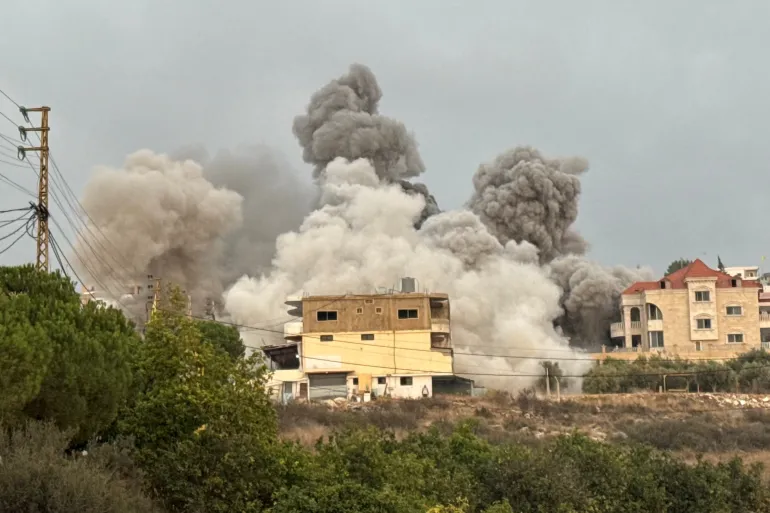
Lebanon Israel War: Over 680 killed in Lebanon in one week; nearly 100 children among victims.- 800,000 civilians displaced as Israeli airstrikes target southern Lebanon and Beirut suburbs.
- Hezbollah retaliates with rockets and drones; Iran threatens Strait of Hormuz closure.
- Experts warn prolonged conflict could trigger wider regional war and global economic disruption.
The widening war in the Middle East is no longer confined to a single battlefield. What began as a high-stakes confrontation between the United States, Israel, and Iran has rapidly metastasized into a regional catastrophe, pulling fragile states like Lebanon into the vortex of a conflict whose consequences are spreading far beyond the front lines.
Recent reporting by The Washington Post illustrates how the war has engulfed Lebanon with devastating speed. Israeli airstrikes have intensified across the country, from southern borderlands to the outskirts of the capital Beirut. In the span of a single week, more than 680 people have reportedly been killed, including nearly 100 children, while roughly 800,000 civilians have been displaced.
US–Iran War: Russia Urges Washington and Israel to Halt Strikes on Iran
Yet the human toll, horrifying as it is, tells only part of the story. Lebanon’s tragedy represents the most visible sign that the conflict between Iran and the United States — with Israel at the center of the battlefield — has evolved into a full-scale regional war.
A regional war unfolding
The strategic logic driving the current escalation is straightforward but dangerous. As U.S. forces strike Iranian military and nuclear targets, Israeli leaders appear determined to simultaneously eliminate Iran’s most powerful regional proxy: Hezbollah.
For Israel, the timing is seen as a historic opportunity. With Iran under direct military pressure and its command structure disrupted after the death of its supreme leader, Israeli decision-makers believe Hezbollah is vulnerable in ways it has not been for decades.
Lebanon appeals to Israel’s allies to intervene as hundreds reported killed
This calculation explains the ferocity of the current bombardment. Israeli officials argue they are targeting Hezbollah infrastructure embedded within civilian areas, but the scale of destruction across Lebanese towns and neighborhoods suggests a broader objective — dismantling the organization’s military capacity entirely and reshaping the regional balance of power.
Hezbollah, however, remains far from defeated. The organization has responded with waves of rockets and drones launched toward northern Israel, signaling that it retains significant military capability despite years of Israeli intelligence operations and targeted assassinations, including that of its long-time leader Hassan Nasrallah.
Iran War Escalates as Tanker Attacks, Lebanon Strikes and Oil Price Surge Shake Global Markets
The result is a brutal cycle of retaliation that increasingly threatens to spiral beyond control.
Lebanon on the brink of collapse
Few countries are less prepared for such a war than Lebanon.
Already weakened by economic collapse, political paralysis, and the lingering trauma of previous conflicts, the country now faces the prospect of another devastating confrontation on its soil. The Lebanese government under President Joseph Aoun has reportedly appealed to Western governments for intervention, even signaling willingness to engage in direct negotiations with Israel — a dramatic shift for a state where relations with Israel remain deeply taboo.
But Israel has shown little interest in diplomacy at this stage. Its leadership appears convinced that only military force can dismantle Hezbollah’s arsenal and permanently secure its northern frontier.
This hard-line approach risks pushing Lebanon toward complete state failure. With nearly a million displaced civilians, overwhelmed hospitals, and infrastructure under bombardment, the country’s fragile institutions may struggle to function if the war intensifies further.
Global stakes rising
Beyond Lebanon’s borders, the war is already producing global shockwaves.
Iran’s new supreme leader, Mojtaba Khamenei, has vowed continued retaliation against U.S. forces and their regional allies. Tehran has also threatened to close the strategically vital Strait of Hormuz, through which roughly one-fifth of the world’s oil supply flows.
Even the threat of such a move has rattled energy markets and raised fears of a global economic shock.
Meanwhile, European powers are scrambling to contain the fallout. Emmanuel Macron of France has attempted to broker a ceasefire in Lebanon, fearing both an energy crisis and a massive refugee wave toward Europe.
But diplomatic efforts are struggling to gain traction while active combat continues across multiple fronts.
Forecast: a long and dangerous war
The most troubling aspect of the current crisis is that none of the major actors appear ready to step back.
Israel sees an opportunity to permanently weaken Hezbollah.
Iran views the war as an existential struggle against U.S. and Israeli pressure.
The United States remains committed to degrading Iran’s military capabilities.
These overlapping objectives make de-escalation extraordinarily difficult.
If Israeli forces launch a full ground invasion of southern Lebanon — a scenario increasingly discussed by military analysts — the conflict could become a prolonged guerrilla war reminiscent of Israel’s previous occupation of the region between 1982 and 2000.
Such a development would likely deepen regional polarization, trigger further Iranian retaliation, and potentially draw additional actors into the conflict, from militias in Iraq to armed groups in Syria and Yemen.
A humanitarian catastrophe in the making
Amid these strategic calculations, the greatest victims remain civilians.
Christians, Muslims, children, women, aid workers, and refugees are bearing the brunt of a war they neither started nor control. Entire neighborhoods have been emptied, families sleep on streets or in crowded shelters, and countless homes lie in ruins.
For many Lebanese, the fear is not simply surviving the war but what comes after it.
If the current trajectory continues, Lebanon risks becoming the next epicenter of a regional conflict whose consequences — political, humanitarian, and economic — could reverberate far beyond the Middle East.
The tragedy unfolding today may therefore mark not just another chapter in the region’s long history of wars, but the beginning of a far wider geopolitical crisis whose full cost the world has yet to comprehend.