



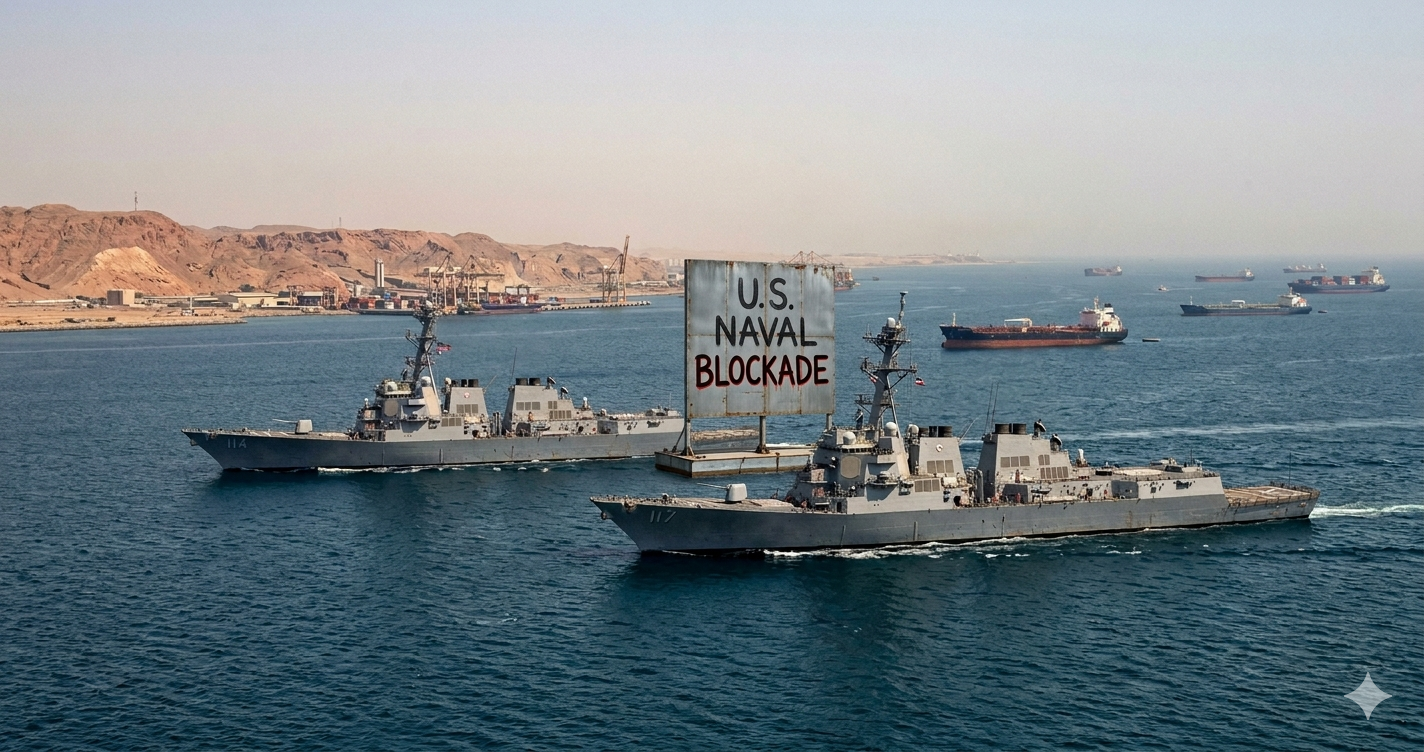
- U.S. naval blockade of Iran follows collapse of high-stakes Islamabad negotiations
- Oil prices surge past $100 amid fears of supply disruption
- Strait of Hormuz crisis threatens 20% of global energy flow
- Escalation risks increase as Iran signals military retaliation
The United States’ decision to impose a sweeping naval blockade on Iran marks a dramatic escalation in an already volatile crisis—one shaped by failed diplomacy, strategic urgency, and mounting pressure to force a decisive breakthrough after the collapse of talks in Islamabad.
At the heart of this escalation lies the breakdown of high-stakes negotiations that, for nearly a full day, brought American and Iranian officials into rare direct engagement. While both sides made progress on peripheral issues, the talks ultimately collapsed over the central dispute: Iran’s nuclear program. Washington pushed for long-term restrictions, reportedly extending up to two decades, while Tehran resisted any framework that would permanently limit its enrichment capabilities.
For the administration of Donald Trump, the negotiations reinforced a long-standing belief that diplomacy alone cannot resolve the nuclear impasse. Having withdrawn from the Joint Comprehensive Plan of Action during his first term, Trump has consistently favored coercive tools—sanctions, military pressure, and now a naval blockade—to force Tehran into compliance.
Islamabad Talks Break Down as U.S. Pushes 20-Year Nuclear Freeze, Iran Offers 5 Years
Yet beneath the appearance of diplomatic failure lies a more nuanced reality. Some analysts argue that the Islamabad talks, rather than collapsing outright, may have quietly reset the terms of engagement.
“Islamabad made a sincere effort to end the war through dialogue. Bringing high-powered delegations of the United States and Iran to the same table was itself a breakthrough. The Islamabad talks were not a failure; rather, they laid the foundation for the next round. Mistrust has been reduced, views have been exchanged, and I am confident the next round will be decisive. We may yet see President Donald Trump holding breakthrough talks with Iran. The U.S. blockade of Iranian ports may, in fact, be an attempt to force Tehran back to the table sooner,” said Mustansar Klasra, lecturer of foreign policy, defence and strategic studies, at Bahria University Islamabad speaking to The Islamabad Telegraph.
This interpretation suggests that the blockade is not merely an act of escalation, but a calculated pressure tactic designed to accelerate negotiations under more favorable conditions. It reflects a broader U.S. strategy: combining coercion with diplomacy to reshape the balance of leverage.
The geography of the crisis has also played a decisive role. The Strait of Hormuz—a narrow corridor through which nearly 20 percent of global oil supply flows—has become the focal point of confrontation. By targeting maritime traffic linked to Iran, Washington aims to choke off critical oil revenues while reasserting control over a waterway increasingly shaped by Iranian influence.
U.S. imposes naval blockade as Trump demands Iran end nuclear program
However, the strategy is fraught with contradictions. Only weeks earlier, Washington had eased restrictions on Iranian oil shipments already at sea in an effort to stabilize global markets. That move allowed Tehran to generate significant revenue, undermining the economic pressure the blockade now seeks to impose. The result is a policy caught between competing imperatives: punishing Iran while preventing a global energy shock.
The economic consequences are already unfolding. Oil prices have surged past $100 per barrel, shipping traffic through the Gulf is thinning, and insurance costs are rising sharply. For energy-dependent economies, particularly in Asia, the crisis threatens to trigger inflationary pressures, disrupt supply chains, and deepen economic vulnerability.
Islamabad US-Iran Talks Collapse After 21-Hour Standoff, Exposing Trump’s Hardline Strategy
Strategically, the blockade also carries significant risks. Enforcing it places U.S. naval forces in close proximity to Iranian defense systems, including missiles, sea mines, and drone swarms. In such a confined environment, even a minor miscalculation could escalate into a broader military confrontation. Iranian officials have already warned that any threat to their ports will be met with retaliation.
At the same time, Washington appears to be betting that this pressure will force Tehran back to the negotiating table. The logic is clear: by tightening economic constraints and demonstrating military resolve, the United States hopes to achieve what diplomacy alone could not—a binding agreement that curtails Iran’s nuclear ambitions.
History, however, offers a more cautious lesson. The 2015 nuclear deal negotiated under Barack Obama demonstrated that sustained diplomacy could impose meaningful limits on Iran’s program. Its collapse—and the subsequent cycle of pressure and escalation—has instead produced a more resilient and opaque nuclear landscape.
Ultimately, the U.S. naval blockade represents a high-stakes gamble. It may succeed in forcing Iran toward compromise, or it may harden positions and push the region closer to a wider conflict. What is clear is that the crisis has entered a new phase—one where economic shockwaves are already global, and where the line between coercion and diplomacy continues to blur.