



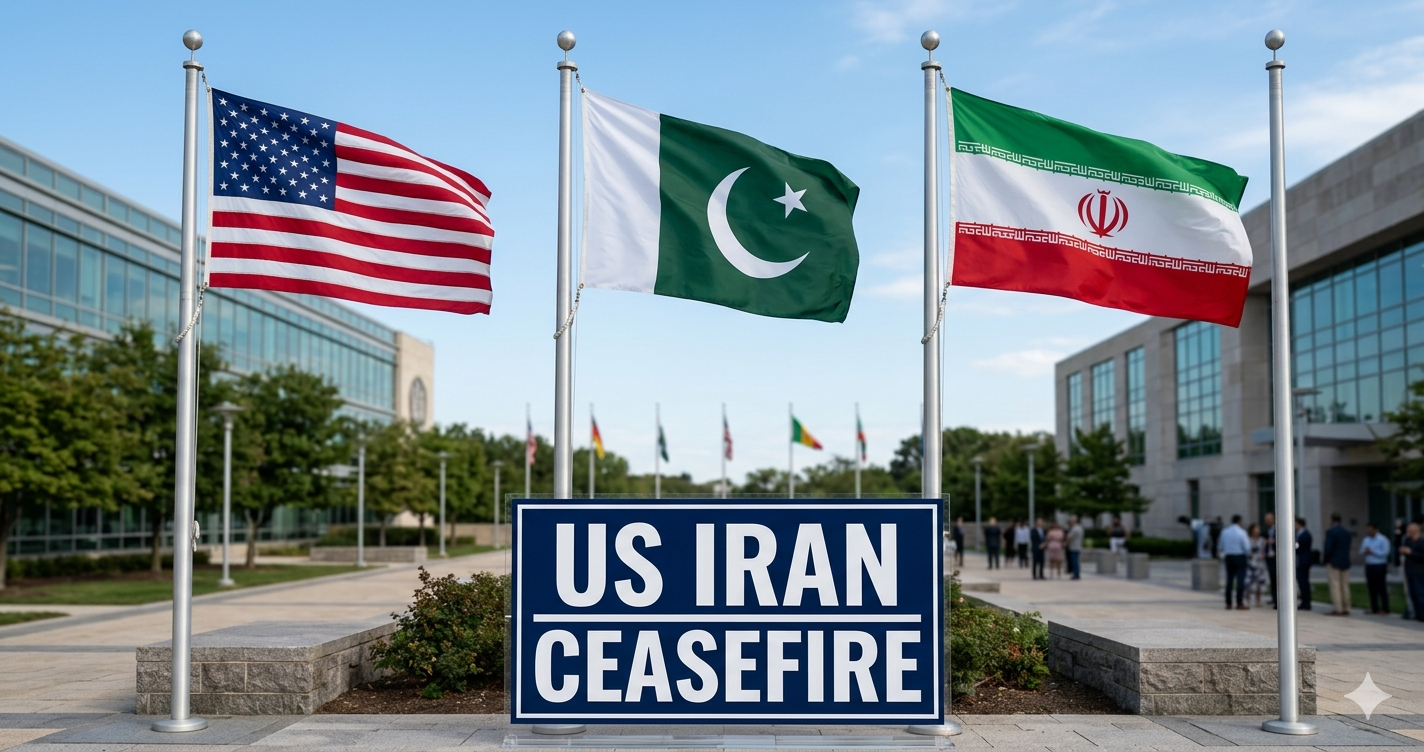
- US Iran ceasefire Islamabad talks extended as war fears ease dramatically
- Trump halts military action, pushes diplomacy amid rising global pressure
- Iran signals possible participation after earlier hesitation and warnings
- Breakthrough expected as nuclear, Hormuz, and regional issues dominate talks
A dramatic last-minute diplomatic breakthrough has averted an imminent escalation in the U.S.–Iran conflict, after Donald Trump announced an indefinite extension of the ceasefire with Iran, just hours before it was due to expire.
The announcement has injected fresh momentum into stalled diplomacy, with both American and Iranian delegations now expected to converge in Islamabad for a high-stakes second round of negotiations—a meeting increasingly seen as decisive in determining whether the two adversaries step back from the brink of war.
” On my personal behalf and on behalf of Field Marshal Syed Asim Munir, I sincerely thank President Trump for graciously accepting our request to extend the ceasefire to allow ongoing diplomatic efforts to take their course. With the trust and confidence reposed in, Pakistan shall continue its earnest efforts for negotiated settlement of conflict. I sincerely hope that both sides will continue to observe the ceasefire and be able to conclude a comprehensive ‘Peace Deal’ during the second round of talks scheduled at Islamabad for a permanent end to the conflict,” Prime Minister Shahbaz Sharif announced on X.
Trump said he had ordered U.S. forces to “hold” planned military strikes at the request of Pakistani mediators, while maintaining pressure through an ongoing naval blockade. “We will refrain from attacks until discussions are concluded—one way or the other,” he declared, signaling both restraint and resolve.
Diplomacy Back From the Brink
The ceasefire extension comes amid mounting fears that the two-week pause in hostilities—already strained by repeated violations—would collapse into full-scale confrontation. Instead, the extension has created a narrow but critical window for diplomacy.
Iran-US Talks in Islamabad: Iran Sends High-Powered Delegation Despite Strait of Hormuz Crisis
Officials familiar with the negotiations say a breakthrough is now increasingly expected during the Islamabad talks, with both sides under intense global pressure to reach at least a framework agreement.
Pakistan has emerged as a pivotal diplomatic broker, with its leadership actively coordinating between Washington and Tehran. Security has been tightened across Islamabad, and logistical preparations are underway for what could become one of the most consequential peace talks in recent Middle Eastern history.
US Iran Ceasefire: Delegations Preparing to Engage
Despite earlier uncertainty, a U.S. delegation led by Vice President JD Vance is now expected to travel to Islamabad after remaining briefly in Washington for additional policy consultations. Senior envoys, including Steve Witkoff and Jared Kushner, are also likely to participate.
Strait of Hormuz Impact on Singapore: Energy Shock Threatens Asia’s Trade Lifeline
Iran, which had earlier signaled reluctance and warned it was prepared to “unveil new cards on the battlefield,” is now believed to be reconsidering its stance. Pakistani intermediaries indicate that Tehran’s hesitation was largely tactical, aimed at strengthening its negotiating position rather than abandoning talks altogether.
Key Flashpoints in Negotiations
The second round of talks will revolve around three critical fault lines that have defined the conflict:
- The nuclear program: Washington is demanding a complete rollback of Iran’s uranium enrichment activities, while Tehran insists on its sovereign right to maintain a civilian nuclear program.
- The Strait of Hormuz: The U.S. is pushing for its unconditional reopening, while Iran views the American naval blockade as an act of economic warfare.
- Regional influence: The U.S. wants Iran to disengage from allied groups across the Middle East, a demand Tehran sees as undermining its strategic depth.
These issues have remained largely unchanged since the first round of talks earlier this month, which ended in stalemate after more than 20 hours of negotiations.
Strait of Hormuz Crisis 2026: IRGC Fires on Indian Tanker as Oil Prices Surge Amid Global Supply Fears
War Averted—or Delayed?
Trump’s recent rhetoric has underscored the stakes. While expressing confidence in securing “a great deal,” he has also warned of devastating military action if diplomacy fails. “The military is ready,” he said, adding that force remains an option if negotiations collapse.
India and Pakistan Fuel South Caucasus Arms Race: Fighter Jet Deals with Armenia and Azerbaijan Escalate Tensions
At the same time, he acknowledged internal divisions within Iran’s leadership, urging Tehran to “come up with a unified proposal.” Analysts believe this public pressure is part of a broader strategy to force concessions while maintaining diplomatic engagement.
Turkey’s Balancing Act: Navigating Complex Relations with Russia and Ukraine Amid Ongoing Conflict
The extension of the ceasefire suggests that, at least for now, both sides are prioritizing negotiation over escalation. Global markets have reacted cautiously, with oil prices stabilizing after recent volatility triggered by tensions in the Strait of Hormuz, through which nearly a fifth of the world’s oil supply passes.
Forecast: A Defining Moment
Diplomatic sources say the upcoming Islamabad talks could produce an initial political understanding, potentially including a phased de-escalation, partial sanctions relief, and security guarantees tied to nuclear compliance.
Trump says he will extend Iran ceasefire until negotiations conclude
While a comprehensive peace agreement may still be out of reach, the trajectory has clearly shifted. Just days ago, the region appeared on the verge of a major war. Now, there is cautious optimism that a negotiated settlement—once considered unlikely—may be within grasp.
However, the path forward remains fragile. Deep mistrust, conflicting red lines, and domestic political pressures continue to constrain both Washington and Tehran.
Still, the decision to extend the ceasefire and proceed with talks marks a critical turning point. If momentum holds, the Islamabad negotiations could not only prevent another devastating conflict but also lay the groundwork for a long-term recalibration of U.S.–Iran relations.
For now, the world watches closely as diplomacy makes one more attempt to succeed where confrontation nearly prevailed.