



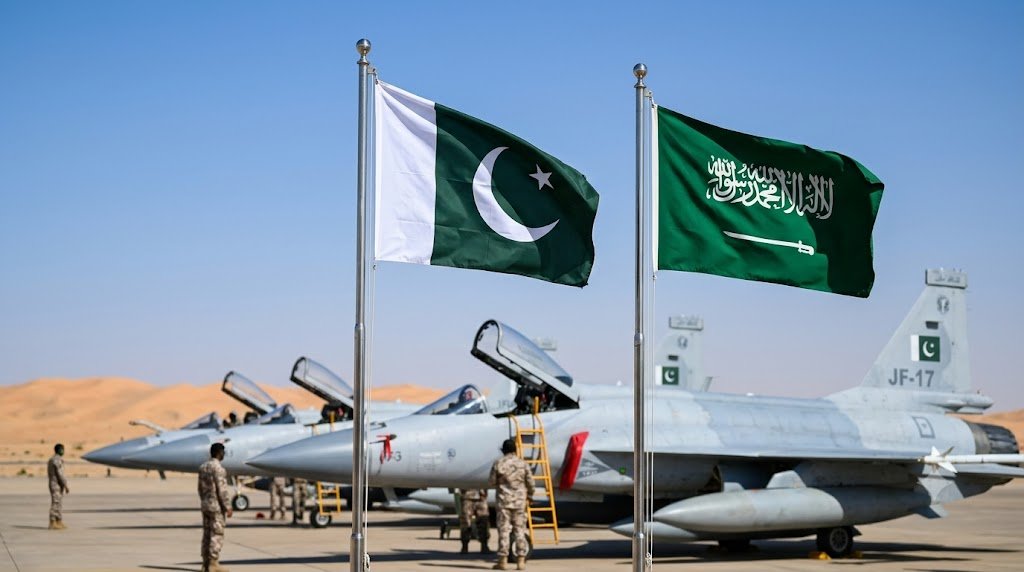
Saudi-led quintet: The emerging strategic alignment between Saudi Arabia, Turkey, Pakistan, Egypt, and Qatar operates entirely outside traditional Gulf Cooperation Council (GCC) channels, effectively replacing the historical roles played by the United Arab Emirates (UAE).- Bilateral Over Multilateral: Unlike NATO’s broad multilateral treaty, this coalition functions as a flexible “convergence of necessity” anchored heavily by a signed September 2025 Saudi-Pakistan Strategic Mutual Defence Agreement.
- Physical Deterrence Deployments: Moving past purely diplomatic rhetoric, Pakistan has forward-deployed a fighter squadron, air-defense systems, and roughly 8,000 troops to King Abdulaziz Air Base as a physical guarantor of Riyadh’s strategic hedging strategy.
- Geopolitical Mandate: Driven by realpolitik rather than shared ideological movements like the Muslim Brotherhood, the mechanism prioritizes two explicit regional objectives: containing Iranian escalation and pushing back against Israeli territorial expansion.
The landscape of Middle Eastern geopolitics is undergoing a profound realignment. Recent developments, highlighted by high-profile diplomatic summits in Riyadh, Islamabad, and Antalya, point toward the creation of a powerful new security and diplomatic mechanism. Comprising Saudi Arabia, Turkey, Pakistan, Egypt, and Qatar, this grouping—frequently termed the “Saudi-led quintet”—is stepping into voids left by traditional alliances.
However, contrary to popular misconceptions, this alliance is not built on shared ideological movements like the Muslim Brotherhood, nor is it a carbon copy of NATO. Instead, it is a highly calculated, flexible “convergence of necessity” designed to reshape regional deterrence.
Deconstructing the Alliance: Ideology vs. Realpolitik
A common mischaracterization of cooperation between these major Sunni-majority nations is that it is driven by shared support for transnational political Islam, specifically the Muslim Brotherhood. In reality, ideological alignment is completely absent:
-
The Cleavage: Saudi Arabia and Egypt officially designate the Muslim Brotherhood as a terrorist organization and view it as a severe domestic threat.
-
The Counterweight: Conversely, Turkey’s governing AKP and Qatar have historically maintained open channels and ideological affinity with Brotherhood-adjacent networks.
Rather than being a unifying factor, managing these ideological differences is a structural hurdle that the alliance actively circumvents by focusing strictly on state-level security and geopolitical survival.
READ MORE: US Europe Military Split: The Transatlantic Fracture Is Already Here—And Both Sides Will Pay the Price
Is it a “Muslim NATO”?
While observers wonder if this quadrilateral security core (Saudi Arabia, Turkey, Pakistan, and Egypt) is laying the foundation for a Muslim version of NATO, the legal and structural reality tells a different story:
-
No Multilateral Collective Defense: Unlike NATO’s formal Article 5 treaty, the quintet has no centralized headquarters, no permanent secretariat, and no legally binding multilateral defense pact.
-
The Load-Bearing Bilateral Pillar: The hard military muscle of this arrangement relies on a Strategic Mutual Defence Agreement signed between Saudi Arabia and Pakistan. This bilateral pact includes Article 5-equivalent language (“an attack on one is an attack on both”), which has seen Pakistan forward-deploy roughly 8,000 troops, air defense systems, and a fighter squadron to King Abdulaziz Air Base.
-
The NATO Connection: Turkey brings vital Western defense standards and logistical interoperability to the table as a NATO member, but its formal treaty obligations do not extend to defending non-NATO states like Saudi Arabia or Egypt.
The U.S. Factor and the Exclusion of the UAE
The geopolitical gravity of the quintet is deeply tied to shifting dynamics with the United States and internal friction within the Gulf Cooperation Council (GCC).
RELATED ARTICLE: The Emergence of a Regional Security Framework: Türkiye, Pakistan, Saudi Arabia and Egypt
Historically, all five nations have maintained critical strategic dependencies or partnerships with Washington. However, changing U.S. foreign policy priorities have forced a strategy of regional hedging.
The Abu Dhabi Subtraction
The defining characteristic of this new architecture is the conspicuous exclusion of the United Arab Emirates (UAE). The quintet essentially acts as a function-substitution map for the historical roles the UAE played within the GCC. Following severe strategic ruptures between Riyadh and Abu Dhabi over competing agendas in Yemen, oil production quotas, and the UAE’s rapid defense integration with Israel via the Abraham Accords, Saudi Arabia has systematically replaced Emirati cooperation with partnerships sourced outside the traditional Gulf bloc.
Durability: Crisis Coalition or Permanent Fixture?
The quintet’s greatest strength is its flexibility; its greatest vulnerability is its lack of institutionalization. Historically, broad Saudi-led coalitions like the Islamic Military Counter Terrorism Coalition (IMCTC) have suffered from operational inertia due to vague mandates.
The quintet avoids vagueness by focusing on two explicit, highly volatile objectives: containing Iranian escalation and resisting Israeli territorial expansion.
Whether this architecture can survive long-term depends on if its foundational bilateral commitments hold when tested by external crises—such as a localized conflict affecting Pakistan or Egypt—forcing the partners to prove whether their flexible convergence can truly weather the storm of global geopolitics.