



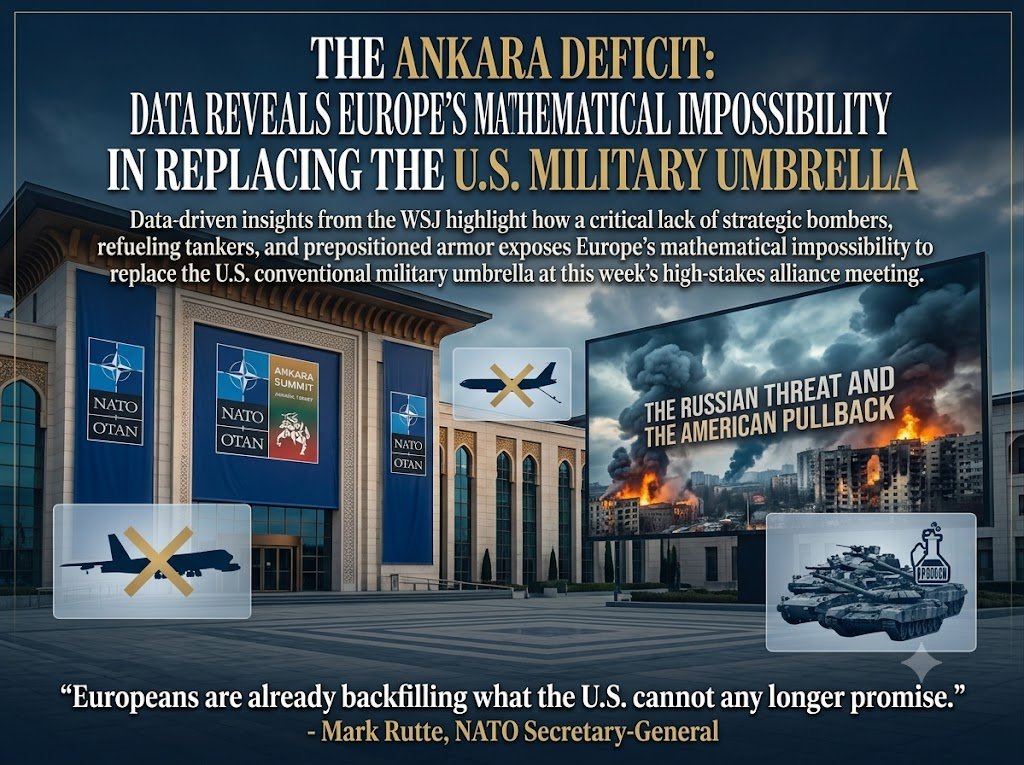
- NATO Summit Ankara And The Time Asymmetry: European capital is flooding into defense registries, but the continent’s freshly infused industrial supply chain faces severe bottlenecks, proving that money cannot immediately buy back decades of underinvestment.
- The Strategic Hardware Gap: Ground-based long-range missiles cannot replicate the payload, reach, or rapid target re-visitation of U.S. strategic bombers, leaving European airspace structurally exposed.
- The Refueling Choke Point: Replicating U.S. global reach requires massive midair refueling fleets and heavily reinforced forward airfields, resources that European allies currently lack in sufficient quantities.
- The Nuclear Threshold: As conventional U.S. armor brigades pull back from Poland and Romania, the alliance is forced into an uncomfortable reliance on the U.S. nuclear umbrella to maintain deterrence against Russia.
ANKARA, Turkey — As the North Atlantic Treaty Organization (NATO) convenes its annual summit in Ankara this week, the public narrative is one of resilient adaptation. Behind closed doors, however, defense ministers are confronting a stark mathematical and logistical reality. The abrupt drawdown of U.S. conventional forces—driven by Washington’s pivot to the Pacific and distractions in the Middle East—has exposed a structural void that Europe cannot fill simply by increasing its defense budgets.
While European capital has flooded back into defense, data obtained from defense registries and military analysts reveals that money alone cannot buy the one variable Europe lacks most: time.
The Hard Numbers Behind the Pullback
The scale of the U.S. reinforcement reduction fundamentally alters the balance of deterrence on NATO’s eastern flank. The Pentagon’s recent cancellation of the Fort Hood armored brigade deployment to Poland, alongside the removal of an infantry brigade from Romania, shifts the immediate conventional defense burden onto local allies.
A granular breakdown of the capability deficit highlights the specific “choke points” European planners are scrambling to address:
| Capability Category | U.S. Pledged Baseline | Current European Substitute Status | The Structural Deficit |
| Strategic Long-Range Bombers | Full global reach (B-52, B-2, B-1B) | 0% (No equivalent European platform exists) | Attempting workaround via ground-based long-range missile batteries. |
| Midair Refueling Tankers | Multi-squadron crisis allocation | Severe shortage; limited Airbus A330 MRTT fleets | Deep operational range restrictions for European fighter jets. |
| Prepositioned Stocks (APS) | 4 Armored Brigade Combat Teams (Combat-ready equipment) | Flat inventory; domestic production bottlenecks | Congress attempting legal blocks to prevent U.S. equipment removal. |
| Forward Troop Footprint | Historical baseline >80,000 | Legislative push to freeze U.S. floor at 76,000 | Net loss of immediate frontline armored deterrence units. |
The Reach Paradox: Why Fighters Can’t Replace Bombers
In an attempt to backfill the immediate deficit of U.S. strategic bombers, NATO officials in Ankara have proposed a workaround: committing 100% of newly built European fifth-generation fighter aircraft to collective defense missions, supplemented by ground-launched long-range missile artillery.
However, aerospace data reveals a severe payload and endurance asymmetry.
“Ground-based long-range fires can supplement, but they cannot come anywhere close to the reach of a bomber or replicate the bombers’ capability to quickly revisit targets,” Wall Street Journal quoted David Deptula, retired Air Force three-star general and dean of the Mitchell Institute for Aerospace Studies, as saying.
“Fighters cannot carry as great a payload as bombers and have less reach, and when you look at a nation the size of Russia, range matters.”
READ MORE: NATO Arms Supply Shortages: Translating the ‘Trump Trillion’ into Transatlantic Teeth
To achieve the equivalent tonnage delivery of a single strategic bomber flight, Europe would have to coordinate multiple fighter squadrons. This operational math is severely crippled by Europe’s systemic shortage of midair refueling tankers. Without a drastic expansion of secure, fuel-heavy forward airfields, the operational radius of European air defense shrinks significantly.
[Target Range in Russia] ◄────────────────────────────────────────┐
                                                                  │
[U.S. Strategic Bomber]  ========================================► [High Payload Delivery]
                                                                  │
[European Fighter Jet]   ==========► (Requires Refueling Tanker) ─┘
The Industrial Cadence Bottleneck
European nations have aggressively scaled up defense outlays, but the continent’s defense industry is stumbling over decades of structural underinvestment. Production lines for critical munitions, air defense interceptors, and armored components are facing severe supply chain friction.
According to industrial data compiled by the German Marshall Fund, the lead times for major defense systems have doubled since the expansion of the war in Ukraine. “The big issue I think that Europeans should be focusing on is the industrial cadence and capacity to actually deliver in a much quicker way to meet the moment,” notes Alexandra de Hoop Scheffer, president of the think tank.
READ MORE: Europe Races to Plug Security Holes After U.S. NATO Pullback
While Russia’s ground forces remain heavily committed to its grinding campaign in Ukraine, Western intelligence indicators confirm that Moscow’s air, missile, and naval capabilities remain largely intact. Furthermore, a highly coordinated Russian campaign of low-threshold hybrid warfare and sabotage across Europe has convinced defense ministers that the timeline to field conventional replacements is shrinking rapidly.
The Shift to a Nuclear Asymmetry
The conventional deficit is forcing an uncomfortable tactical calculation within NATO headquarters. If the alliance’s conventional threshold is degraded by the rapid withdrawal of U.S. brigades and long-range systems, the math of deterrence changes fundamentally.
Former defense officials warn that this dynamic will inevitably lower the threshold for nuclear posturing. Under NATO’s long-standing “nuclear sharing” program, states like Germany, the U.K., and Turkey maintain aircraft modified to carry U.S. tactical nuclear weapons. European diplomatic sources confirm that Poland is actively lobbying to join this arrangement to offset its loss of U.S. armored brigades.
As Celeste Wallander, former assistant secretary of defense for NATO and Russia policy, puts it:
“If NATO is less able to count on its conventional forces for deterrence, it makes the alliance more dependent on the credibility of American nuclear weapons.”
The ultimate irony hovering over the Ankara summit is stark: the Trump administration’s push to force European strategic autonomy is inadvertently stripping away the conventional buffer zone, leaving the continent structurally reliant on Washington’s ultimate nuclear umbrella to maintain the balance of power.