



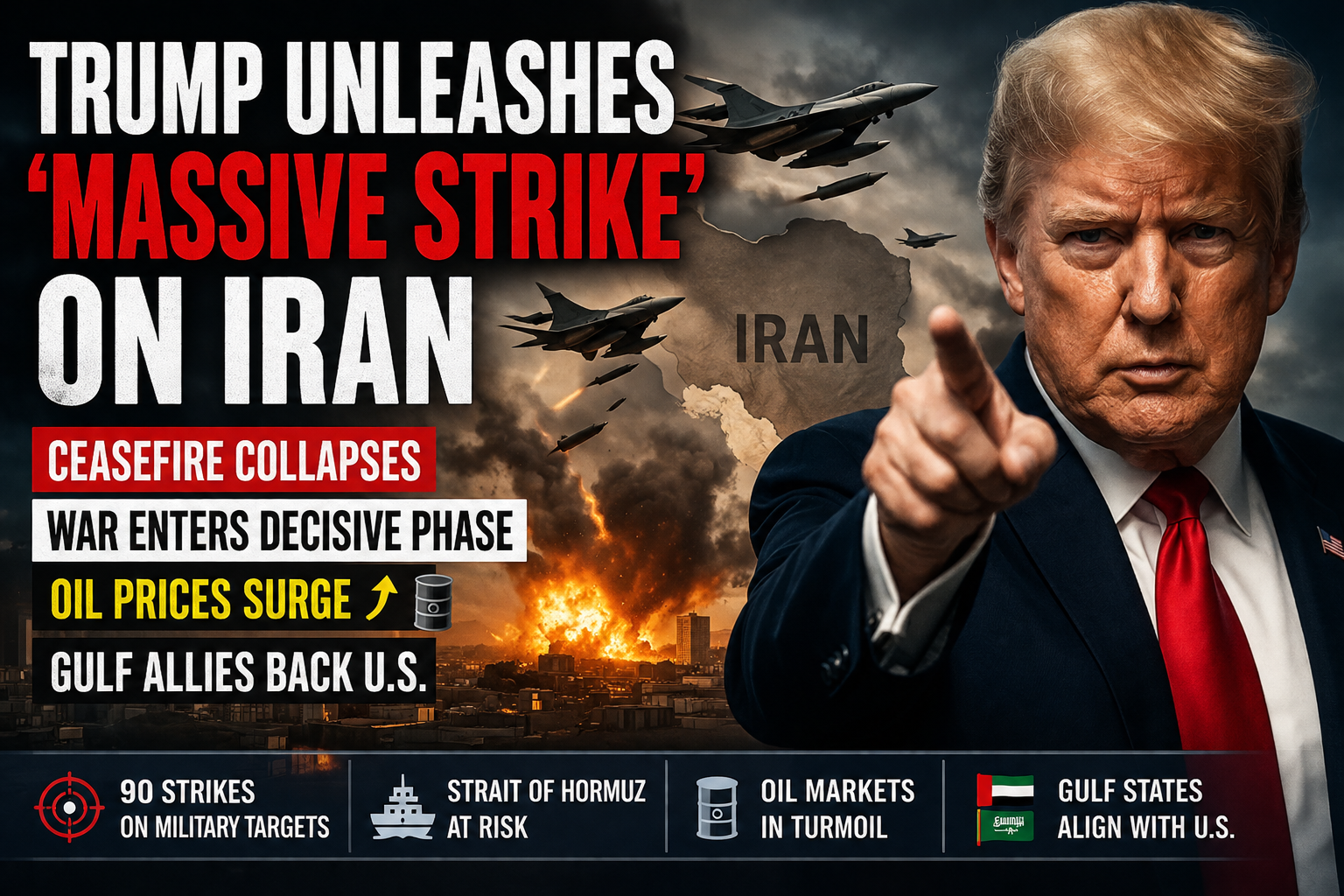
- Trump Iran War Escalation: Trump orders nearly 90 U.S. strikes on Iranian military targets
- Ceasefire collapses after alleged Iranian attacks on shipping
- Gulf states align openly with Washington against Tehran
- Oil prices surge amid fears of prolonged Strait of Hormuz disruption
ANKARA — U.S. forces launched a second consecutive day of coordinated attacks on Iranian military targets on Wednesday, carrying out nearly 90 strikes aimed at weakening Tehran’s ability to threaten maritime security in the Strait of Hormuz. The operation followed Trump’s declaration that the recently brokered ceasefire with Iran was “over,” marking a dramatic shift from diplomacy back to open confrontation.
According to sources within Trump’s inner circle who spoke to The Islamabad Telegraph, the escalation is as much political as it is strategic. The president had reportedly faced criticism from some of his closest aides, who believed that the earlier ceasefire—encouraged by Pakistan’s Chief of Army Staff Field Marshal Asim Munir and Prime Minister Shehbaz Sharif—had granted Iran excessive concessions and strategic breathing room.
Trigger for Renewed Conflict
The fragile ceasefire, part of the Islamabad Memorandum of Understanding (MoU), was intended to serve as a 60-day cooling-off period, allowing both sides to negotiate on critical issues including Iran’s nuclear program and the reopening of key shipping routes. However, the agreement began to unravel amid mutual accusations of violations.
Iran’s alleged attacks on commercial vessels, including ships linked to Qatar transiting the Strait of Hormuz, provided the immediate trigger for Washington’s response. Trump framed the renewed strikes as retaliation, warning that further Iranian aggression would invite even stronger military action.
US Strikes On Iran: US Missiles Hit Iran Ports After Ceasefire Ends — Oil Prices Surge, Shipping at Risk
“We hit them very hard, and we will probably hit them again,” Trump said during remarks in Ankara, adding that the United States had not yet used its “full force”—a statement widely interpreted as a warning of potential escalation targeting critical infrastructure.
Regional Alignment Shifts
This phase of the conflict is notably different from previous escalations. Gulf Cooperation Council (GCC) states, particularly Saudi Arabia and the United Arab Emirates, are now more openly aligned with Washington. Regional allies are reportedly providing logistical support, intelligence cooperation, and operational access to U.S. forces.
This growing alignment reflects increasing concern among Gulf states over Iran’s assertiveness in the Strait of Hormuz. Tehran’s suggestion that it could exert control over maritime traffic, or impose transit conditions, has heightened alarm in energy-dependent economies across the region.
The International Maritime Organization has warned shipowners to avoid the Strait unless safety can be guaranteed, underscoring the rising risks to global trade.
Oil Markets React Instantly
The collapse of the ceasefire has had an immediate impact on global energy markets. Brent crude prices surged by more than 5 percent, crossing $78 per barrel amid fears of prolonged disruption.
Trump orders new round of strikes after calling Iranian leaders ‘scum’
Energy analysts warn that even a limited continuation of hostilities could drive prices significantly higher. Given that nearly 20 percent of the world’s oil supply passes through the Strait of Hormuz, any sustained instability poses serious risks to global economic stability.
Iran Responds with Force
Iran has retaliated with missile and drone strikes targeting U.S. military installations in Bahrain and Kuwait. The Islamic Revolutionary Guard Corps (IRGC) claimed responsibility for attacks on dozens of targets, though Gulf defense systems reportedly intercepted most incoming threats.
Iranian leadership has adopted a defiant posture. Senior officials have rejected U.S. pressure and signaled readiness for continued confrontation, while also navigating internal pressures following the recent killing of Supreme Leader Ayatollah Ali Khamenei earlier in the conflict.
Despite the aggressive rhetoric, Tehran faces a complex strategic dilemma—balancing retaliation with the risk of provoking a broader coalition response.
U.S. Strategy: Pressure Without Full War
While the scale of U.S. strikes suggests a significant escalation, Trump has maintained ambiguity about the ultimate objective. He has suggested that the conflict could remain limited and short-lived, even as military operations intensify.
Analysts see this as a strategy of calibrated pressure—using overwhelming force to deter Iran while avoiding the costs of a full-scale war. However, such a strategy carries inherent risks, particularly in a volatile environment where miscalculation can rapidly escalate tensions.
Trump has also hinted at the possibility of reimposing a naval blockade on Iran, a move that would mark a major escalation and could draw wider international involvement.
Diplomatic Fallout and Pakistan’s Role
The breakdown of the ceasefire is also a setback for Pakistan’s diplomatic efforts. Islamabad had briefly emerged as a key mediator, bringing both Washington and Tehran to the negotiating table.
The involvement of Field Marshal Asim Munir and Prime Minister Shehbaz Sharif was seen as a significant diplomatic achievement. However, the rapid collapse of the agreement highlights the limitations of mediation in deeply entrenched geopolitical rivalries.
Although backchannel talks continue—reportedly involving U.S. Vice President JD Vance—Trump himself has expressed skepticism about the prospects for meaningful negotiations.
Forecast: A Narrow Path Ahead
Looking forward, the conflict appears headed toward a phase of controlled but persistent escalation. Limited strikes, retaliatory actions, and heightened tensions are likely to continue in the near term.
However, the risks of broader war remain significant. A major incident—such as a successful strike on critical infrastructure or high casualties—could quickly push the conflict beyond containment.
At the same time, the economic implications are mounting. Prolonged instability in the Strait of Hormuz could disrupt global energy supplies, fuel inflation, and strain already fragile economies.
For now, Trump’s approach reflects a high-stakes balancing act—seeking to assert dominance without triggering an uncontrollable regional war. Whether that balance can be maintained will determine not only the future of U.S.-Iran relations but also the stability of the broader Middle East.
What is clear is that the region has once again become the focal point of global geopolitical tension—and the margin for error is rapidly shrinking.