



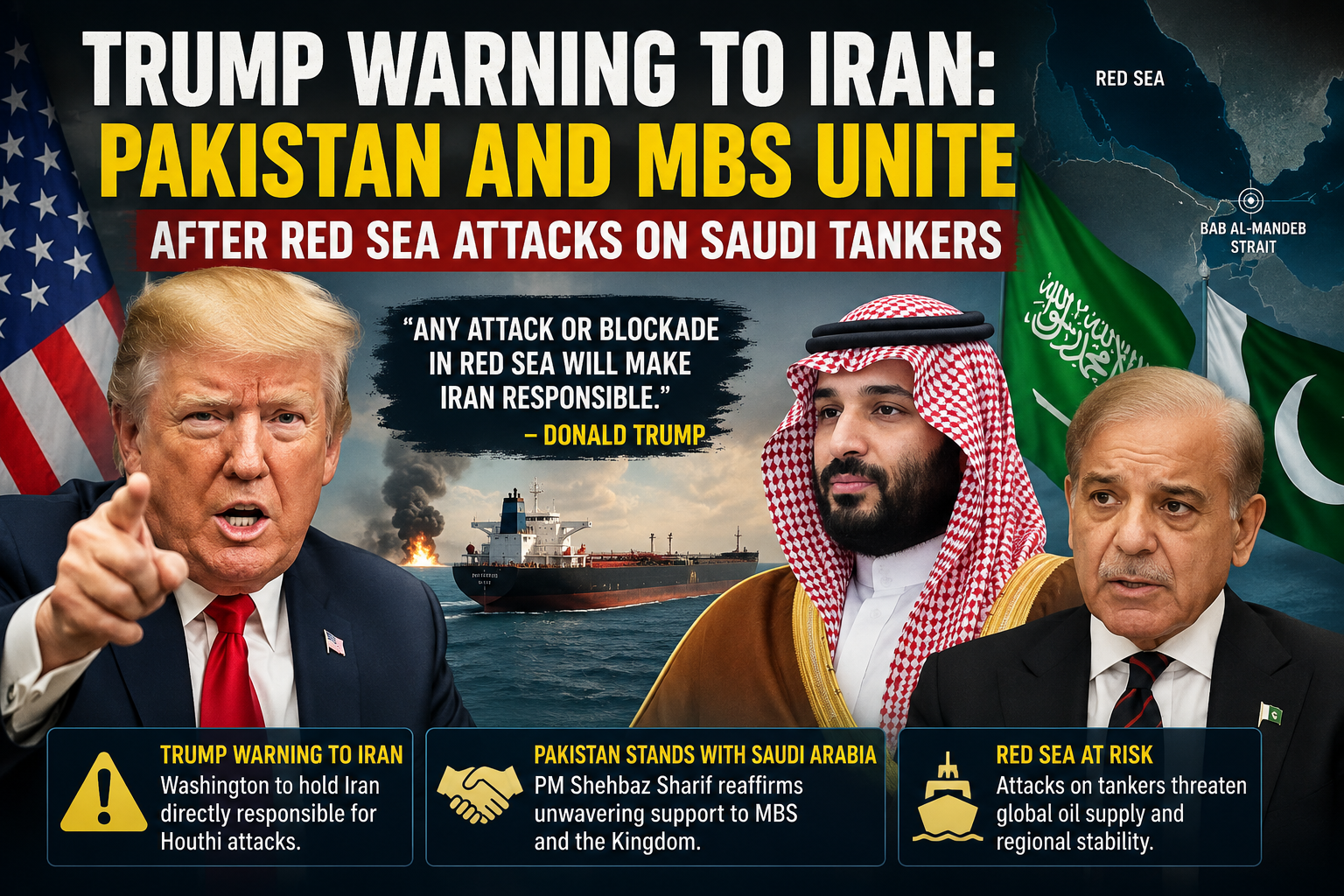
- Trump warning to Iran signals direct accountability for Houthi attacks on Saudi tankers in the Red Sea
- Pakistan reinforces Saudi Arabia with strong diplomatic and strategic backing alongside MBS
- Rising tensions threaten global oil supply routes, pushing markets toward instability
The Trump warning to Iran has sharply escalated tensions in the Middle East following Houthi attacks on Saudi oil tankers in the Red Sea. The incident has triggered global concern over maritime security, energy flows, and the risk of a wider regional conflict.
President Donald Trump issued the Trump warning to Iran after Houthi militants launched coordinated strikes on two Saudi tankers, Encelia and Layla. The attacks involved ballistic missiles, cruise missiles, and drones, marking a dangerous expansion of the conflict into one of the world’s most vital shipping corridors.
In a strong statement, Trump described the Houthis as a “proxy of Iran” and made clear that Washington would hold Tehran directly accountable. The Trump warning to Iran emphasized that any future attacks or attempts to disrupt shipping in the Red Sea would invite serious consequences.
The U.S. Strikes on Yemen’s Houthis: A New Flashpoint in the Middle East?
Global markets reacted immediately. Oil prices surged toward $100 per barrel, reflecting fears that instability in the Red Sea could disrupt international energy supplies. The Bab al-Mandeb chokepoint, a critical route for global oil shipments, is now under renewed threat. The Trump warning to Iran therefore carries major economic as well as military implications.
Trump further reinforced his position by stating that any damage to ships or cargo would be compensated using Iranian funds under U.S. control. This aspect of the Trump warning to Iran signals a shift toward direct financial accountability alongside military deterrence.
READ NEXT: Iran US Talks Islamabad Resume Without VP JD Vance as High-Stakes Negotiations Enter Critical Phase
Pakistan also moved quickly to support Saudi Arabia. Even before the latest developments, Islamabad had issued a stern warning to the Houthis, making it clear that attacks on Saudi oil infrastructure and maritime routes were unacceptable.
Prime Minister Shehbaz Sharif held a telephone conversation with Saudi Crown Prince Mohammed bin Salman (MBS), strongly condemning the attacks. He described them as a violation of international law and a threat to freedom of navigation and regional stability.
Sharif reaffirmed Pakistan’s full support for Saudi Arabia, emphasizing that the country stands with the Kingdom during times of crisis. This position aligns closely with the broader implications of the Trump warning to Iran, as regional actors move toward a more unified stance.
READ MORE: Trump Says Iran Will Be Held Responsible for Future Houthi Attacks
The conversation between Pakistan and MBS highlighted deep strategic ties and a shared commitment to safeguarding maritime security. Pakistan also pledged to work with international partners to ensure the uninterrupted flow of trade through key waterways, including the Red Sea and the Strait of Hormuz.
Meanwhile, the United States has increased its military readiness in the region. Naval deployments, air power, and special operations forces have been positioned to respond to any escalation. These steps underline that the Trump warning to Iran is backed by credible military capability.
Iran, however, has shown no signs of retreat. Its continued reliance on proxy forces raises the risk of further escalation, especially if attacks on commercial shipping persist. The Trump warning to Iran marks a significant shift by linking proxy actions directly to Tehran’s responsibility.
This development could redefine the rules of engagement in the region. By removing ambiguity, the Trump warning to Iran increases the احتمال of direct confrontation if deterrence fails.
With Pakistan firmly backing Saudi Arabia and MBS leading a decisive regional response, the Red Sea is emerging as a central arena in a broader geopolitical contest. Stability in this corridor is essential for global trade and energy security.
The Trump warning to Iran is therefore more than a political statement—it is a strategic signal that the balance of power in the Middle East is entering a more confrontational phase. How Tehran responds will determine whether the crisis stabilizes or escalates further.