



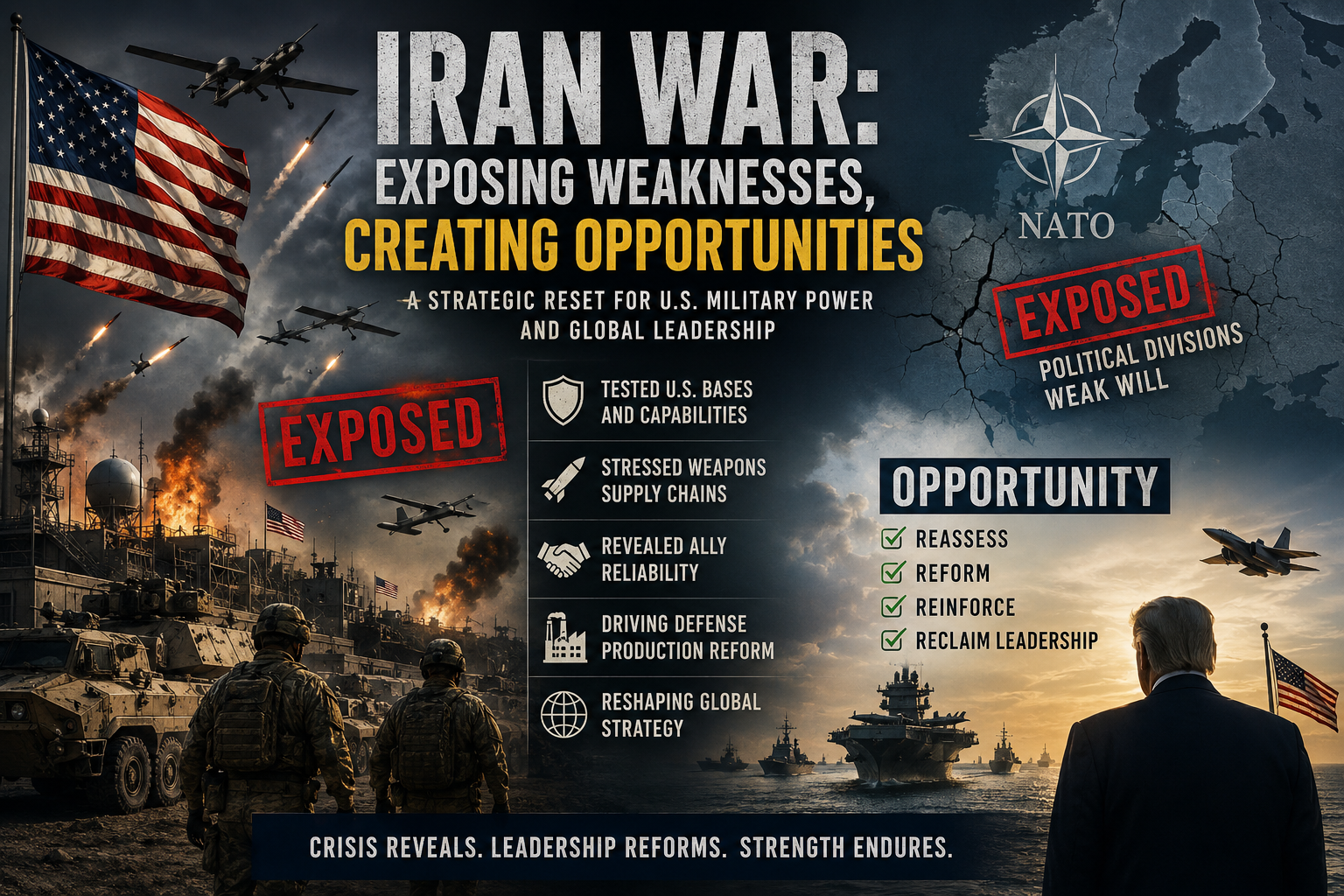
- Iran war US military exposure has revealed gaps but also enabled a critical reassessment of U.S. defense capabilities
- Iranian strikes tested U.S. bases, weapons systems, and alliance reliability across the Middle East
- The conflict exposed NATO and Europe’s weak political will, giving Washington clarity on true allies
The ongoing Iran war has triggered an intense debate within Washington’s strategic circles about the resilience—and vulnerability—of the United States military posture across the Middle East and beyond. While some analysts warn that the conflict has exposed dangerous weaknesses, others argue that the war has provided a rare and critical opportunity for the United States to reassess, recalibrate, and ultimately strengthen its global military architecture.
Among the most prominent voices sounding alarm is Mr. Jones, president of the Defense and Security Department at the Center for Strategic and International Studies, who cautions that the U.S. military is increasingly exposed in an era of advanced missile and drone warfare. His assessment comes in the wake of sustained Iranian strikes across the region under Operation Epic Fury, which have reportedly targeted more than 20 U.S.-linked sites in eight countries, inflicting billions of dollars in damage.
“U.S. infrastructure’s vulnerability to these sorts of strikes shouldn’t have been a surprise,” Mr. Jones argues, pointing to the rapid evolution of drone and missile warfare witnessed in Ukraine. He emphasizes that the United States has been too slow to adapt, leaving critical bases and personnel exposed not only in the Middle East but also in the Indo-Pacific, where China and North Korea pose even greater threats.
READ NEXT: Trump’s Iran War Triggers U.S. Ammunition Surge, Reshaping the Global Military Industry
Recent Iranian attacks appear to validate these concerns. Strikes on Muwaffaq Salti Air Base in Jordan resulted in American casualties, while key U.S. facilities in Qatar, Bahrain, Kuwait, and Saudi Arabia suffered damage to infrastructure, communications systems, and military assets. Iran’s growing ability to deploy drones, cruise missiles, and ballistic systems in coordinated barrages has underscored a shifting battlefield reality—one where traditional military superiority is increasingly challenged by asymmetric capabilities.
Yet, this narrative of vulnerability is only one side of the story.
According to Kaswar Klasra, Editor-in-Chief of The Islamabad Telegraph, the Iran war should not be viewed merely as a strategic setback for Washington but rather as a defining moment of recalibration. In his view, the conflict has provided the United States with an unprecedented opportunity to test and reassess the strength of its naval, air, and ground forces, as well as the reliability of its weapons supply chains and defense manufacturing capacity.
“The Iran war has provided a chance to the United States to reassess its strength—across the Navy, Air Force, and ground forces—as well as its weapons supply and the critical role of allies,” Klasra notes. “It has tested not only America’s military hardware but also the political and military resolve of its partners in the Middle East.”
READ MORE: America’s Military Is Dangerously Exposed
Klasra argues that the war has exposed gaps in U.S. preparedness, particularly in defending forward-deployed assets, but insists that these exposures are not signs of decline. Instead, they represent a necessary stress test for a global superpower operating in an increasingly complex and contested security environment.
Indeed, the scale and intensity of Iranian strikes have forced Washington to confront longstanding vulnerabilities in its overseas infrastructure—ranging from insufficient air-defense systems to inadequate passive protection measures such as hardened shelters and underground facilities. However, these shortcomings are now driving urgent policy and budgetary discussions within the Pentagon and Congress, particularly around modernizing defensive systems and accelerating the deployment of advanced technologies such as directed-energy weapons and electronic warfare tools.
Beyond the battlefield, the Iran war has also revealed deeper geopolitical fault lines—particularly within NATO and across Europe.
Klasra contends that the conflict has “clearly exposed Europe” before former President Donald Trump, highlighting what he describes as a lack of political will and strategic cohesion among U.S. allies. From inconsistent responses to Iranian aggression to hesitations over defense commitments, European divisions have, in his view, reinforced long-standing American concerns about burden-sharing within the alliance.
“The Iran war exposed NATO and Europe, providing a chance for the United States to assess Europe’s political will as well as its weaknesses,” Klasra says. “It has shown who stands firmly with Washington and who remains an unreliable partner in times of crisis.”
This perspective aligns with a broader argument gaining traction in some policy circles—that the Iran war has served as a geopolitical litmus test, revealing not only military vulnerabilities but also the true alignment of allies and adversaries.
Klasra goes further, asserting that the United States remains firmly a superpower despite current challenges and that the lessons learned from the Iran conflict could ultimately reinforce its global dominance.
“The United States is still a superpower,” he states. “And through the Iran war, it has gained clarity—about its enemies, its allies, and the urgent need to strengthen its military and strategic partnerships. This is an opportunity to bring its house in order.”
In this context, the war has become a catalyst for reform. It has highlighted the urgent need to expand weapons production, secure supply chains, and enhance interoperability with allies. It has also underscored the importance of investing in next-generation defense systems capable of countering drone swarms and hypersonic threats—areas where adversaries are rapidly advancing.
Moreover, the conflict has provided Washington with a clearer picture of the capabilities and limitations of its regional partners. From Gulf states hosting U.S. bases to coalition members contributing to air defense and logistics, the war has effectively tested the strength of America’s alliance network under real combat conditions.
For policymakers in Washington, the choice is now stark: treat the Iran war as a warning of decline or as an opportunity for renewal.
Mr. Jones and other analysts urge immediate investment in both active and passive defenses—ranging from Patriot missile systems to underground infrastructure and decoy deployments—to mitigate future risks. Meanwhile, voices like Klasra emphasize the strategic upside of the crisis, arguing that exposure can lead to adaptation, and adaptation to renewed strength.
Ultimately, the Iran war may be remembered not only for the damage it inflicted but for the strategic clarity it provided. It has exposed weaknesses—but it has also illuminated pathways for reform, resilience, and renewed global leadership.
In a world where drones and missiles are redefining warfare, the true measure of power lies not in avoiding exposure, but in how swiftly and effectively a nation responds to it. For the United States, the Iran conflict may well prove to be less a moment of vulnerability—and more a turning point toward strategic reinvention.