



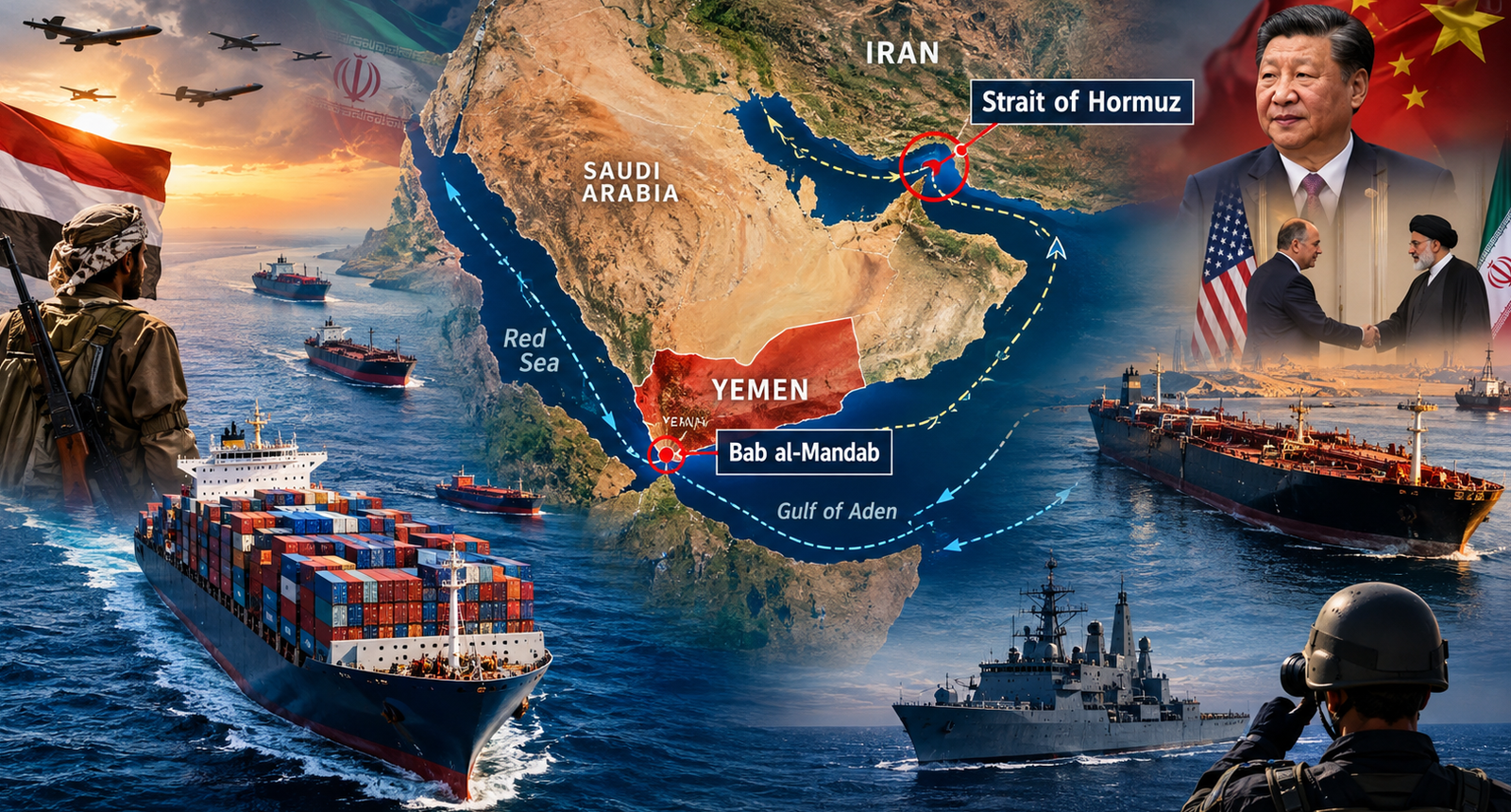
- Yemen Houthi threat has become a global economic concern after the group expanded its position around the strategic Bab al-Mandab Strait.
- Iran and the Houthis now have influence over the security environment surrounding two critical maritime gateways: Hormuz and Bab al-Mandab.
- China’s support for renewed US-Iran talks and Iran’s continued acceptance of the Islamabad MOU provide a diplomatic opening alongside the growing maritime crisis.
Yemen’s Vice President Abdullah Al-Alimi Bawazir’s address at the 81st United Nations General Assembly should have been an eye opener for world leaders. His warning was not simply about Yemen’s unfinished civil war. It was about the transformation of the Houthi movement from a Yemeni armed faction into a force capable of influencing one of the world’s most important arteries of trade.
That warning has become harder to dismiss after the Houthis captured the strategic port city of Mocha and advanced towards strategic islands around the Bab al-Mandab Strait. Their expanded position has altered the security geography of the Red Sea and increased their ability to influence maritime traffic through one of the world’s most important commercial gateways.
Bawazir told the General Assembly that the Houthis had used periods of humanitarian calm to strengthen their military capabilities. He accused Iran of providing the weapons, expertise and technology that enabled the movement to expand beyond Yemen and threaten international waterways. His central argument was that maritime security cannot be separated from restoring Yemen’s state institutions.
READ NEXT: The U.S. Strikes on Yemen’s Houthis: A New Flashpoint in the Middle East?
That argument deserves attention because the issue is no longer confined to Yemen. The Houthis’ position along the Red Sea coast gives them greater capacity to threaten, delay or impose costs on commercial shipping. Control of territory and islands near Bab al-Mandab gives an armed non-state movement a strategic position beside a maritime chokepoint through which global trade passes.
The significance becomes even greater when Bab al-Mandab is considered alongside the Strait of Hormuz.
Iran and its regional allies now have the ability to exert pressure around two of the world’s most important maritime gateways. Iran dominates the strategic environment surrounding Hormuz, while the Iranian-backed Houthis have built a powerful position around Bab al-Mandab. The two waterways serve different routes, but together they connect the energy-producing Middle East with major markets in Europe, Asia and Africa.
READ MORE: How the Capture of Mocha Transformed the Red Sea Crisis
This creates a major vulnerability for the global economy. Disruption in either waterway can increase shipping costs, insurance premiums, delivery times and energy prices. Simultaneous disruption around both would create a far more serious shock.
This is why Bawazir’s warning that maritime security requires addressing the source of the threat on land is important. Protecting individual ships can reduce immediate risks, but it does not remove the strategic leverage created by territorial control. The Houthis’ position around Bab al-Mandab gives them something few armed groups possess: geography capable of converting military power into economic pressure.
The international community therefore faces a larger question: can global trade remain dependent on temporary arrangements for protecting individual shipping lanes, or is a collective strategy required to secure the waterways themselves?
The threat also extends far beyond Saudi Arabia or Yemen. A ship associated with Saudi energy exports can have European, Asian or Chinese owners, insurers, financiers, charterers or destinations. Any attack or disruption can therefore transmit consequences through international supply chains.
China has a direct economic interest in preventing such a scenario. Beijing is one of the world’s largest trading powers and depends heavily on stable energy supplies and maritime commerce. Its support for renewed US-Iran diplomacy is therefore significant.
Chinese President Xi Jinping has supported efforts by Washington and Tehran to return to negotiations. That position gives the diplomatic track a broader international dimension at a moment when military pressure around the region’s maritime chokepoints is increasing.
There is also an important diplomatic development from Islamabad.
Iranian President Masoud Pezeshkian has reaffirmed that the Islamabad Memorandum of Understanding remains acceptable to Tehran and that Iran is prepared to move it forward. The position provides an additional diplomatic channel at a time when the security environment around Hormuz and Bab al-Mandab is becoming increasingly dangerous.
China’s support for US-Iran talks and Tehran’s continued acceptance of the Islamabad framework matter because diplomacy cannot be separated from maritime security. Any durable reduction in regional tensions will require addressing the relationship between Iran, its regional allies and the security architecture of the Gulf and Red Sea.
The international community has repeatedly approached Yemen through separate compartments: humanitarian assistance, Saudi-Houthi negotiations, Iranian diplomacy, maritime patrols and support for Yemen’s internationally recognised government. The latest Houthi expansion demonstrates the limits of that fragmented approach.
The Houthis now have the capacity to influence global shipping, energy markets, Gulf security and the strategic calculations of major powers. Yemen can no longer be treated simply as a distant civil conflict.
This does not necessarily mean another large military intervention. It means recognising that territorial control, maritime security and regional diplomacy are directly connected. A collective international approach should combine protection of commercial navigation with efforts to restore Yemen’s state institutions, prevent illicit weapons transfers and create a political framework capable of reducing the Houthis’ military leverage.
Bawazir’s message at the United Nations was therefore larger than Yemen. His warning was that a non-state armed movement controlling territory beside a global maritime chokepoint cannot be treated simply as another participant in a domestic conflict.
The world economy depends on predictable maritime commerce. Bab al-Mandab and Hormuz are not merely geographical locations; they are gateways through which energy and goods reach global markets.
Allowing either to become an instrument of coercion carries international consequences. Allowing both to remain exposed at the same time could create an economic crisis far beyond the Middle East.
Bawazir’s appeal was ultimately for the international community to recognise that securing Bab al-Mandab requires a stable Yemen. The same principle applies to the wider region: lasting maritime security will require diplomacy, collective action and a political settlement capable of preventing strategic waterways from becoming bargaining instruments.
Ignoring Yemen will not contain its crisis. It will only increase the possibility that Yemen’s war becomes a crisis for the global economy.