



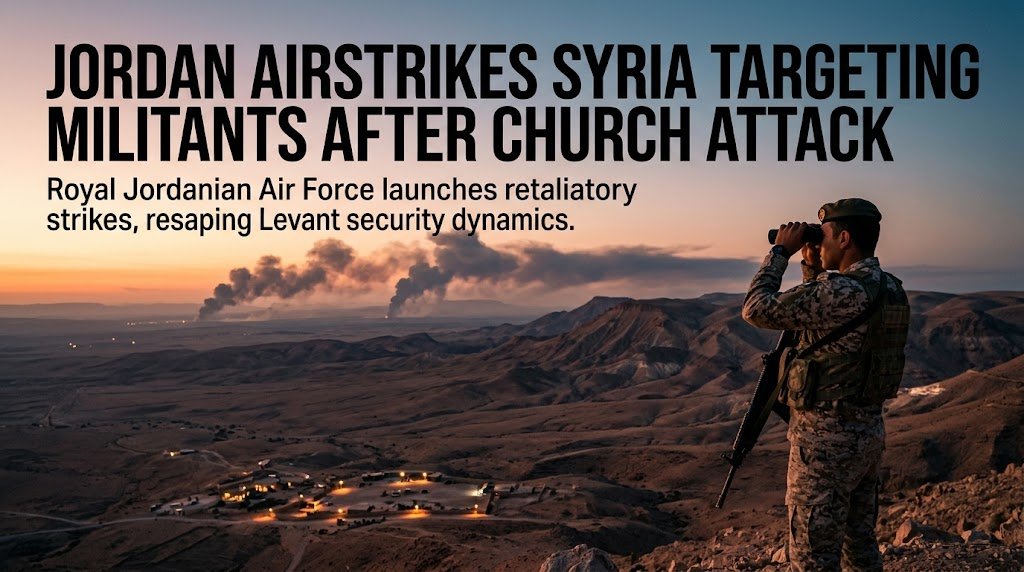
- Jordan airstrikes Syria: Royal Jordanian Air Force warplanes hit militant hideouts and vehicles in southern Syria’s Daraa countryside.
- Suspects Arrested: Security forces captured three primary suspects following a gunfight in Karak governorate.
- Strategic Forecasting: Shift toward preemptive cross-border strikes redefines Levant security dynamics and border control policies.
AMMAN / ISLAMABAD — The Royal Jordanian Air Force launched high-precision airstrikes across southern Syria targeting militant strongholds, marking a sharp operational shift in the Hashemite Kingdom’s counter-terrorism strategy following a deadly assault on Arab Christians in Karak governorate.
The military operation, codenamed “Jordanian Deterrence – Hamoud,” struck multiple hideouts and tactical vehicles belonging to extremist factions in Syria’s Daraa countryside. Amman directly linked the targeted cells to Friday’s shooting at St. George’s Greek Orthodox Church in the village of Hamoud. Jordanian warplanes destroyed key command structures and neutralized several fighters in retaliation for the nine killed and dozens wounded during a funeral procession.
Jordan airstrikes Syria ! Context
The strikes came hours after Jordanian security forces cornered and arrested three principal suspects following a heavy exchange of fire at an abandoned compound in Karak governorate. The Public Security Directorate recovered automatic rifles and ammunition from the scene.
READ NEXT: Jordan attacks militants in Syria in retaliation for last week’s church attack
While the suspects were taken into custody under heavy guard, Jordanian authorities confirmed that the perpetrators belonged to an underground cell nourished by cross-border extremist networks operating out of southern Syria.
Sectarian Cohesion and Historical Context
The attack on St. George’s Greek Orthodox Church represents an unprecedented breach of Jordan’s internal security baseline. Historically, the southern governorate of Karak has served as an emblem of interfaith stability, where Arab Christians and Muslims have coexisted through shared tribal lineage and mutual social pacts for centuries.
READ MORE: Iran Strikes U.S. Bases in Jordan: Middle East War Risks Exploding Again
While major gun violence targeting religious minorities remains exceptionally rare in the Kingdom, Karak was previously hit in 2016 by an Islamic State terror cell. Friday’s shooting—wherein masked assailants fired directly at mourners inside a sacred sanctuary—aimed to shatter Jordan’s internal social fabric.
King Abdullah II pledged to strike perpetrators with an “iron fist,” signaling that Amman views the act not merely as a criminal offense, but as an existential threat to its national model of tribal and religious harmony. A three-day period of national mourning was observed across government entities.
Geopolitical Impact & Regional Forecasting
Jordan’s swift unilateral military projection inside Syria carries profound geopolitical ramifications across the Levant:
-
Sovereignty vs. Security Dilemma: Direct strikes inside Daraa underscore Amman’s growing frustration with security vacuums in southern Syria. The unilateral campaign highlights the inability of regional security frameworks to stem the flow of weapons and radicalized networks along the border.
-
Hardened Border Controls: Following the strikes, cross-border transit—including the vital Nassib commercial arterial—faced immediate friction and closures, threatening regional trade lines already strained by economic pressures.
-
Precedent of Active Retaliation: Operation “Jordanian Deterrence – Hamoud” signals a permanent departure from defensive containment toward preemptive external interdiction. Amman is asserting itself as an active power willing to project force deep into neighboring territories to eliminate threats before they cross its frontiers.
Moving forward, Jordan faces a delicate balancing act. While cross-border strikes satisfy domestic demands for decisive action, extended military campaign risks drawing the Kingdom deeper into southern Syria’s volatile security landscape. Security agencies in Amman will likely intensify domestic surveillance, tighten border enforcement, and demand greater intelligence-sharing mechanisms across the Levant to prevent radical sleeper cells from exploiting regional instability.
Forecasting:
Looking ahead, Jordan’s active cross-border campaign will reshape Levant security dynamics. Amman’s shift from defensive containment to preemptive power projection risks deepening its entanglement in southern Syria’s volatile security landscape. Expect Jordan to tighten domestic surveillance, harden border trade arterials, and push for enhanced regional intelligence-sharing networks to preemptively dismantle cross-border radical sleeper cells before they can exploit regional vacuums and threaten internal stability.