



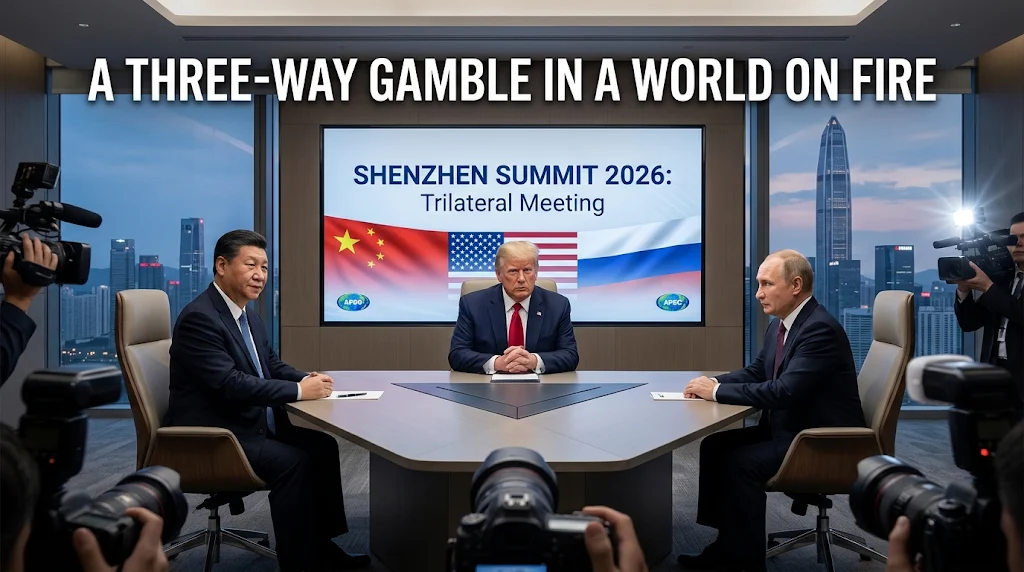
- Shenzhen Summit brings together Xi Jinping, Donald Trump, and Vladimir Putin for a crucial trilateral meeting on the sidelines of APEC.
- Middle East & Ukraine tensions remain at the forefront, balancing ongoing Iran conflict talks against unresolved security guarantees in Europe.
- High-tech fallout surrounds the discussions as a major Nvidia chip scandal casts a massive shadow over the US-China bilateral talks.
SHENZHEN / ISLAMABAD, 16 November 2026. Few summits arrive carrying this much baggage. Beijing confirmed on Monday that Xi Jinping, Donald Trump and Vladimir Putin will hold their first trilateral summit in Shenzhen on Thursday, 19 November. It takes place on the sidelines of APEC, and the leaders are meeting at a moment when almost every major fault line in world politics runs through the room.
Iran: The Urgent File
Washington has said Iran will be on Trump’s agenda with Xi and Putin. That is no courtesy. Contacts between Iran and the United States to end their eight-month war continue after days of talks with Qatari mediators produced altered proposals but no breakthrough. The danger is that the pause ends. Trump has repeatedly suggested the US could attack Iran after the 3 November midterms. AP reports that Netanyahu is pressing him to do so.
Both Beijing and Moscow hold real leverage over Tehran. China’s Middle East envoy Zhai Jun travelled to Iran on 8 November and met Parliament Speaker and chief negotiator Mohammad-Bagher Ghalibaf. Islamabad has a particular stake here. Pakistan was a named mediator when the US and Iran signalled progress in May. Any Shenzhen understanding on the Strait of Hormuz would be felt first in Pakistani fuel bills.
Ukraine: The Elephant Washington Says It Will Leave Out
US officials say Trump does not intend to raise Russia’s war in Ukraine at the trilateral. The diplomatic track is live but stuck. The Abu Dhabi round on 10–11 November agreed a major prisoner swap but ended without a breakthrough. Territory and security guarantees remain the core disagreements. Trump has also softened his posture toward Moscow. He has agreed to allow Russian diesel into global and US markets and lifted oil sanctions on Moscow. Expect Kyiv and European capitals to watch for any side deal struck without them.
Shenzhen Summit And The Nuclear Vacuum
The strategic stakes are higher still. The summit comes nine months after the last US–Russia nuclear arms treaty expired. Washington wants China at the table, but Beijing said last month it would be neither fair nor realistic to ask it to join trilateral nuclear disarmament talks at this stage. Kremlin spokesman Dmitry Peskov called the meeting extremely significant, while stressing that any agreements cannot be imposed on other nations. That caveat is a signal to the Global South and to Europe.
The Houthi Factor: The Energy Squeeze
The Red Sea is now a second Gulf. The Houthis announced a blockade of Saudi shipping on 22 July. In September they seized the port of Mocha and Perim Island beside the Bab el-Mandeb strait, and the Suez route carries about 15% of global maritime trade by volume. Combined with a disrupted Hormuz, the result is volatile oil prices and freight rates, which hurt import-dependent economies such as Pakistan hardest.
The Nvidia Scandal: The Shadow Over The Xi–Trump Lunch
Nothing complicates the bilateral more than chips. Trump will also hold a bilateral meeting and working lunch with Xi on Thursday afternoon. Days before it, Jensen Huang’s relationship with a woman accused of being a Chinese spy has fuelled debate in Washington over chip exports.
Read More: US, China, Russia summit: Trump, Xi, and Putin Chart a New Global Security Architecture
China’s foreign ministry calls the allegations groundless and intended to smear China, and Trump says the FBI is examining whether national security was compromised. The Information reported that she helped move about 240,000 restricted Nvidia chips into China, worth at least $7.5 billion. House committee chairs have asked Huang for a closed-door session on 18 November, the day after Nvidia reports earnings.
Trump to meet with Putin and Xi in China next week, US officials say
The politics are awkward for Trump. He reversed course in December 2025 to let Chinese firms buy Nvidia’s H200 chips, and Republican Jim Banks and Democrat Elizabeth Warren now urge Commerce to suspend export licences. CSIS fellow Ilaria Mazzocco told the South China Morning Post the scandal “could have a bigger impact down the line,” a warning that the fallout may outlast the truce.
What to Watch
Expectations should stay modest. NTU’s Hoo Tiang Boon told AP that hosting lets Xi project diplomatic clout, even if power politics overshadow APEC’s trade agenda. The Kremlin says a separate Putin–Trump bilateral has not been finalised. Realistic outcomes are a Hormuz de-escalation message, a nuclear-talks framework, and a tech-trade truce. The worst case is a photo-op that leaves every war where it was.