



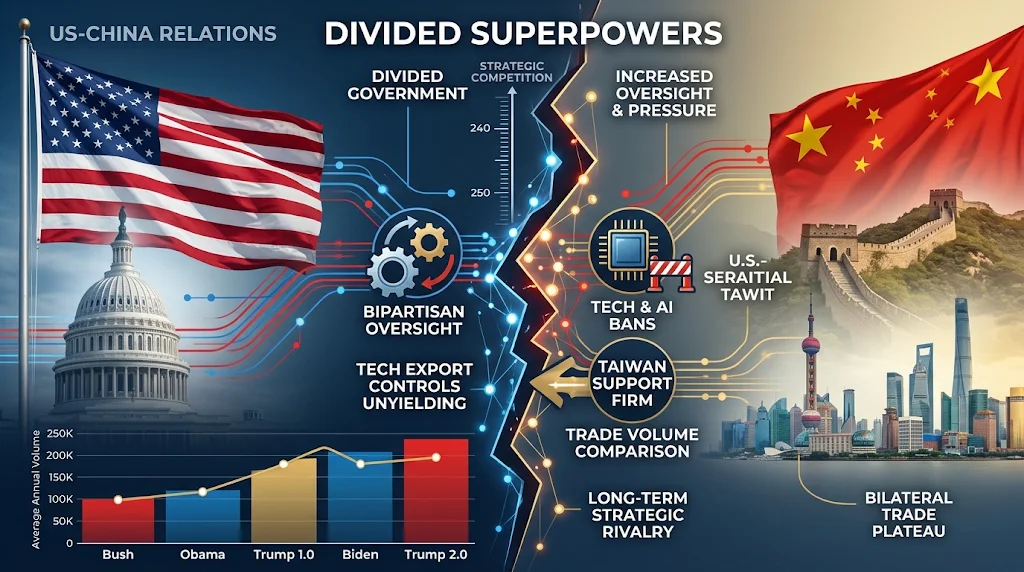
- US-China relations face heightened complexity as a Democratic-controlled Congress introduces fierce bipartisan oversight, institutional pressure, and stricter export controls alongside a politically weakened executive branch.
- Strategic competition between Washington and Beijing remains entirely unyielding on core pillars like advanced artificial intelligence restrictions, semiconductor export bans, and Indo-Pacific security.
- Bilateral trade volumes have evolved significantly over the past two decades, transitioning from early-2000s integration under both Democratic and Republican administrations toward managed decoupling, tariffs, and systemic supply chain de-risking.
The sweeping victory by the Democratic Party in the 2026 United States midterm elections—securing control of both the Senate and the House of Representatives—has introduced a new layer of complexity to the world’s most consequential bilateral relationship.
As President Donald Trump faces a divided government during the back half of his presidency, Beijing is forced to recalculate its diplomatic and economic strategy.
Drawing from recent developments highlighted by the Anadolu Ajansı report on China’s reaction, Chinese Foreign Ministry spokesperson Mao Ning responded to the results by emphasizing Beijing’s desire to maintain a “constructive strategic relationship” based on respect and equality.
READ NEXT: Trump-Xi Summit: A Fragile Truce Between Two Superpowers
However, behind the diplomatic niceties lies a profound structural shift: Beijing must now navigate “two Americas”—a politically weakened executive branch seeking transactional deals, and an emboldened, highly critical legislative branch determined to maintain intense strategic pressure.
1. What a Democratic Victory Means for US-China Bilateral Relations
The shift in legislative power fundamentally alters how China policy is shaped, monitored, and restrained in Washington.
-
Bipartisan Consensus on Strategic Competition: The structural competition between Washington and Beijing will not soften. Both Democrats and Republicans view China as the primary long-term competitor in advanced technology, industrial capacity, and Indo-Pacific security.
-
Institutionalized Legislative Pushback: With Democrats controlling both chambers of Congress, lawmakers are positioned to exercise aggressive oversight. Analysts, such as Fudan University’s Wu Xinbo, note that a Democratic-led Congress will likely criticize the White House for any perceived softness on Beijing and aggressively push for long-stalled measures—such as expediting a $14 billion arms package to Taiwan.
-
Complicated Diplomatic Bargaining: While President Trump may look toward high-profile summits—such as his expected meeting with Chinese President Xi Jinping on the sidelines of the APEC forum in Shenzhen—congressional resistance will make it considerably harder for the executive branch to deliver on major bilateral concessions or permanent trade truces.
READ NEXT: What the Democratic midterms sweep changes for U.S.-China relations
2. Unyielding Policy Pillars: Where US Stance Will Not Change
Regardless of the congressional majority or political party in power, certain core national security and economic pillars of US policy toward China remain entirely non-negotiable:
-
Advanced Technology and AI Restrictions: Export controls on cutting-edge semiconductors, supercomputing, and Artificial Intelligence infrastructure will remain tightly restricted. Democrats, historically aligned closely with domestic labor unions and high-tech security hawks, share a unified stance with Republicans on preventing China from achieving dominance in next-generation AI and advanced manufacturing.
-
Indo-Pacific and Taiwan Deterrence: Bipartisan support for Taiwan’s security framework is firmly entrenched in Washington. While the tactical approach to enforcement may differ between the executive and legislative branches, neither party advocates for stepping back from security commitments in the Taiwan Strait or the broader South China Sea.
-
Supply Chain De-risking: Efforts to secure critical mineral supply chains, reduce systemic economic dependencies on Beijing, and counter industrial overcapacity will continue unabated. Both sides view industrial self-sufficiency as a fundamental component of national security.
3. Two Decades of Trade: Democratic vs. Republican Era Comparison
To understand the trajectory of US-China economic integration and friction, it is instructive to compare trade volumes across successive administrations over the last twenty years:
US-China Relations: Forecasting
For Beijing, the path forward requires abandoning the assumption that US-China relations can be managed solely through personalized diplomacy at presidential summits. As experts point out, building geopolitical stability on the shifting sands of domestic executive politics is a high-risk strategy.
With a Democratic Congress poised to ramp up scrutiny on technology transfers, export controls, and Taiwan policy, the coming years will test the resilience of both superpowers as they manage the friction between short-term political expediency and long-term strategic rivalry.