



- U.S.–South Korea trade hit nearly $170 billion in 2023, making Seoul America’s seventh-largest trading partner.
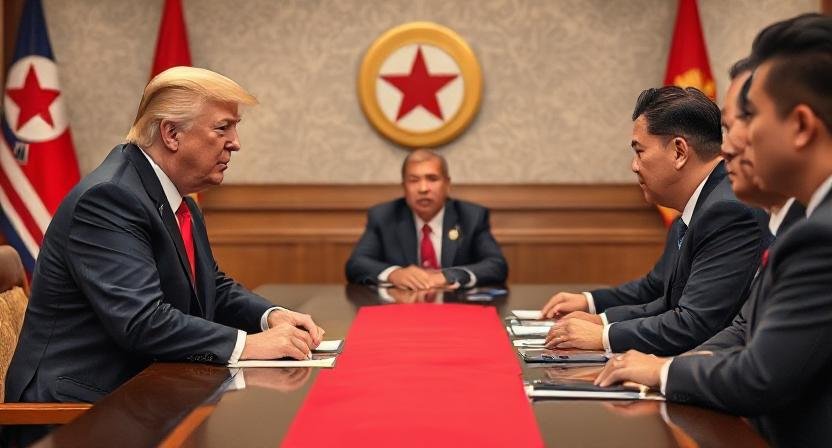
- Trump praised North Korean leader Kim Jong-un during his Oval Office meeting with South Korean President Lee Jae Myung, raising diplomatic eyebrows.
- Experts warn renewed Trump-era tariffs could disrupt semiconductor and EV supply chains critical to both economies.
- Analysts say Trump’s personal diplomacy with Kim risks sending mixed signals about U.S. security commitments to South Korea.
Washington, D.C. – The U.S.–South Korea alliance in 2025 has become a study in contrasts: deepening security cooperation on one hand, bruising economic confrontation on the other. Former President Donald Trump’s August 25 meeting with South Korean President Lee Jae Myung revealed both the promise and the peril of this evolving relationship.
What began with Trump lambasting Seoul on social media—calling South Korea’s domestic upheaval a “Purge or Revolution”—ended with warm handshakes, tariff concessions, and grandiose investment promises. Yet behind the theatrics lies a relationship increasingly driven by hard-nosed transactionalism rather than the traditional rhetoric of shared democratic values.
Trump’s Tariffs: The Bold Path to Making America Great Again
Trump, never one to shy away from drama, praised Kim Jong-un at the very same press conference where he lauded the U.S.–South Korea partnership. This dissonance unsettled Seoul. For decades, South Korea has viewed its alliance with Washington as a hedge against the very North Korean regime Trump now seems eager to flatter.
But in Trump’s world, alliances are leverage points, not sacred trusts. And in 2025, South Korea is learning that lesson all over again.
Tariffs, Trade Surpluses, and Trump’s ‘America First’ Revival
The economic data paints a stark picture. U.S.–South Korea trade in goods and services hit $239.6 billion in 2024, with Seoul enjoying a record $55.6 billion surplus thanks to booming semiconductor and auto exports. By mid-2025, America’s trade deficit with South Korea had already crossed $31 billion.
Trump saw not partners, but imbalances—and pounced.
In April 2025, he slapped 25% tariffs on South Korean goods, sending shockwaves through global markets. Seoul responded with restraint, seeking negotiation over retaliation, aware that its export-reliant economy could ill afford a trade war with Washington.
READ MORE: Breaking: Trump Threatens Russia with Sanctions as Kremlin Blocks Peace Talks
By August, a compromise emerged: Seoul pledged $350 billion in U.S.-based investments and $100 billion in liquefied natural gas purchases, extracting a reduction in tariffs from 25% to 15%. Yet Trump left the door open to escalate again—a classic pressure tactic designed to keep allies off balance.
Legal limits offered some relief. In May, the U.S. Court of International Trade struck down Trump-era “Liberation Day” tariffs as unconstitutional. Still, markets remained jittery, with economists warning that renewed tariff battles could disrupt high-tech supply chains just as South Korea’s semiconductor sector rebounds from a global slump.
Security Guarantees Amid Economic Tensions
For President Lee, the challenge is existential. South Korea depends on U.S. security guarantees even as it absorbs economic blows from Washington’s tariff brinkmanship.
ALSO READ: Trump Repeatedly Praises North Korea’s Dictator in Meeting With South’s President
At the August summit, Lee secured renewed U.S. commitments on missile defense, joint military exercises, and modernization of the Osan Air Base lease. Yet Trump’s rhetorical embrace of Kim Jong-un raises uncomfortable questions: Could Washington someday cut a deal with Pyongyang over Seoul’s objections?
Dr. Emily Park of Harvard’s Belfer Center warns that “Trump’s praise for Kim risks signaling to both Koreas—and to China—that Seoul’s interests could be sidelined in pursuit of a grand bargain.”
For now, security ties hold firm, but the shadow of uncertainty grows longer. Tokyo’s quiet exploration of nuclear deterrence options underscores how regional actors are hedging against U.S. unpredictability.
The Transactional Alliance of 2025
What emerges from this turbulent year is an alliance stripped to its pragmatic core. Gone is the Cold War-era talk of shared values and common destiny. In its place stands a hard-bargaining relationship where tariffs, LNG purchases, and semiconductor supply chains carry as much weight as troop deployments or joint military drills.
Seoul has adapted quickly. The $50 billion in new nuclear energy and aviation deals announced during Lee’s Washington visit were designed not just for economic gain but as political insurance—tangible proof that South Korea brings value to the table beyond security dependence.
Yet this adaptation comes at a cost. By tying economic concessions to security guarantees, Trump has set a precedent future administrations may find hard to reverse. The alliance is no longer primarily about defending democracy on the Korean Peninsula; it is about defending balance sheets in both capitals.
Looking Ahead
As 2025 heads into its final quarter, the U.S.–South Korea relationship feels both stronger and shakier than at any point in recent memory. Trade volumes grow even as tariff threats loom. Military cooperation deepens even as Trump praises Seoul’s adversary in Pyongyang.
Dr. Robert Jenkins of CSIS captures the paradox: “South Korea is too important to abandon, too successful to ignore, and too prosperous to escape Trump’s tariff diplomacy. The alliance survives, but on terms increasingly defined by transaction, not tradition.”
For now, Seoul walks a narrow path—paying billions to placate Washington, hedging against China’s rise, and praying that Trump’s dealmaking instinct stops short of a grand bargain with Kim Jong-un. The U.S.–South Korea alliance endures in 2025, but it is no longer the predictable partnership of old. It is a marriage of necessity—lucrative, volatile, and perpetually one tweet away from crisis.