



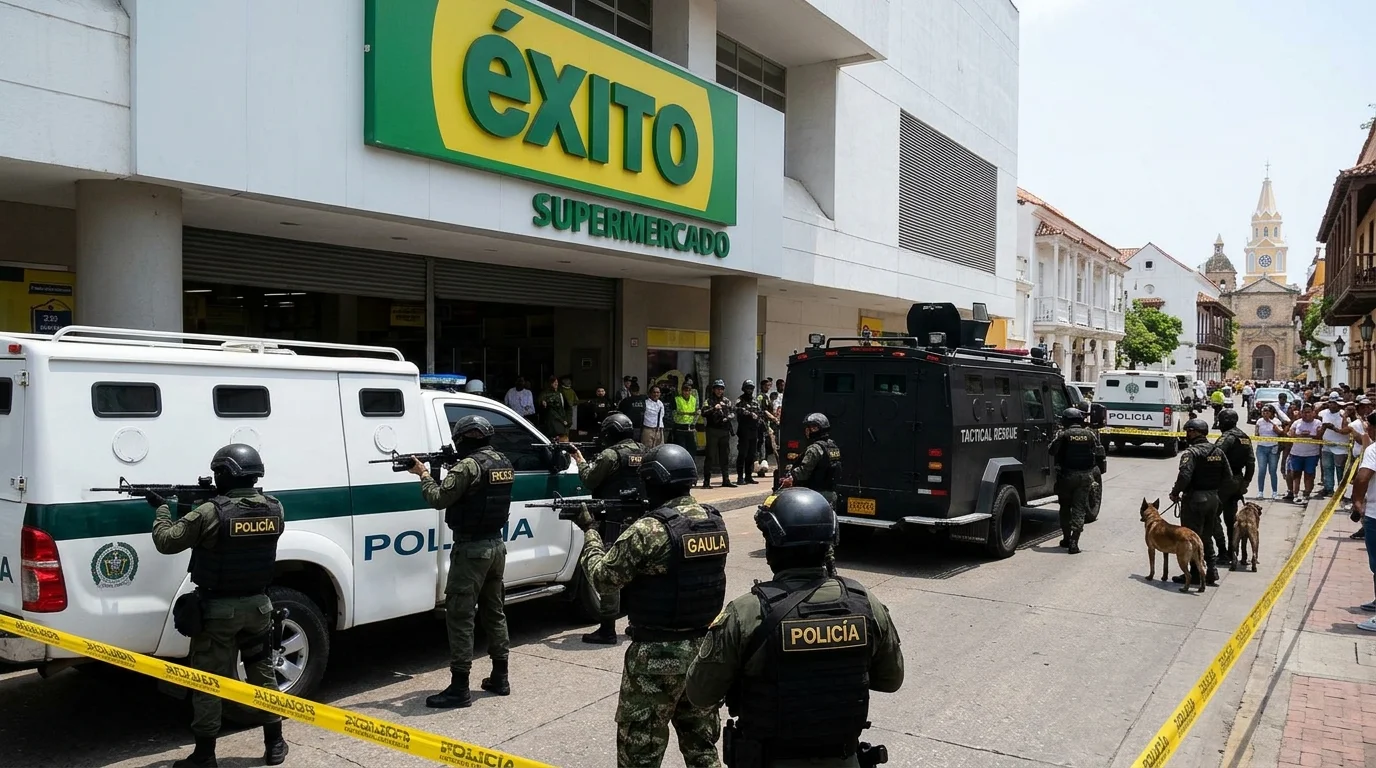
- Colombia Supermarket hostage crisis in Cartagena leaves 25 people held inside a supermarket as security forces launch a major rescue operation.
- Gunmen reportedly demand $2 million, two armoured vehicles and safe passage to Barranquilla.
- Rising kidnappings, FARC dissidents, ELN activity and organised crime expose Colombia’s worsening security challenges.
CARTAGENA, Colombia — A failed attempt to rob an armoured cash-transport vehicle turned into a dramatic hostage crisis in Colombia’s Caribbean tourist city of Cartagena on Tuesday, after heavily armed gunmen stormed an Éxito supermarket and seized approximately 30 people, triggering a major security operation involving police snipers, military units and special forces.
At least 25 people remained hostage after five elderly women were released, according to President Abelardo de la Espriella. The attackers, whose identities had not been established, reportedly fled into the supermarket after their attempted robbery was detected and police moved to intercept them.
The standoff unfolded in the La Castellana neighbourhood, where security forces sealed surrounding streets, positioned snipers on nearby rooftops and deployed heavily armed officers around the supermarket entrance. Images circulated by Colombian media showed masked men carrying rifles while hostages appeared to be kneeling on the supermarket floor.
The crisis also disrupted aviation operations, with authorities temporarily suspending arriving flights at Cartagena airport before gradually restoring services. The navy, army, police and special forces were involved in the response.
The situation became particularly distressing for families of supermarket employees. Jacob Perez, whose son was working inside the store, told AFP that he had been unable to contact him and feared he had been taken hostage.
READ MORE: Gunmen take 25 hostage at Colombia supermarket
Local media reported that the gunmen were demanding nearly $2 million, two armoured vehicles and safe passage to Barranquilla, approximately 130 kilometres northeast of Cartagena. However, these demands had not been independently verified by AFP.
President De la Espriella described the attackers as ordinary criminals rather than members of an insurgent or paramilitary organisation, suggesting that they had taken hostages after becoming trapped by the police response. He promised that the authorities would secure the hostages’ release and indicated that the criminals would face serious consequences.
A criminal operation or a symptom of a wider insurgency?
The distinction between organised criminality and Colombia’s armed insurgencies is central to understanding the incident. Although the president has ruled out guerrilla or paramilitary involvement, the identities and organisational affiliations of the gunmen remain unconfirmed.
READ NEXT: Gulf to Berlin: The Limits of Great-Power Security Guarantees
Colombia has a complicated security landscape involving several armed organisations. The National Liberation Army (ELN), the Revolutionary Armed Forces of Colombia (FARC) dissident factions and the Gulf Clan are among the most influential groups operating in different parts of the country.
The ELN, founded in 1964, remains active, particularly in areas bordering Venezuela. FARC dissident organisations emerged after the 2016 peace agreement, when some former combatants rejected demobilisation or subsequently returned to armed activity. The Gulf Clan, meanwhile, has developed into a powerful criminal organisation with interests in drug trafficking, illegal mining, extortion and territorial control.
There is, however, no verified evidence linking any of these organisations to the Cartagena supermarket siege. The government’s initial assessment points towards an attempted robbery that escalated into hostage-taking.
The wider security environment nevertheless makes the episode particularly significant. On Monday, a car bomb exploded in Villavicencio, injuring 25 people. Authorities blamed a dissident FARC faction, adding to concerns about the increasing ability of armed organisations to conduct attacks beyond their traditional rural strongholds.
Colombia’s long history of kidnappings
Kidnapping is not a new security challenge for Colombia. It was one of the defining features of the country’s decades-long internal conflict, when guerrilla organisations and criminal networks used abductions to finance operations, extract ransom payments and exert political pressure.
During the late 1990s and early 2000s, Colombia experienced some of the world’s highest kidnapping rates. According to Colombian Ministry of Defence figures cited in a US Government Accountability Office report, the country recorded 2,889 kidnappings in 2000. The number remained exceptionally high in subsequent years before declining substantially as military pressure and security operations weakened several armed organisations.
Ministry of Defence figures show that reported kidnappings increased from 160 in 2021 to 223 in 2022 and 338 in 2023. The number reached 313 in 2024 before climbing to a preliminary 651 in 2025. The latest figure represents a substantial deterioration and illustrates how kidnapping has returned as a major national security concern.
A fragile peace and expanding security threats
The 2016 peace agreement between the government and the FARC was intended to end more than five decades of armed conflict. It resulted in the demobilisation of thousands of guerrilla fighters, but did not eliminate the illegal economies that had sustained armed organisations.
Instead, competing groups moved to occupy territories, trafficking routes and revenue-generating activities previously controlled by the FARC. The ELN, dissident factions and criminal networks have continued competing for influence, particularly in strategically important rural regions.
The humanitarian consequences have been severe. Human Rights Watch reported that more than 137,000 people were unable to leave their communities between January and August 2025 because of threats, fighting and activities by armed groups. Violence in Catatumbo, near the Venezuelan border, displaced more than 64,000 people in January 2025 alone.
The security challenge has also acquired a technological dimension. Armed organisations are increasingly employing explosive-laden drones, roadside bombs and coordinated attacks against security installations. An Associated Press report published on November 24 described a drone attack against a police base in Cúcuta that injured civilians and damaged dozens of homes. Another assessment recorded 323 illegal armed-group drone attacks during the first nine months of 2026, an increase of 95 per cent over the corresponding period in 2025.
Colombia Supermarket Hostage: Regional implications
Colombia’s security problems cannot be separated from the wider geopolitical dynamics of northern South America. Its extensive borders with Venezuela, access to both the Caribbean Sea and Pacific Ocean, and proximity to major international maritime trafficking routes make it strategically important.
The Venezuelan border, particularly the Catatumbo region, remains a significant arena of competition between armed organisations. Weak state presence in remote territories, illegal economic activities and cross-border criminal networks complicate efforts to restore government authority.
The consequences extend beyond Colombia. Instability threatens regional trade, maritime security, tourism and migration, while organised criminal networks exploit international connections to move narcotics and generate revenue.
For the government of President De la Espriella, the Cartagena hostage crisis presents an immediate test of its ability to protect civilians and restore public confidence. His hardline approach towards criminal organisations will face scrutiny as authorities attempt to contain violence without endangering hostages.
Cartagena is not an isolated rural settlement but one of Colombia’s most recognisable international tourist destinations. An armed siege inside a major supermarket, accompanied by airport disruption and the deployment of military forces, demonstrates how criminal violence can threaten economic confidence even in prominent urban centres.
The immediate priority remains the safe release of every hostage. But the larger challenge is political and strategic: preventing criminal organisations and armed factions from exploiting gaps in state authority. Colombia’s experience demonstrates that a peace agreement can end a major insurgency without necessarily dismantling the networks, economic incentives and territorial rivalries that sustain violence.