


-
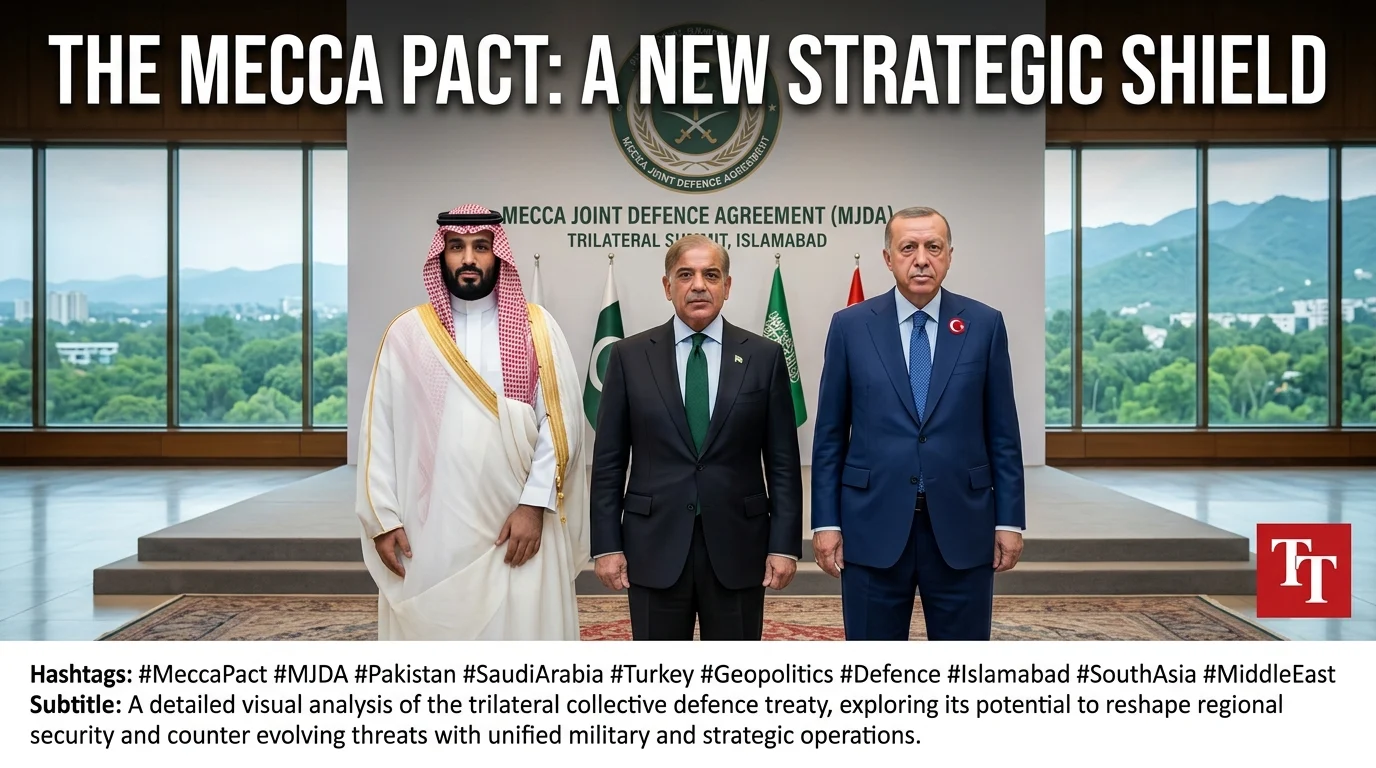
Mecca Pact Meeting in Islamabad will focus on practical measures to address growing Houthi attacks on Saudi Arabia.
-
Pakistan, Saudi Arabia and Türkiye are expected to discuss intelligence-sharing, air defence and military coordination.
-
The trilateral agreement provides a framework for mutual assistance, logistical support and joint defence cooperation.
Pakistan has taken elaborate security and diplomatic steps to host a crucial meeting of the Mecca Joint Defence Agreement on Friday, bringing together senior political, defence and military officials from Pakistan, Saudi Arabia and Türkiye as increasing Houthi attacks on Saudi territory raise fresh questions about the implementation of the trilateral security arrangement.
Delegations from Saudi Arabia and Türkiye have already arrived in Islamabad for the high-level discussions. The Pakistani government has announced a public holiday in the federal capital to facilitate security arrangements, with authorities introducing additional security measures ahead of the gathering.
The meeting comes at a particularly sensitive moment for the region. Saudi Arabia’s Jazan oil refinery was struck by a hostile aerial projectile, killing a Nepalese worker and injuring several others. The attack triggered a fire that was subsequently brought under control, adding urgency to discussions about protecting Saudi Arabia’s critical infrastructure against aerial threats.
The gathering also coincides with the killing of two Italian technicians in Kuwait in an alleged Iranian drone attack on an air-defence surveillance facility. The incident, attributed to Iran by Italy and Kuwait but denied by Tehran, underscores the widening security risks facing Gulf countries amid the confrontation involving Iran, the United States and Israel.
Pakistan’s Defence Minister Khawaja Asif has confirmed that the Saudi-Houthi confrontation will feature prominently in the Islamabad discussions. Describing the continuing instability south of Saudi Arabia as an important agenda item, he said any threat to the kingdom should be considered a threat to Pakistan and Türkiye under the agreement.
READ MORE: Houthi Strike on Riyadh Signals Urgent Test for the Mecca Defence Agreement
The discussions are expected to focus on practical arrangements for implementing the collective defence commitments, including military coordination, intelligence-sharing, air defence and possible assistance to Saudi Arabia.
Turning the Mecca agreement into practical cooperation
Signed on August 7, 2026, the Mecca agreement commits Pakistan, Saudi Arabia and Türkiye to treating an externally originating armed attack against any member as an attack against all three.
Article 2 is particularly significant in the current circumstances. It states that if a member faces armed attack or military aggression, the other parties shall immediately assist it using available means of mutual assistance. It also provides for determining the nature and scope of support following an assessment of the assistance required, including military resources and capabilities.
RELATED NEWS: Pakistan, Saudi Arabia, Türkiye to hold Makkah pact talks in Islamabad on Nov. 26-27
Article 9 establishes arrangements for intelligence-sharing, while Article 10 provides for logistical assistance, including weapons, ammunition, fuel, spare parts and other military equipment during peacetime, wartime and emergencies.
These provisions offer several avenues through which Pakistan and Türkiye could help Saudi Arabia strengthen its defensive capabilities without necessarily becoming directly involved in hostilities.
Pakistan could contribute through intelligence cooperation, military training and operational expertise, particularly in strengthening air-defence arrangements and countering aerial threats. Türkiye, meanwhile, brings defence-industrial capabilities in unmanned aerial systems, electronic warfare, surveillance and military technology.
Combining Pakistani military experience with Turkish technological capabilities could help Saudi Arabia improve surveillance, early-warning mechanisms and its ability to detect and intercept incoming drones and missiles.
Article 6 also encourages joint military exercises, personnel exchanges and deployments to improve interoperability among the three countries’ armed forces.
However, the agreement does not prescribe an identical military response to every security incident. Article 2 requires an assessment of the assistance needed and the resources available to each member.
Pakistan’s diplomatic role
Beyond military cooperation, Islamabad could use its diplomatic relationships to help prevent the Saudi-Houthi confrontation from developing into a wider regional conflict.
Pakistan maintains communication channels with several regional actors, including Iran, and has previously facilitated diplomatic engagement between Tehran and Washington. Türkiye’s regional relationships could also complement these efforts by creating opportunities for de-escalation.
The challenge for Islamabad, Riyadh and Ankara will be to strengthen Saudi Arabia’s ability to defend its territory while avoiding steps that could widen the conflict.
The meeting will also test the institutional framework established under Article 8, which created the Strategic Political and Defence Committee to provide strategic direction and develop defence cooperation.
The immediate question is whether the three countries can translate their collective defence commitment into practical arrangements to help Saudi Arabia address the growing security threat from Yemen while preventing further escalation across an already volatile Middle East.